Most UAV operators do not lose aircraft to a component that failed without warning. They lose them to a component that had been telling them something for fifty flight hours and nobody had defined who was supposed to read it. A motor bearing that starts running warm, a boom socket whose fasteners need a quarter turn at every inspection, a battery whose internal resistance has drifted enough that its usable capacity is no longer what the label says, a propeller that has taken one too many gravel strikes at a landing zone the operator stopped thinking about — none of these are surprises. They are entries that only mean something inside a program, and a program only exists if it was written down before the aircraft flew.
This article is about the preventive side of UAV fleet ownership: the schedule, the intervals, the wear-out list and the records. It is deliberately not about what happens when something breaks. The warranty and RMA guide covers the failure response path, and the spares and lifecycle planning guide covers inventory sizing, MTBF and total cost of ownership. What sits between them and is usually missing is the scheduled program that decides when a part gets replaced before it fails and what evidence is retained when it does.
Why the interval is the first decision, not the parts list
An operator who asks a supplier for a maintenance plan usually receives a list of items and no intervals. That inverts the problem. The interval is what determines whether the program is affordable, whether it is credible, and whether it survives contact with a real flight schedule. Set intervals too short and the fleet spends its life on the bench, the operator stops following the schedule, and an unenforced program is worse than no program because it creates false confidence. Set them too long and the first indication of a problem is a repair, which puts the program back where it started.
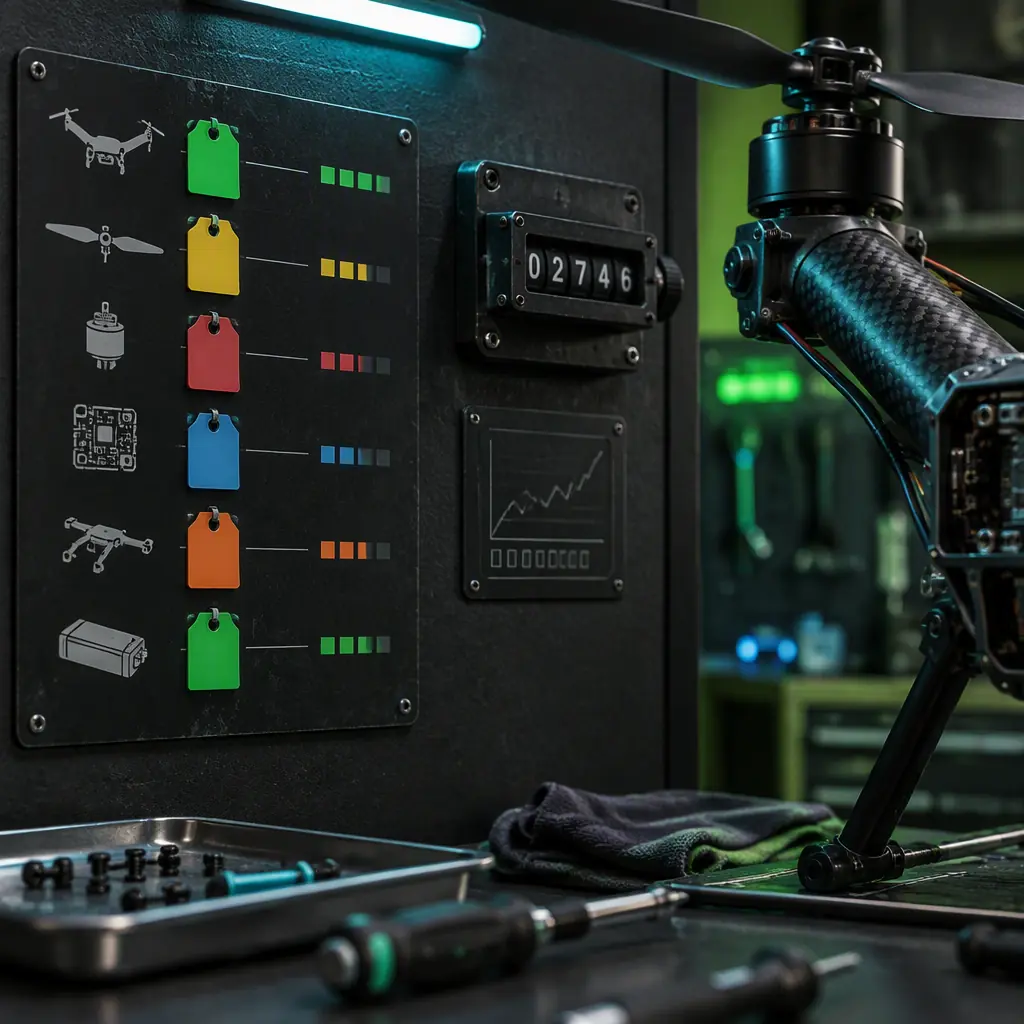
The workable approach is to derive intervals from the two quantities that actually accumulate on a UAV: flight hours and cycles. Flight hours capture time-dependent degradation — bearing wear, thermal cycling, seal ageing, lubricant depletion. Cycles capture event-dependent degradation — every landing loads the gear and the airframe, every arm/unarm sequence exercises the ESC and the arming interlocks, every battery charge and discharge consumes a slice of cell life. Some items are driven almost entirely by one or the other. A propeller blade is a cycle item as much as an hour item, because a landing incident does more damage than ten hours of cruise. An airframe fastener is dominated by cycles, since vibration loosening scales with flight events rather than smooth time.
The practical structure that most fleets converge on is a three-tier interval set measured in both units. A frequent check at every flight (visual, functional, pre-flight items), a periodic interval at a defined hour or cycle threshold (detailed inspection of high-load interfaces), and a deep interval at a much longer threshold (teardown-level inspection or component replacement). Expressing the same schedule in two units matters because a mapping or survey aircraft may log 4 hours per flight while a training aircraft logs 0.6, and an hour-only schedule silently over-maintains one and under-maintains the other. A useful working split for a mid-size multirotor is a pre-flight check on every flight, a periodic inspection every 25 flight hours or 200 cycles, whichever comes first, and a deep inspection at 200 hours or 1,500 cycles — with the cycle count doing the real work on airframes flown in short, frequent hops.
| Tier | Trigger | Typical scope | What it catches |
|---|---|---|---|
| Pre-flight | Every flight | Visual, functional, control-response check | Damage, loose items, abnormal noise |
| Periodic | Hours or cycles threshold | Interface torque, bearing play, connector seating, insulation resistance | Loosening, wear onset, intermittent faults |
| Deep | Long hours or cycles threshold | Component removal, bearing replacement, harness inspection | Wear-out items before failure |
 Hours for time-dependent wear, cycles for event-driven wear
Calendar-limited versus usage-limited components
The most common error in a hastily written program is treating every component as usage-limited. Some are not. A lithium battery pack degrades whether or not it flies: electrolyte decomposition, SEI layer growth and self-discharge all continue at rest, and a pack stored at 45 °C for six months may have less usable capacity than one that flew 60 cycles in a cool climate. This is why a battery's retirement criterion has to be written as a combination — cycle count and calendar age and measured capacity — and any one of them should be able to take the pack out of service. The battery and power management guide covers the degradation mechanisms; the maintenance program's job is to set the retirement thresholds and the measurement interval that proves them.
Elastomers behave the same way. Vibration isolators, grommets, seals and O-rings are specified by a material that hardens, cracks or takes a set with age and ozone exposure regardless of load. An isolator that has been installed for three years has a different transmissibility than the datasheet value, even at low hours, and a program that only checks isolators 'on condition' will miss a stiffness shift that shows up as a payload vibration complaint the operator cannot explain. A calendar limit — commonly two to four years depending on the elastomer and the storage environment — belongs in the schedule alongside the hour limit. Silicone isolators tolerate storage far better than natural rubber, and a workshop at 40 °C with direct sun exposure will age a natural-rubber grommet in eighteen months to a state that a cool, dark store room takes four years to reach.
At the other end, several items are almost purely usage-limited and should not be retired on age at all. Motor bearings, ESC power stages, servo gear trains, propeller blades, landing-gear dampers and release mechanisms all degrade in proportion to how much they have been used and under what duty, not how long they have sat in the rack. Retiring them on calendar time throws away serviceable life and, worse, trains the operator to treat the schedule as arbitrary. The classification decision should be made once, explicitly, for each line item, and the resulting table is the core of the program.
| Component family | Dominant driver | Evidence that governs retirement |
|---|---|---|
| Battery packs | Both — cycles, calendar, thermal history | Cycle count, measured capacity, internal resistance, storage temperature log |
| Vibration isolators, seals, O-rings | Calendar | Installation date, visual condition, measured transmissibility |
| Motor bearings, servo gears | Usage | Flight hours, bearing play measurement, temperature trend |
| Propeller blades | Cycles and incidents | Landing/incident log, blade tracking, static balance check |
| Structural fasteners | Cycles | Torque check history, vibration exposure hours |
| Harnesses and connectors | Cycles and handling | Mating cycle count, contact resistance trend, inspection at each periodic interval |
Condition monitoring: turning logged data into a wear trend
A scheduled program alone is a calendar, and a calendar cannot see a component that is degrading faster than average. Condition monitoring closes that gap, and on a modern UAV it does not require new hardware — it requires deciding which of the data already flowing through the flight controller and the telemetry link is worth trending over time rather than only alerting on in flight. The fleet management components guide covers the telemetry layer that collects this data; the maintenance program decides what the numbers mean against a baseline.
The signals that earn their place in a maintenance trend are the ones with a known physical degradation mechanism behind them. Motor current at a fixed propeller load rises as bearing friction and magnetic losses increase, so a slow upward drift relative to the same flight profile is a bearing indicator long before it becomes audible — a 5 to 8 per cent rise over 100 flight hours at matched load and ambient is worth an inspection. ESC and motor temperature at a matched ambient and throttle profile does the same job, and it is one of the few signals that flags a partially degraded power stage before a hard failure; a 10 °C rise at identical throttle and ambient is a first-order alarm. Vibration amplitude in the airframe's first bending band — measured with the accelerometer the flight controller already carries — drifts upward when a propeller loses balance, a fastener loosens, or an isolator stiffens with age. Battery internal resistance, calculated from voltage sag under a known current step, is the single most useful battery health number and is almost never logged by default; a pack that has risen from 8 mΩ to 20 mΩ per cell has lost a substantial fraction of its usable capacity even though its voltage still reads normal at rest.
Two discipline rules make condition monitoring useful rather than noisy. First, compare like with like: a temperature trend is meaningless unless the reference flight is the same payload, the same ambient band and the same profile, which is why the trend should be computed over a normalised subset of flights rather than all of them. Second, set thresholds against a per-aircraft baseline established during the first twenty or thirty flights, not against an absolute fleet-wide number, because two airframes built to the same drawing still have different vibration signatures. A trend that crosses 20 to 30 per cent above its own baseline is the trigger for an unscheduled inspection; below that, the data is confirmation rather than action.
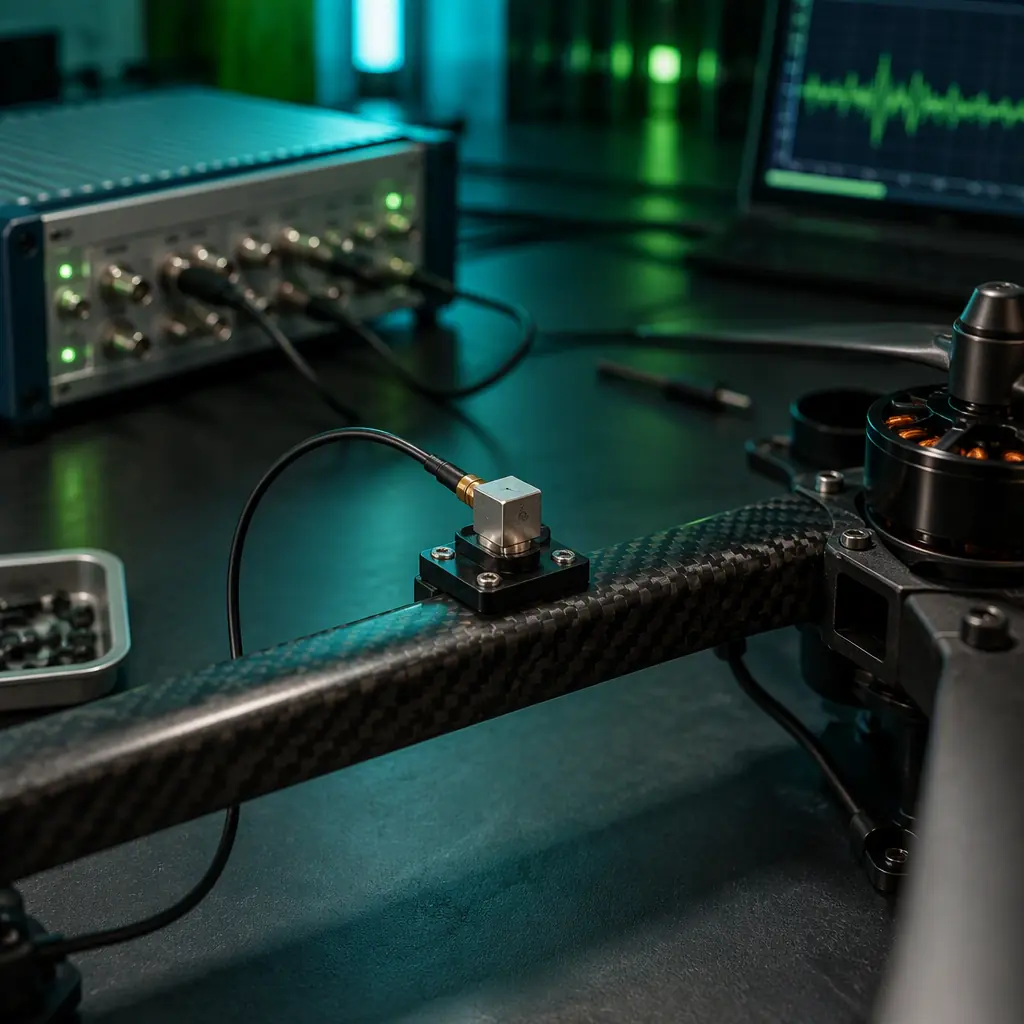 Trend against the aircraft's own baseline, not a fleet average
Setting the numbers: MTBUR, hazard rate and the limit you can defend
Intervals should be defensible, which means they should trace back to a reliability figure rather than to convention. Two numbers do most of the work. Mean time between unscheduled removals (MTBUR) is the practical figure for a component that gets pulled when it degrades, and it is a better planning input than mean time between failures for anything with a wear-out characteristic, because a component that is removed early still costs a maintenance action. Hazard rate is the probability of failure per unit of exposure at a given age, and for most UAV components it follows the classic bathtub shape: an early infant-mortality region, a long roughly constant middle, and a wear-out region that rises steeply at the end. The spares guide uses MTBF to size inventory; the maintenance program uses the hazard-rate curve to place the replacement point.
The defensible interval sits where the wear-out region begins, not where the average failure occurs. If a bearing family reliably runs to 800 hours before its hazard rate climbs and failures cluster between 900 and 1,100 hours, the replacement interval belongs near 700 hours — inside the flat region, with margin before the rise — and not at the 950-hour mean. Setting it at the mean guarantees that roughly half the fleet fails in service, which is exactly the outcome a scheduled program exists to prevent.
A brand-new component with no field history is the harder case, and the honest answer is that the first interval is a placeholder that must be revised. Establish it from the supplier's bearing life calculation, the rated life of the servo gear train or the manufacturer's cycle rating where one exists, then set the first revision point at the moment the first real wear-out data arrives. A program that states its assumptions and its revision trigger is tractable; one that presents an interval as a fixed truth and never revisits it gradually drifts away from the aircraft it describes. Purchasing the data along with the part is the practical lever here — asking a supplier for MTBUR, the wear-out mechanism and the tested cycle life at the RFQ stage is what makes the first interval something better than a guess.
The records: logbooks, traceability and what an auditor asks for
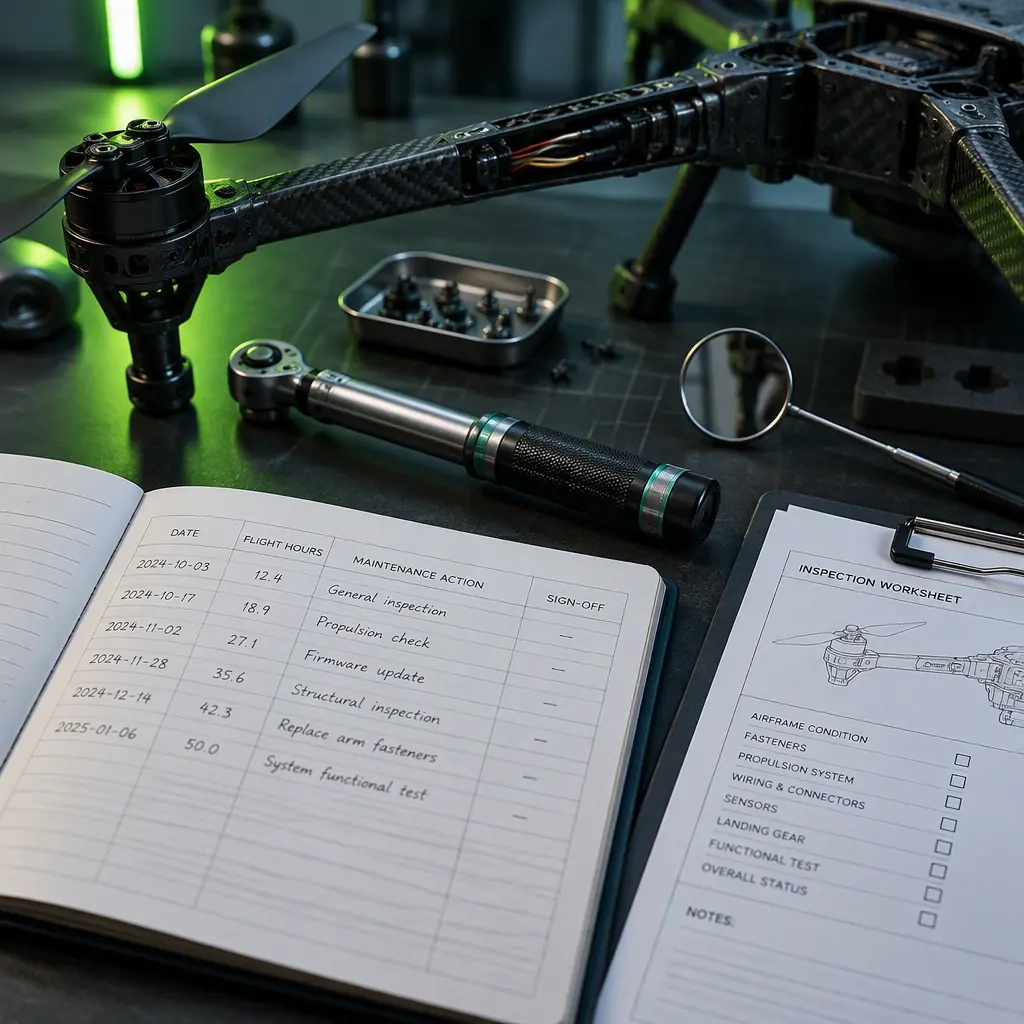
The schedule produces maintenance; the records are what make the maintenance count. Three record structures carry the weight. The airframe logbook is the continuous history of the aircraft — every flight hour, every cycle, every maintenance action, every component change, in sequence, with the aircraft's configuration at each point. The component record follows an individual serialised part across airframes and across owners: its installation and removal dates, the hours and cycles it accumulated in each installation, and the reason it came off. The maintenance action record documents a single intervention — what was inspected, what was found, what was done, by whom, against which revision of the manual, with what measurement results.
Serialisation is what makes the middle structure possible, and it is a procurement decision long before it is a maintenance one. A motor delivered with a serial number and a record of its rated life can be tracked, retired on evidence and re-qualified for a second airframe. The same motor delivered as an unmarked unit can only be replaced and discarded. The obsolescence management guide covers the supply-side of this; the maintenance-side consequence is that a fleet of unmarked components has no reliable way to prove that a scheduled replacement happened at all.
What an auditor or a customer's quality function will actually ask for is a short and predictable list: can you show this aircraft's total hours and cycles; can you show that each scheduled item was performed within its interval; can you show the evidence for each life-limited component's accumulated usage; can you show that the configuration flown matches the configuration documented; and can you trace a reported incident back to the maintenance history that preceded it. Every one of those questions is answered by a logbook structure that was designed before the first flight, and none of them is answered by a folder of invoices. The flight data recorder guide is the companion for the post-incident half of that record, but the maintenance history is what gives the recorder's data a context to be read against.
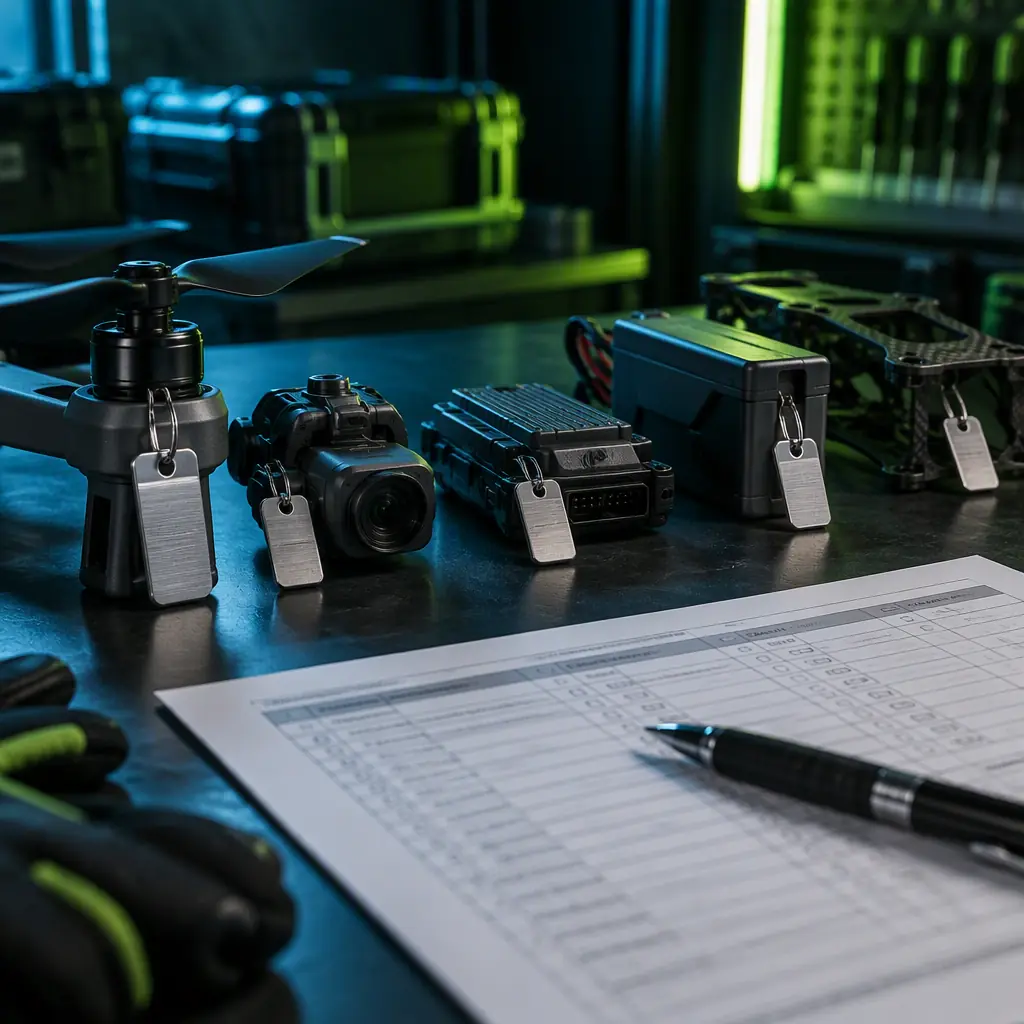 Serialisation is a procurement decision, not a maintenance one
Writing maintenance requirements into the purchase order
Maintainability is bought, not discovered. An operator who receives an airframe with no documentation of what wears out, at what rate, or how to reach the parts that need replacing has an aircraft that can only be maintained by returning it to the supplier. The requirements that prevent this are short, and they belong in the component contract alongside the performance figures.
First, a maintenance manual or service schedule naming the inspection items, their intervals in hours and cycles, the tools and access required, and the acceptance criteria for each check. An airframe whose manual omits the access steps is one where a routine fastener check turns into a partial teardown. Second, a life-limited component list identifying which items have a defined life, what the basis of that life is (hours, cycles, calendar, or a combination) and what the replacement procedure is. Third, reliability data: MTBUR or MTBF figures with the test basis and sample size, and the dominant wear-out mechanism for each life-limited item. Fourth, serialisation and traceability: which components are serialised, what the serial number records, and what documentation accompanies a replacement part. Fifth, configuration control, so that a replacement part is interchangeable with the original and the record of what changed is retained. Sixth, the record format: whether the supplier provides a logbook template, and whether records are expected to transfer with the aircraft.
The bottom line: a maintenance program is four decisions — what to inspect, at what interval, against what evidence, and how it is recorded. Derive intervals from hours and cycles rather than from a supplier's list, classify each component as calendar-limited or usage-limited once and explicitly, trend the few signals that have a real degradation mechanism behind them against the aircraft's own baseline, place replacement points at the rise of the hazard curve rather than at the mean time between failures, and buy the documentation, the life-limited list, the reliability data and the serialisation at the same time as you buy the hardware. EMS Drone supplies UAV components and subsystems with the service schedule, the life-limited component list and the traceability records that make a fleet maintainable — and reviews each programme's utilisation profile to set the initial intervals before delivery. Send us your flight-hour and cycle projections, your operating environment and the components you are running, and we will return the interval schedule, the wear-out item list and the spare and documentation package that supports it.
Explore Capabilities Back to Blog