
Mission & environment
Application, operating context, aircraft type and environmental priorities frame the build.
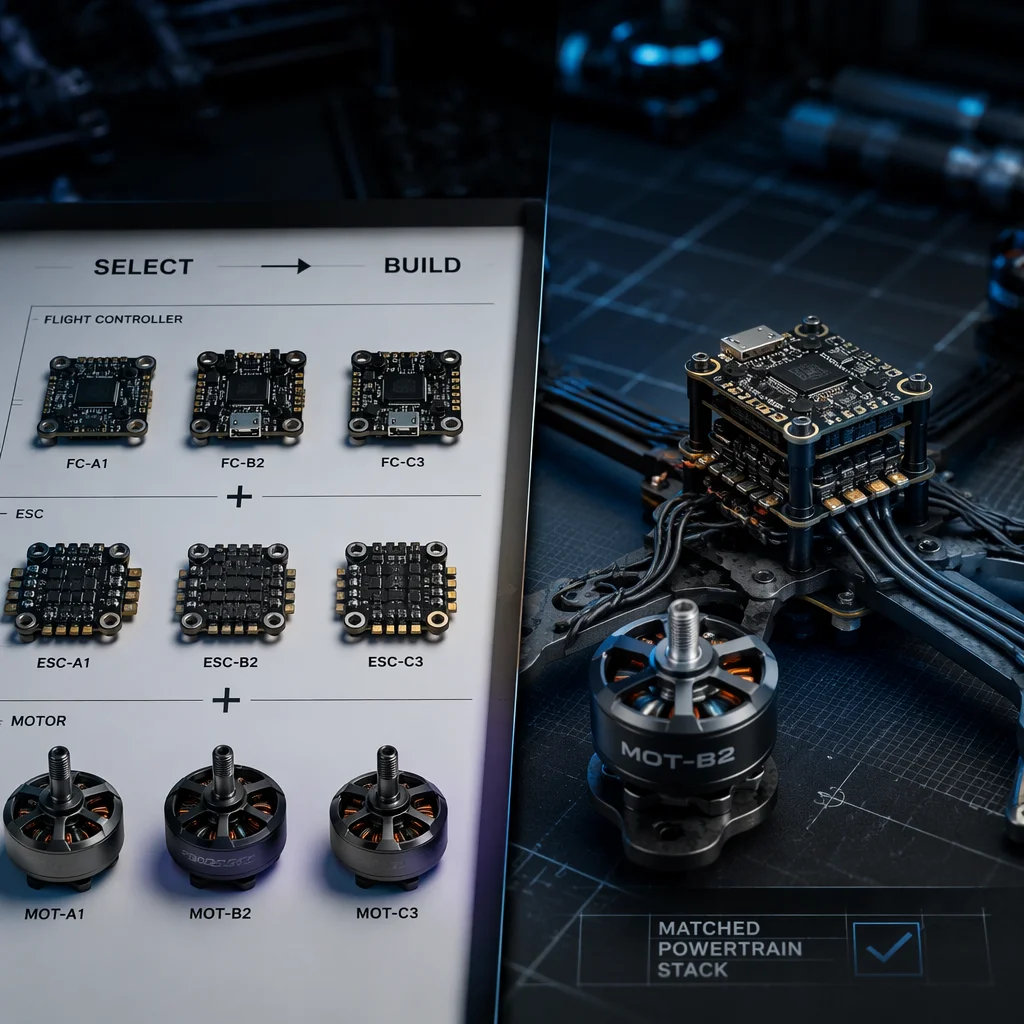 Concept illustration
Customization connects application requirements to component architecture, interfaces, integration depth, tuning and test preparation.
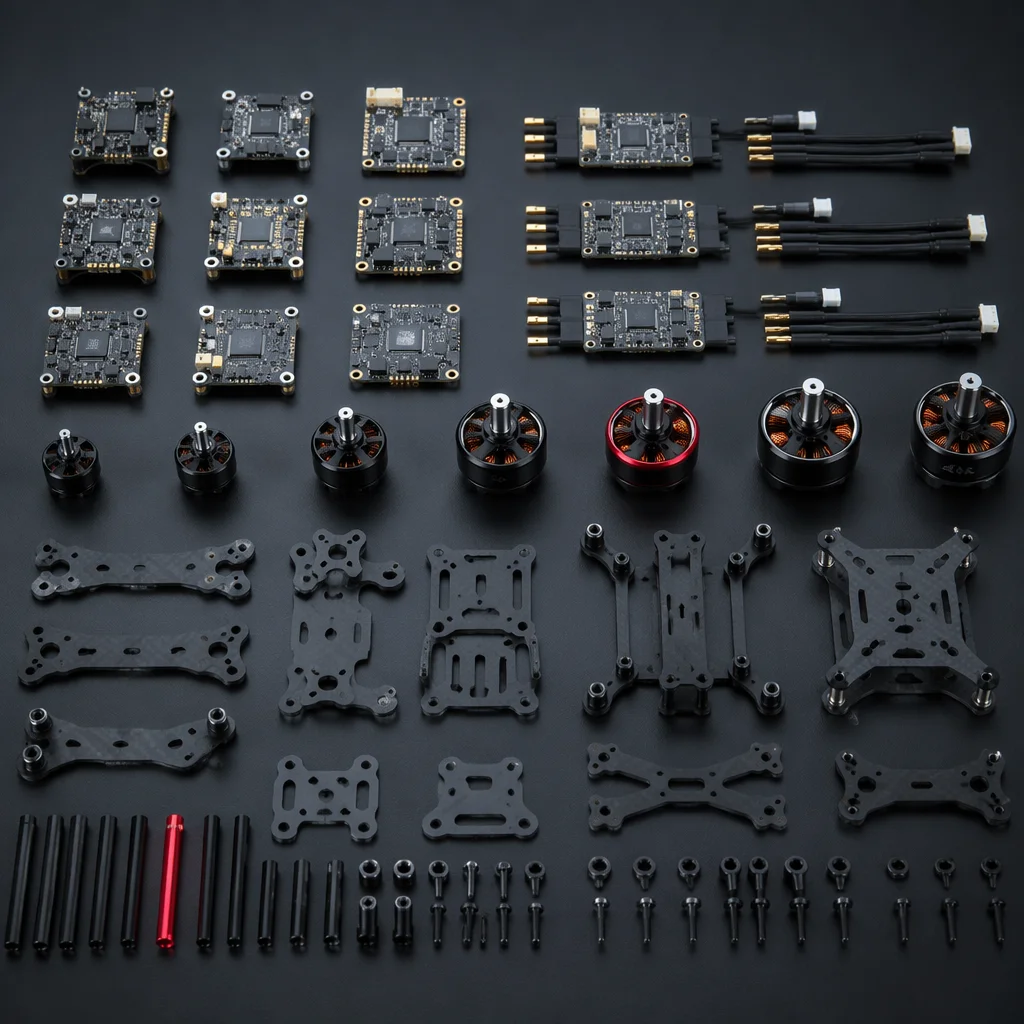 Concept illustration
Start with a flight controller or ESC requirement, request a matched subsystem, assemble a component kit or discuss a complete platform. The configuration depth follows your team’s engineering and sourcing needs.
We use your requirements to shape the system conversation. Exact options and technical ranges are reviewed per project.
Application, operating context, aircraft type and environmental priorities frame the build.
Payload interfaces and performance priorities help define the control, power and structural architecture.
Map sensors, GNSS, radio, telemetry, data links, firmware context and peripheral connections.
Coordinate battery architecture, ESC, motor, propeller, wiring and mechanical fit.
Consider frame format, component placement, mounting, protection, harnesses and service access.
Define whether the project needs sourcing, configuration, integration, tuning or a complete-aircraft conversation.
Each stage keeps assumptions and interface decisions visible as the system moves deeper into integration.
Capture mission, payload, operating context and target cost.
Map the control, power, propulsion and interface stack.
Select the option set and integration depth.
Coordinate electrical, mechanical and communication fit.
Review control response and system parameters.
Complete bench checks and flight-readiness preparation.
Value comes from aligning the build with what the application actually needs, making interface assumptions visible and choosing the right delivery depth for your team.
Prioritize the requirements that drive the system.
Review compatibility before adding integration work.
Buy only the sourcing and engineering depth you need.
Keep prototype and productization conversations connected.
The bands below are working ranges for the build depths described above, quoted per project ex-works and excluding freight and duty. They exist so a buyer can size the conversation before requesting a quotation rather than after, and they scale with volume, repeatability and how much of the engineering is already fixed.
| Build depth | Engineering effort | Typical project band | What moves it |
|---|---|---|---|
| Individual configurable component | Selection and configuration review | USD 40 to 900 per unit | Volume, custom interface, firmware options |
| Matched control or propulsion subsystem | Compatibility and bus verification | USD 800 to 6,000 per set | Cell count, thrust class, telemetry depth |
| Application-oriented component kit | Kit definition and interface mapping | USD 3,000 to 18,000 per kit | Number of subsystems, spares, documentation |
| Integrated complete aircraft | Full integration, tuning and verification | USD 18,000 to 75,000 per platform | MTOW, payload, endurance, qualification scope |
| Engineering development support | Design, review and build support | USD 90 to 220 per engineering hour | Discipline, duration, on-site requirement |
Two rules hold across every band. Repeatability lowers unit cost: a configuration built and verified once can be reproduced for roughly 60 to 75 percent of the first-article engineering effort, because the interface decisions are already settled. And a fixed, single-source custom interface adds cost that never appears in the bill of materials, since every future replacement then depends on that one supplier, which is why we keep the interface documented and portable. The component-level cost split behind these figures is covered in the capabilities overview.
A custom aircraft fails in the requirements, not on the bench. This split fixes who owns each decision, so that the configuration conversation produces a build and not a permanent engineering loop.
| Decision | EMS Drone | Customer |
|---|---|---|
| Mission and operating envelope | Translate the mission into component-level requirements | State the real mission, environment and duty cycle |
| Component and stack selection | Propose the matched control, power and propulsion set | Approve the option set and the trade-offs accepted |
| Interface definition | Document protocols, pinouts and mechanical interfaces | Confirm downstream compatibility with own systems |
| Configuration depth | Recommend the least engineering depth that meets the need | Decide the build depth and the budget ceiling |
| Tuning and verification scope | Define the gates and record the results | Accept the flight profiles the results enable |
| Configuration changes after freeze | Re-qualify only the affected interfaces and document the delta | Notify us of any change that invalidates a prior result |
The clause that prevents the most rework is the last one. A configuration frozen in March does not carry to a June build with a different payload mass or propeller, and the customer is the party who knows a change happened. Writing "notify the supplier of any change affecting a frozen interface" into the agreement turns an unbudgeted re-integration into a scheduled task.
The numbers below come from aircraft we have configured and integrated. Each is a published engineering project on this site with the components and the outcome recorded.
The brief fixed the payload at 30 L and the spray speed at 8 m/s, which set the power architecture: eight motors drawing continuous load through a 400 A distribution board, with CAN-based ESC telemetry verified before flight so motor temperature and RPM data would be trustworthy in service. The sealed electronics bays were configured against the humid, dusty operating case rather than a laboratory one. Endurance settled at 14 minutes at full tank, and the build reused a matched propulsion subsystem rather than a single-source custom board.
Agricultural spraying buildThe mission was long-endurance mapping, so the configuration optimised cruise efficiency and held the RTK GNSS link as a gate: the pusher-propeller set and the RTK link were verified before the LiDAR payload was integrated. The interface definition kept the antenna off the airframe to protect the connector, and the integration depth stopped at the payload boundary so the camera vendor's own qualification was not duplicated. The link verification caught a telemetry budget that would not have met the BVLOS margin, resolved by repositioning the antenna before the airframe was closed out.
LiDAR mapping platform buildThe engineering behind these configurations is documented across the library: payload integration, flight controller and ESC matching, powertrain matching, build versus buy and payload power budgeting. Read them alongside the configuration decision rather than instead of it, because each explains a decision the brief has to settle.
A configuration quotation is only as good as the brief behind it. These are the items we recommend a buyer fix before requesting a custom build, because each one removes a later ambiguity about what is being configured, to what depth and against what constraint.
Mission, payload, environment, interface needs and target build depth are enough to begin the conversation.