
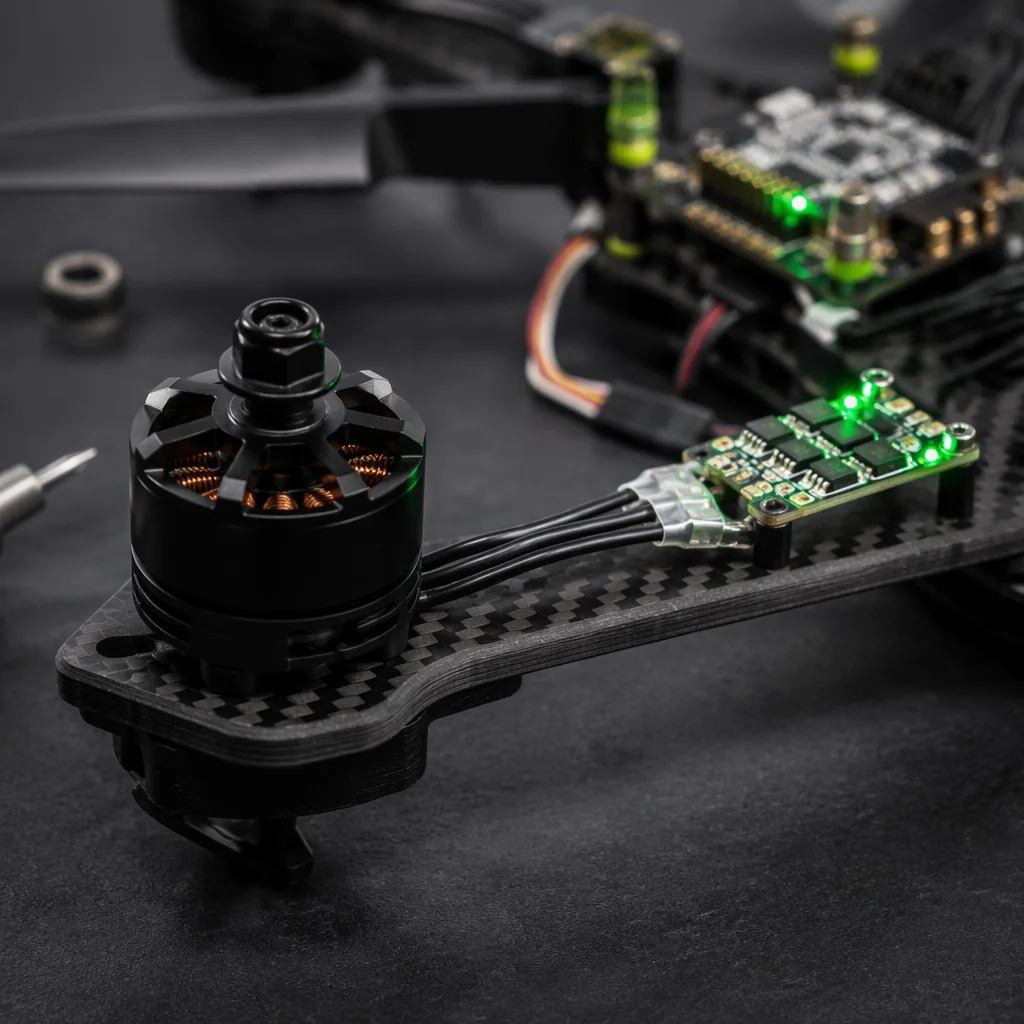
Many engineering teams treat the flight controller, ESC and motor as independent procurement items. On paper each part has its own datasheet, its own evaluation criteria and its own supplier. In the aircraft those three components share voltage rails, control protocols and a common current path. A mismatch at any interface creates risk that no single datasheet can warn you about.
Why the powertrain chain matters
The powertrain is not three separate choices, it is one closed electrical and logical loop. The battery voltage feeds the ESC, the ESC modulates current to the motor under commands from the flight controller, and the motor spins the propeller against aerodynamic resistance. Every decision in that chain constrains the next.
Voltage architecture determines the ESC input range and the motor KV ceiling. The ESC protocol determines which flight controllers can speak to it and with what telemetry bandwidth. The motor KV and propeller size together set the current draw. And if the ESC current rating was chosen in isolation, that draw can push it past its thermal margin. These are not edge cases. They are the normal consequence of catalog-first sourcing.
Step 1: Start with voltage
The battery voltage, 3S through 12S for LiPo packs, or 6S through 14S for Li-Ion, sets the floor for every downstream choice. Higher voltage reduces current for the same power output, allowing thinner wiring harnesses and cooler-running ESCs. But it also demands lower KV motors and a flight controller whose power input stage can handle the rail without overheating.
A practical reference: 4S systems suit small inspection quads under 2 kg all-up weight. 6S covers the mid-size industrial range. Mapping drones, agricultural sprayers and light cargo platforms in the 3 to 10 kg class. 12S and above is the territory of heavy-lift multirotors carrying LiDAR rigs, cinematography gimbals or delivery payloads above 15 kg. Selecting voltage first prevents the common mistake of locking a motor and ESC pair then discovering the battery weight makes the airframe unworkable.
Step 2: ESC protocol and current headroom
Modern ESCs communicate over several protocol families: BLHeli_32 and AM32 offer fast digital protocols with RPM and temperature telemetry; CAN-bus ESCs provide robust industrial control with error-checked frames; traditional PWM remains available for legacy compatibility. The flight controller must speak the same protocol. An FC with only PWM outputs cannot drive a CAN ESC without an adapter, and that adapter introduces latency the control loop may not tolerate.
Current rating needs 20–30% headroom above the maximum expected draw. A motor that pulls 40 A at full throttle under static load will spike higher in gust recovery or during a rapid climb. An ESC rated for exactly 40 A continuous leaves no margin for transients. Also consider the form factor: 4-in-1 ESC boards save weight and wiring but concentrate heat and create a single point of failure. Individual ESCs on the arms offer better cooling and field-replaceability, at the cost of a more complex harness. The trade-off depends on the mission. A survey drone that must stay airborne for 45 minutes values the weight saving; a heavy-lift platform flying over infrastructure values the serviceability.
Step 3: Motor KV and propeller load
KV rating multiplied by voltage gives the unloaded RPM, but the propeller diameter, pitch and blade count determine the actual mechanical load the motor sees. A high-KV motor on a large propeller behaves like a stalled transmission: the motor demands current the winding was not sized for, and thermal runaway follows within seconds at full throttle.
The matching logic is straightforward once you frame it as a table:
| Motor Size (stator) | Typical KV Range | Propeller Range | Typical Thrust (per motor) |
|---|---|---|---|
| 22xx–23xx | 1800–2450 KV | 5–6 inch | 0.8–1.5 kg |
| 28xx–31xx | 700–1200 KV | 9–13 inch | 2.0–4.5 kg |
| 35xx–40xx | 340–580 KV | 15–18 inch | 4.0–8.0 kg |
| 50xx–62xx | 120–340 KV | 20–30 inch | 8.0–18.0 kg |
These ranges represent common industrial configurations at 6S to 12S. Always verify against the specific motor manufacturer's thrust table for your propeller and voltage combination. A bench test with a watt meter is the only way to confirm the real current draw before committing to production quantities.
 Concept illustration
Step 4: Interface checklist before ordering
Before placing orders, verify every interface in the chain. A one-hour checklist review costs far less than a failed integration:
- Voltage range compatibility, Confirm the FC power input, ESC voltage rating and motor winding all share a common operating voltage band with headroom for sag and ripple.
- Connector types and pinouts, ESC signal connectors, motor bullet size, battery connector type and current rating. Mismatched connectors add resistance, weight from adapters and assembly errors.
- Firmware support. Verify that ArduPilot, PX4 or Betaflight has a parameter file or configuration target for your FC–ESC combination. A controller with no firmware target means weeks of porting work.
- BEC and power distribution, Map the power tree: battery to PDB to ESCs, plus regulated outputs for the FC, radio receiver, payload interface and any servo-driven mechanisms. A missing BEC rail is a common reason builds stall on the bench.
- Telemetry feedback path. RPM, current draw and ESC temperature are not optional for industrial aircraft. Confirm the ESC protocol carries telemetry and that the FC firmware logs it. A hot ESC in flight is a warning you need to receive.
Education, not a case study
This article is an engineering primer on powertrain component matching. It does not describe a specific customer deployment, capacity claim or certified production outcome. Exact ratings, protocols and compatibility should be validated against your project brief and the manufacturer's current datasheets.
What the powertrain layer costs, and where the budget breaks
Matching a controller, ESC and motor is an engineering exercise until it meets a quantity. The order of magnitude each line contributes to a powertrain program, and the line that most often escapes the quotation:
| Cost element | Order of magnitude | What drives it |
|---|---|---|
| Motors | Largest recurring line at fleet scale | Thrust class and winding; a motor that is 15 percent over-specified adds mass to every arm, not just cost to every order |
| ESCs | Second hardware line, sensitive to current margin | Whether continuous or burst rating is specified; the sustained rating is what thermal design should target |
| Propellers | Low unit cost, high test cost | Diameter and pitch trials; the pairing that reads best on a thrust stand is not always the one that survives a full envelope sweep |
| Power distribution and harness | Small hardware, disproportionate failure share | Connector current rating, wire gauge, and whether the BEC rails were planned as part of the powertrain or added afterwards |
| Bench validation and tuning | Recurring engineering hours per configuration | Full throttle-envelope sweeps, thermal soak runs, and PID retuning after any prop or winding change |
| Spares and field replacement | Recurring, quoted per airframe-year | Which parts are serviceable in the field, and what the swap turnaround is expected to be |
Bench validation is the line a component-level quotation never contains, and it is the line that decides whether the matched set actually holds together in the envelope. A supplier quoting motors, ESCs and props as a pick list is selling parts; the same supplier quoting a validated configuration with the sweep conditions attached is selling a subsystem.
Responsibility at the powertrain boundary
The powertrain is where a build stalls most often, because the mismatch is almost never inside a single part. Assigning the obligations explicitly keeps a mismatch from becoming a dispute:
| Activity | Supplier responsibility | Operator responsibility |
|---|---|---|
| Voltage band compatibility | State each part's operating voltage range including sag and ripple tolerance | Confirm the battery chemistry's real sag under peak current, not the nominal pack voltage |
| Current rating and thermal behaviour | Quote continuous and burst current separately, with the cooling condition assumed | Provide the enclosing airflow or heatsinking the rating assumes; a rating on a bench rig is not a rating in a sealed bay |
| Protocol and telemetry | State which ESC telemetry fields are exposed and on which protocol revisions | Confirm the autopilot firmware logs RPM, current and ESC temperature; a warning you cannot receive is not a warning |
| Firmware and configuration | Supply parameter files or configuration targets for the supplied combination | Re-run the bench sweep after any firmware change; a firmware major version is a configuration change and invalidates prior validation |
| Mechanical and connector interface | Provide bullet sizes, connector types, mass and mounting pattern | Verify adapter use, junction resistance and arm resonance after assembly |
| Spares and obsolescence | Publish lifecycle status and matched replacement sets | Hold matched spares rather than individual parts: replacing one element of a validated set re-opens the validation |
The motor mount and the propeller retaining hardware are also powertrain-layer items, and they are covered in more detail in the assembly tooling and fixture guide. The point that matters for procurement is the closing row: a validated combination is the asset, not the individual part numbers.
Two reference builds: what the matched loop looks like at scale
Two platforms we build show powertrain matching at both ends of the design space:
- A heavy-lift multirotor built as an X8 coaxial octocopter with a 1,600 mm wheelbase, a 30 litre payload and a maximum take-off weight around 25 kg, giving 12 to 15 minutes of active work per tank fill. The number that matters for powertrain matching is the wheelbase comparison: coaxial propulsion over a 1,600 mm span produces the disc area a flat octocopter would need beyond 2,100 mm for, so the same thrust target is met with eight smaller motor-and-propeller pairs rather than eight larger ones. That choice propagates straight down the powertrain list, changing ESC current class, harness gauge and the thermal load in each arm. See the heavy-lift reference architecture.
- A VTOL fixed-wing survey platform with 120 minutes of usable endurance carrying a 5 kg payload on an 888 Wh 6S8P pack, where roughly 68 percent of mission energy goes to cruise propulsion, 22 percent to the payload, 7 percent to avionics and 3 percent to transition. The transition figure is the one a multirotor-derived powertrain budget usually misses: eight lift motors drawing about 1,200 W combined for under 90 seconds is a burst requirement that the same battery has to absorb on top of cruise, and it is what decides whether the pack's continuous rating is adequate or merely close. See the LiDAR mapping platform reference architecture.
Powertrain clauses for the requirement document
- Matched-set declaration. Require the supplier to name the exact motor, ESC and propeller pairing that was validated together, not a list of individually compatible parts.
- Sweep conditions on every rating. Thrust, current and temperature figures stated with the propeller, input voltage, ambient and duty cycle used to obtain them.
- Telemetry contract. Which fields must be exposed over which protocol revision, and at what update rate the autopilot can log them.
- Thermal acceptance test. A soak run at the specified sustained current in the enclosure the aircraft actually uses, with a recorded temperature rise limit.
- Firmware change notice and re-validation. Advance notice of any change that alters timing, protocol or current limiting, plus re-validation of the matched set at the supplier's cost where the change breaks a stated interface.
- BEC and power tree definition. The regulated rails required by the control layer, quoted as part of the powertrain configuration rather than assumed separately.
- Spares as matched sets. Replacement parts supplied against the validated combination, with lifecycle status and a last-time-buy window per element.