

Obsolescence in UAV component supply chains is not a binary event — it is a probability distribution that increases with the age of every semiconductor, connector, sensor and passive component on the BOM, and the procurement team's job is to maintain a BOM where the probability of any single component going EOL within the production forecast horizon (typically 2–5 years for an industrial UAV programme) is below 5%, and where the contingency plan for each component — the alternate source, the lifetime buy quantity, the redesign trigger point — is documented and costed before the PDN arrives. The alternative is the reactive cycle: a PDN arrives for a DC-DC converter that costs $4.20 in 1,000-unit quantities, the last-time-buy window closes in 8 weeks, the minimum lifetime buy to cover the remaining 3 years of production is 2,400 units ($10,080), the engineering team identifies a replacement that requires a PCB layout change (the pinout is different — same function, different footprint), the EMC re-certification costs $12,000 and takes 14 weeks, and the production line is idle for 6 weeks between the exhaustion of the lifetime buy stock and the qualification of the replacement — the total cost of this single EOL event, including inventory carrying cost, engineering NRE, certification cost and lost production margin, is $35,000–55,000, or approximately 3–5% of the UAV programme's annual revenue for a small-to-medium UAV manufacturer. This article provides the framework to prevent that cycle.
For the broader supply chain structure that determines how UAV components flow from semiconductor manufacturers through distributors to integrators — the tiered supply chain that defines how quickly an EOL notification propagates from the component manufacturer to the UAV programme manager — the UAV supply chain layers guide covers the fabless semiconductor model, the authorized distribution channel, the independent broker market and the counterfeit risk that increases when procurement teams are forced to buy EOL components on the grey market. For the make-vs-buy decision framework that determines whether a UAV programme should stock EOL components or redesign the subsystem — the UAV component build vs buy guide covers the total cost of ownership calculation that compares inventory carrying cost against redesign NRE. This article focuses on the obsolescence management process itself: the BOM risk assessment, the lifetime buy economics, the alternate qualification workflow and the proactive monitoring programme.
Why UAV components go EOL: the semiconductor lifecycle that drives obsolescence
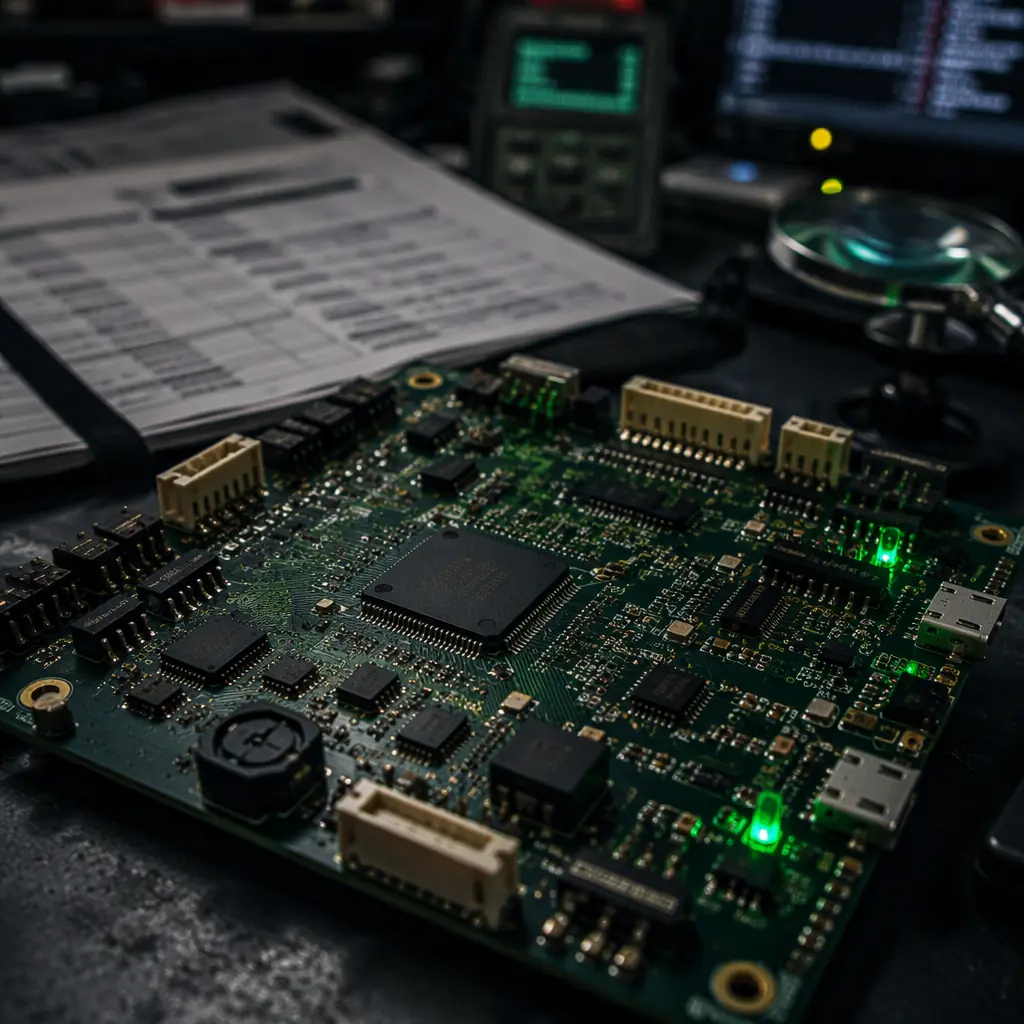
A UAV's BOM is dominated by semiconductors — the STM32H7 microcontroller on the flight controller ($8–25), the u-blox GNSS chipset ($15–50), the Semtech or TI radio transceiver ($3–12), the Infineon or TI gate drivers on the ESC ($2–8), the Bosch or InvenSense IMU ($5–15), the TI or Analog Devices power management ICs ($1–6 each, and a typical UAV has 6–12 of them). Every one of these components follows the semiconductor product lifecycle: introduction (1–2 years), growth (2–5 years), maturity (3–8 years), decline (2–4 years) and EOL (the PDN is issued, last-time-buy window opens). The total lifecycle for a commercial/industrial-grade semiconductor is typically 7–15 years — the STM32F4 series, introduced in 2011, is still in active production in 2026 (15 years and counting), while an image sensor designed for a specific smartphone model may have a 3–5 year lifecycle because the smartphone OEM that consumed 80% of the production volume switched to a newer sensor, making the older sensor economically unviable for the manufacturer to continue producing.
 Concept illustration
The UAV industry is particularly exposed to obsolescence for three structural reasons. First, UAV programme lifetimes are long — a mapping UAV that was designed in 2020 and certified for commercial operation may have a production run of 5–8 years (the time it takes to recover the NRE investment, build a customer base and iterate through two or three hardware revisions), but the semiconductors on its BOM were designed 2–3 years before the UAV entered production, meaning the component is 7–11 years old by the time the UAV programme is 5 years into production — well into the decline phase of the semiconductor lifecycle. Second, UAV production volumes are low by semiconductor industry standards — 500–5,000 units per year for a successful industrial UAV model, compared to 5–50 million units per year for a smartphone or automotive ECU — so the UAV manufacturer has negligible influence over the semiconductor manufacturer's product roadmap: when STMicroelectronics decides to discontinue a specific STM32 variant because the automotive and industrial customers that consumed 95% of the volume have migrated to a newer variant, the UAV manufacturer's 2,000 units per year of demand do not factor into the decision. Third, UAV components are often selected for a specific combination of SWaP (size, weight and power) characteristics that are not replicated in the replacement — the STM32H743 in a 7×7 mm BGA package with 1 MB of flash and 1 MB of RAM running at 480 MHz is selected because it fits on a 36×36 mm flight controller PCB, draws 200 mA at full load, and has enough headroom to run the ArduPilot EKF at 400 Hz, and when STMicroelectronics replaces it with the STM32H753 (which adds a crypto accelerator but moves to a different BGA ball map, requiring a PCB respin), the replacement is not form-fit-function compatible — it requires engineering work.
BOM risk scoring: how to identify which components will go EOL first
A typical industrial UAV BOM contains 150–400 line items — not all of them carry the same obsolescence risk. A 100 nF 0402 ceramic capacitor (Murata GRM155R71C104KA88, $0.003 in volume) is manufactured by 12 different suppliers in identical form factors and will be available for the next 30 years. An STM32H743IIT6 microcontroller in a 176-pin LQFP package ($12 in 1,000-unit quantities) is manufactured by one supplier, has a specific pinout that no other microcontroller replicates, and will be available for another 5–8 years before STMicroelectronics issues a PDN. The procurement team's first task is to score every component on the BOM for obsolescence risk, so that the 10–15% of components that carry 80% of the risk receive proactive monitoring while the remaining 85–90% are managed with a simpler annual review.
 Concept illustration
Risk factor 1: component type. The obsolescence risk hierarchy for UAV components, from highest to lowest risk, is: (1) application-specific ICs — GNSS chipsets, RF transceivers, image sensors and motor driver ICs have 5–8 year lifecycles because they are designed for specific market windows and the manufacturer's roadmap replaces them every 3–5 years; (2) microcontrollers and FPGAs — the STM32, i.MX RT and Zynq families typically have 8–15 year lifecycles, but specific package variants (a 100-pin LQFP that is only used by UAV and industrial customers, while the automotive customers use the 144-pin BGA) may be discontinued earlier because the package is uneconomical to maintain at low volumes; (3) power management ICs — DC-DC converters, LDOs and battery charger ICs from TI, Analog Devices and Infineon typically have 10–20 year lifecycles because they are used across multiple industries, but a specific output voltage variant (3.3 V at 3 A in a 3×3 mm QFN) may be discontinued if the manufacturer consolidates its portfolio; (4) connectors — the JST GH, Molex PicoBlade and Samtec connectors used on UAV wiring harnesses have 15–25 year lifecycles because the connector industry does not follow the semiconductor industry's rapid iteration cycle, but a specific pin count or keying variant may be discontinued if the connector series is rationalized; (5) passives — resistors, capacitors, inductors and ferrite beads have effectively unlimited lifecycles because they are commodity components manufactured by dozens of suppliers to standard footprints. The procurement team should score component type risk on a 1–5 scale: ASICs and specialized RF ICs = 5, microcontrollers and FPGAs = 4, power management ICs = 3, connectors = 2, passives = 1.
Risk factor 2: supplier concentration. A component that is sole-sourced from one manufacturer carries a higher obsolescence risk than a component that is multi-sourced from three manufacturers — not because the sole-sourced component is more likely to go EOL (that depends on the manufacturer's product lifecycle, not the number of suppliers), but because the consequence of an EOL is higher: there is no second source to qualify, so the procurement team must either place a lifetime buy or redesign the subsystem. The procurement team should assign a supplier concentration score: sole-sourced (one manufacturer, no cross-compatible alternate) = 5, dual-sourced (two manufacturers with pin-for-pin compatible alternates) = 2, multi-sourced (three or more manufacturers) = 1.
Risk factor 3: lifecycle stage. The semiconductor manufacturer's product lifecycle stage is the most predictive factor for near-term obsolescence risk. A component that was introduced 10 years ago and is still in "active" status may transition to "not recommended for new designs" (NRND) within 1–2 years and to EOL within 2–3 years of NRND. The procurement team should check the manufacturer's product status for every BOM component at least annually — STMicroelectronics, Texas Instruments, Analog Devices, u-blox and most semiconductor manufacturers publish a product status page or a PCN (Product Change Notification) subscription service that provides the current lifecycle stage. The lifecycle stage score: NRND (manufacturer has explicitly stated the component is not for new designs) = 5, mature (in production for > 8 years but still active) = 4, growth (in production for 3–8 years, active) = 2, new (in production for < 3 years, active) = 1.
Risk factor 4: production volume leverage. A UAV manufacturer that consumes 2,000 units per year of an STM32H743 has zero influence over STMicroelectronics' decision to discontinue that variant — the total market for the STM32H7 family is measured in millions of units per year, and 2,000 units is a rounding error. In contrast, a UAV manufacturer that consumes 5,000 units per year of a custom-wound brushless motor from a mid-size motor manufacturer may represent 10–30% of that motor manufacturer's revenue for that specific motor model, giving the UAV manufacturer the leverage to negotiate a last-time-buy window extension or a guaranteed production commitment. Volume leverage score: ≤ 0.1% of the component's total market = 5, 0.1–1% = 3, > 1% = 1.
The composite obsolescence risk score is the product of the four factors, normalized to a 1–100 scale. Components scoring > 60 are high-risk and require quarterly lifecycle monitoring, a documented alternate qualification plan and a pre-approved lifetime buy trigger (the inventory level at which the lifetime buy order is placed, regardless of whether a PDN has been issued — typically when the available inventory covers less than 12 months of forecast production). Components scoring 30–60 are medium-risk and require semi-annual monitoring. Components scoring < 30 are low-risk and require annual review. For the supplier evaluation framework that determines how to assess a component manufacturer's long-term reliability and EOL notification practices — the UAV supplier evaluation checklist covers the supplier audit criteria, the PCN/EOL notification commitment and the alternate sourcing capability assessment.
Lifetime buy economics: how many units to buy and when to pull the trigger
When a semiconductor manufacturer issues a PDN with a 6–12 month last-time-buy window, the procurement team's decision reduces to a single equation: the lifetime buy quantity equals the forecast production volume for the remaining programme life, plus a safety stock buffer for forecast error, minus the existing inventory, all subject to a budget constraint (the lifetime buy cost cannot exceed the alternate qualification cost — if the lifetime buy costs $50,000 and the redesign costs $35,000, the rational decision is to redesign, even if the redesign delays production by 6 months). The equation is straightforward; the difficulty is that the forecast production volume is uncertain — a UAV programme that is 3 years into an expected 5-year production run may be extended to 7 years if a major customer places a follow-on order, or may be terminated next year if the market shifts to a newer platform. The lifetime buy is a bet on the programme's remaining life, and getting it wrong in either direction is expensive.
Lifetime buy quantity calculation. The base lifetime buy quantity for a component is: LTBO = (F × R) − I + S, where F is the annual forecast production volume (units per year), R is the remaining programme life (years), I is the existing inventory (units), and S is the safety stock (units, typically 15–25% of F×R for a component with stable demand, 30–50% for a component with volatile demand or a programme with an uncertain extension). For a UAV programme producing 800 units per year, with 4 years of remaining life, 600 units of existing inventory and a 20% safety stock factor: LTBO = (800 × 4) − 600 + (800 × 4 × 0.20) = 3,200 − 600 + 640 = 3,240 units. At a component cost of $12 per unit, the lifetime buy costs $38,880 — plus the inventory carrying cost, which at a 15–25% annual carrying cost (warehousing, insurance, obsolescence risk on the inventory itself, cost of capital) adds approximately $5,800–$9,700 per year, or $23,000–$39,000 over 4 years. The total cost of the lifetime buy, including carrying cost, is $62,000–$78,000 over 4 years.
When the lifetime buy is the wrong answer. A lifetime buy is the rational choice when the total cost (purchase cost + carrying cost) is less than the alternate qualification cost by at least 30% (the margin accounts for the uncertainty in the forecast and the risk that the programme is extended beyond the lifetime buy coverage, forcing a redesign anyway). If the alternate qualification — finding a form-fit-function compatible replacement, qualifying it through the UAV's acceptance test procedure, and re-certifying if necessary — costs $35,000 and the lifetime buy costs $62,000–$78,000, the redesign is the lower-cost option, and the procurement team should decline the lifetime buy and initiate the redesign immediately to avoid a production gap when the existing inventory runs out. The trap is that the procurement team often does not have the $35,000 redesign cost approved in the current budget cycle, while the $38,880 lifetime buy fits within the component procurement budget — so they choose the lifetime buy because it is budgetarily easier, even though it is more expensive over the full programme life. The procurement team must present the total cost comparison — not just the purchase cost — to the programme manager before the last-time-buy window closes.
 Concept illustration
The partial lifetime buy. A hybrid strategy that is underutilized in UAV procurement is the partial lifetime buy: purchase enough units to cover the redesign period (typically 6–12 months) plus a 3-month buffer, and use that time to qualify the alternate without a production gap. This converts the problem from "spend $78,000 to cover the programme or spend $35,000 and stop production for 6 months" to "spend $14,000 to cover 12 months of production while spending $35,000 to redesign — total cost $49,000, no production gap." The partial lifetime buy is the correct answer when the alternate exists but the qualification timeline (PCB respin + firmware port + EMC test + flight test = 6–9 months for a typical UAV subsystem) exceeds the existing inventory coverage (which might be 2–3 months if the procurement team has been running lean). The partial lifetime buy quantity is: PTBO = (F × T) − I + (F × 3/12), where T is the redesign timeline in years. For the same 800-unit-per-year programme with a 9-month redesign timeline, 600 units of existing inventory, and a 3-month buffer: PTBO = (800 × 0.75) − 600 + (800 × 0.25) = 600 − 600 + 200 = 200 units, at a cost of $2,400 — a negligible investment that prevents a 3-month production gap.
Form-fit-function alternate qualification: finding a replacement that does not require a redesign
The ideal obsolescence mitigation is a form-fit-function (FFF) alternate — a component that has the same physical footprint (form), the same pinout and package (fit), and the same electrical and operational performance (function) as the EOL component, such that the alternate can be substituted on the existing PCB with zero hardware changes and minimal firmware changes. FFF alternates exist for approximately 30–50% of EOL components in a typical UAV BOM — the other 50–70% require some degree of engineering work, ranging from a firmware recompile with a different HAL (Hardware Abstraction Layer) driver (2–4 weeks of engineering effort, $3,000–$8,000) to a full PCB respin with a different package and pinout (8–16 weeks, $15,000–$40,000).
The FFF qualification workflow. The qualification process for a potential FFF alternate has five stages, and the procurement team should require the engineering team to complete them before the last-time-buy window closes — because if the alternate fails at stage 4, the procurement team must fall back to the lifetime buy, and if the last-time-buy window has already closed, the only option is a redesign with a production gap.
Stage 1 — datasheet comparison (1–2 days of engineering time). The engineer compares the EOL component's datasheet against the candidate alternate's datasheet across 15–20 parameters: supply voltage range, operating temperature range, pinout (pin-by-pin comparison of every pin on the package), electrical characteristics (output voltage accuracy, switching frequency, quiescent current, rise/fall time, input capacitance), timing characteristics (startup time, enable-to-output delay, I²C/SPI timing), package dimensions (including the height — a 0.8 mm tall component replacing a 0.6 mm tall component may interfere with a heatsink or an adjacent PCB), and regulatory certifications (CE, FCC, RoHS). If any parameter differs by more than the circuit's tolerance, the alternate requires an engineering analysis (stage 2) — it may still be FFF if the difference is within the circuit's operating margin, but it cannot be assumed. For the communication protocols that govern how a replacement transceiver or microcontroller communicates with the flight controller — the UAV communication protocols guide covers the CAN, DShot, PWM, SBUS and CRSF interfaces that determine whether a replacement ESC or radio module is protocol-compatible with the existing flight controller.
Stage 2 — circuit simulation and margin analysis (3–5 days). The engineer models the alternate component in the existing circuit (using SPICE for analog circuits, or the manufacturer's provided IBIS model for digital I/O) and verifies that the circuit's operating margins remain within specification across the full temperature range (−40 to +85°C for UAV electronics). The critical parameters: power supply stability (the replacement DC-DC converter's control loop must remain stable with the existing output capacitor — a different converter IC may require a different output capacitance for stability, and if the output capacitor value is outside the new converter's specified range, the power rail may oscillate, causing random flight controller resets), signal integrity (the replacement microcontroller's I/O drive strength must match the existing PCB trace impedance — a 50-ohm trace driven by a 12 mA driver produces a different edge rate than a 24 mA driver, and the faster edge rate may cause overshoot and ringing that violates the receiver's input voltage specification), and thermal performance (the replacement IC's junction-to-ambient thermal resistance multiplied by its power dissipation must produce a junction temperature below the maximum rated temperature — typically 125°C for industrial-grade ICs — under the worst-case ambient temperature of 85°C, which allows a 40°C temperature rise; if the replacement IC dissipates 0.5 W and has a θJA of 60°C/W, the junction temperature rise is 30°C, giving a junction temperature of 115°C at 85°C ambient — within the 125°C limit with a 10°C margin).
Stage 3 — firmware compatibility assessment (1–2 weeks). For microcontrollers, GNSS receivers, RF transceivers and any component with a digital interface, the firmware team must assess whether the existing firmware can drive the alternate component with only a HAL driver change, or whether the application-layer code must be modified. A replacement GNSS receiver that uses the same UBX binary protocol as the original u-blox module but with a different UART baud rate default (115,200 bps vs the original's 460,800 bps) requires a configuration command change in the firmware initialization routine — a 2-line code change that takes 30 minutes to implement and test. A replacement microcontroller from a different manufacturer (an NXP i.MX RT replacing an STM32H7) requires a complete firmware port — the RTOS abstraction layer, the peripheral drivers, the DMA configuration, the interrupt vector table and the memory map are all different, and the porting effort is 4–12 weeks of engineering time, which at a loaded engineering cost of $100–150 per hour represents $16,000–$72,000 of NRE — comparable to or exceeding the cost of a lifetime buy.
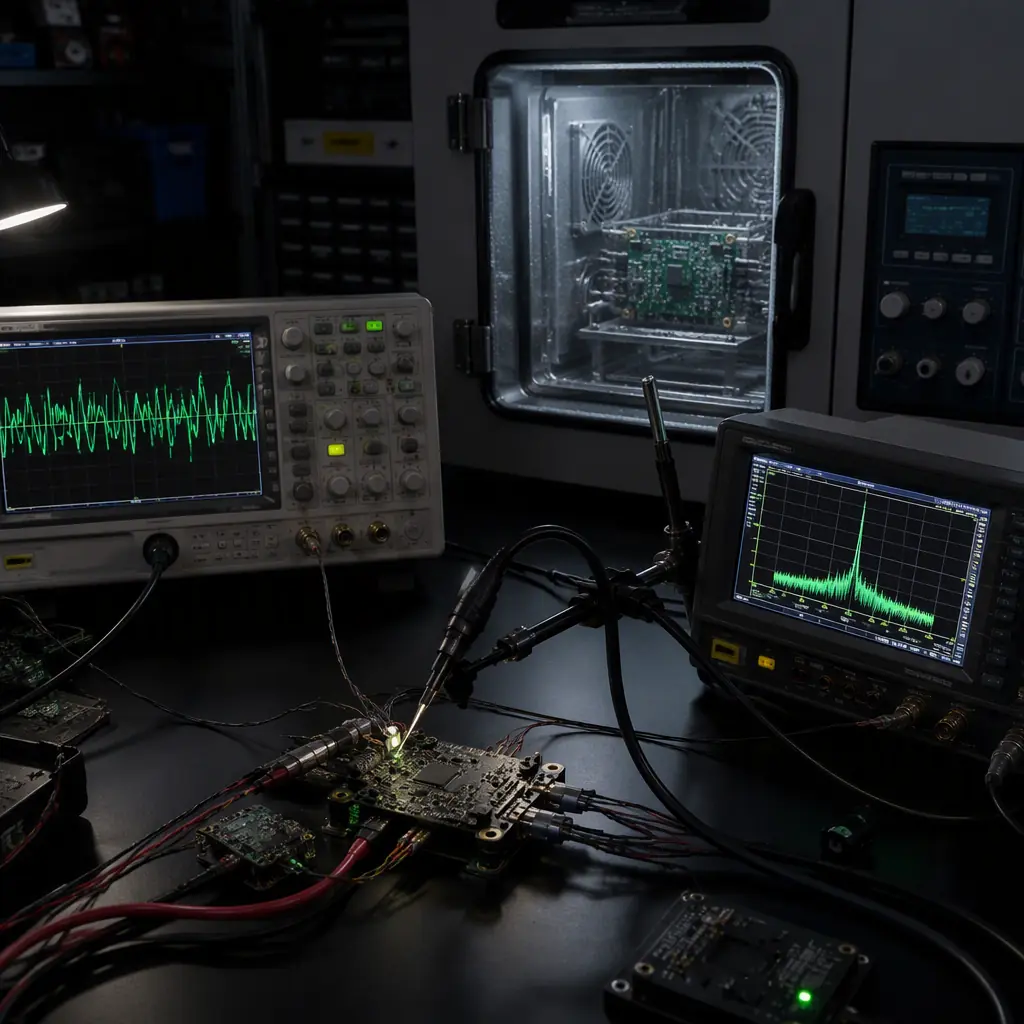
Stage 4 — bench test and environmental qualification (2–4 weeks). The alternate component is soldered onto a test PCB (or the existing PCB if the alternate is pin-compatible) and subjected to the UAV's standard acceptance test procedure: power-on test (does the board boot correctly on the first power cycle and on 20 subsequent power cycles at 25°C, −20°C and +60°C), functional test (does every subsystem — GNSS fix, RC input, telemetry output, servo PWM output, SD card logging — operate within specification), thermal soak (24 hours at +85°C ambient with the board powered and all subsystems active — monitoring for degradation, resets or out-of-specification outputs), thermal cycling (10 cycles from −40°C to +85°C with a 30-minute dwell at each extreme, powered off during the transition and powered on at each extreme for functional verification — this stresses the solder joints and the component's internal wire bonds), vibration test (the UAV's operational vibration profile — typically 5–500 Hz at 0.02–0.05 g²/Hz random vibration for 1 hour per axis, representing the motor and propeller vibration transmitted through the airframe to the avionics bay), and EMI/EMC test (radiated and conducted emissions per FCC Part 15 or CISPR 32, and radiated and conducted susceptibility per IEC 61000-4 — the alternate component may have different EMI characteristics than the original, and a replacement DC-DC converter that radiates 6 dB more noise at 150 MHz may interfere with the GNSS receiver's L1 band, reducing the carrier-to-noise ratio by 3–6 dB and degrading the RTK fix availability from 95% to 80%). For the propulsion testing and validation framework that covers the full UAV system-level acceptance test — the UAV propulsion testing and validation guide covers the thrust stand measurement, the thermal performance validation and the endurance test protocols that apply to any component change in the propulsion subsystem.
Stage 5 — flight test (1–2 weeks). The alternate component is installed in a production-representative UAV and flown through the standard flight test profile: takeoff and hover (verifying stability and control response), waypoint navigation (verifying that the autopilot's position hold and trajectory tracking are within specification — a replacement GNSS receiver that has a 0.5-second longer reacquisition time after a signal blockage may cause the UAV to deviate from the flight path by 2–5 metres, which may be acceptable for a mapping UAV flying at 120 metres AGL but not for an inspection UAV flying 3 metres from a bridge structure), full-throttle climb (verifying that the replacement ESC or motor driver does not trigger over-current or over-temperature protection), and autonomous landing (verifying that the replacement GNSS or optical flow sensor provides sufficient accuracy for a precision landing on a 1-metre pad).
 Concept illustration
Proactive obsolescence management: the monitoring programme that prevents surprises
The difference between a procurement team that manages obsolescence and one that reacts to it is a proactive monitoring programme — a systematic process for tracking the lifecycle status of every medium-risk and high-risk component on the BOM, detecting EOL signals 12–24 months before the PDN is issued, and maintaining a current alternate qualification plan for every component that scores above 40 on the obsolescence risk matrix.
PCN/PDN subscription. Every major semiconductor manufacturer provides a PCN (Product Change Notification) and PDN (Product Discontinuance Notification) subscription service — typically an email alert system that notifies registered customers when a component's lifecycle status changes. The procurement team must register every BOM component with the manufacturer's PCN system, using a generic procurement-team email address (not an individual engineer's email — engineers leave, and the PCN subscription is lost when their email account is deactivated). The PCN system provides two critical early-warning signals: an NRND (Not Recommended for New Designs) notification, which typically precedes a PDN by 12–24 months, and a lead-time extension notification (when the manufacturer extends the standard lead time from 8–12 weeks to 16–26 weeks, indicating that the production line is being deprioritized in favor of newer products — a leading indicator of an impending EOL). The procurement team should review the PCN digest weekly — a 15-minute task that converts a surprise PDN into a managed transition.
Distributor inventory monitoring. The authorized distributors (Digi-Key, Mouser, Arrow, Avnet, Future Electronics) provide inventory APIs that the procurement team can poll programmatically to track the available stock of every BOM component. A component whose distributor inventory is declining — from 5,000 units across three distributors to 500 units at one distributor over 6 months — is being phased out, even if the manufacturer has not yet issued a PDN. The procurement team should set automated alerts for any BOM component whose total distributor inventory drops below 12 months of forecast consumption — this is the earliest reliable signal of an impending EOL, and it typically precedes the manufacturer's PDN by 3–6 months.
Alternate qualification pre-work. For every high-risk component (obsolescence risk score > 60), the procurement team should commission the engineering team to complete stages 1 and 2 of the FFF qualification workflow (datasheet comparison and circuit simulation) before the PDN is issued — the cost is 3–7 days of engineering time per component ($2,000–$5,000), and it converts the post-PDN timeline from "6 months to qualify an alternate while the last-time-buy window is closing" to "6 weeks to bench-test and flight-test an already-analyzed alternate." The pre-work also identifies whether a true FFF alternate exists — if it does not, the procurement team has 12–24 months (the NRND-to-PDN window) to redesign the subsystem before the last-time-buy window opens, rather than 6 months (the last-time-buy window) to design, prototype, test and certify a redesign — a 4× time compression that eliminates the production gap risk.
Multi-source procurement at the design stage. The most effective obsolescence mitigation is built into the UAV's design, not retrofitted after the PDN arrives. The engineering team should, as part of the component selection process, identify at least one FFF alternate for every sole-sourced semiconductor on the BOM and document it in the BOM's "alternate" column. This requires an additional 1–2 hours of engineering time per component during the design phase — the engineer opens the parametric search on Digi-Key or Mouser, filters for components with matching package, pinout and electrical specifications, and confirms that at least one alternate exists at a comparable cost and availability — and it costs $100–$200 per component in engineering time, compared to $3,000–$40,000 per component to find and qualify an alternate after the PDN is issued. For the certification and compliance framework that governs whether a component substitution requires re-certification — the UAV certification and compliance guide covers the CE, FCC, RoHS, NDAA and ITAR requirements that may be triggered by a component substitution, particularly for defense and dual-use UAV programmes where a component change may require an export control reclassification.
Obsolescence management procurement checklist
The following checklist translates the obsolescence management framework into actionable procurement items that a UAV programme manager can implement within one quarter.
BOM risk assessment (weeks 1–2). Score every semiconductor, connector and specialized passive on the UAV BOM using the four-factor risk model (component type × supplier concentration × lifecycle stage × volume leverage). Classify each component as high-risk (> 60), medium-risk (30–60) or low-risk (< 30). Document the current lifecycle stage (active, NRND, EOL) and the manufacturer's stated product longevity commitment for every high-risk component. The deliverable is a BOM risk register — a spreadsheet with one row per component, columns for the four risk scores and the composite score, and a "next review date" column (quarterly for high-risk, semi-annual for medium-risk, annual for low-risk).
PCN subscription setup (week 3). Register every BOM component with the manufacturer's PCN/PDN notification system. Create a procurement-team email alias for PCN notifications. Set up a weekly calendar reminder to review the PCN digest. The deliverable is a confirmed PCN subscription for every BOM component from a manufacturer that provides a PCN service (the major semiconductor manufacturers all do; smaller connector and passive manufacturers may not, and these components are typically low-risk anyway).
Lifetime buy trigger policy (week 4). For each high-risk component, calculate the lifetime buy trigger inventory level: when the available inventory (existing stock + firm purchase orders) drops below 12 months of forecast consumption, place a lifetime buy order for the remaining programme life plus 20% safety stock, unless the alternate qualification cost is less than 70% of the total lifetime buy cost (purchase cost + carrying cost), in which case initiate the alternate qualification instead. Document the trigger level and the decision tree in the BOM risk register.
Alternate qualification pre-work (weeks 5–8). For each high-risk component that does not have a documented FFF alternate, commission the engineering team to complete stages 1 and 2 of the FFF qualification workflow (datasheet comparison and circuit simulation). The deliverable is a one-page alternate qualification report per component: the alternate part number, the datasheet comparison results (any parameters that differ from the original), the circuit simulation results (confirmation that the alternate operates within the circuit's margins), and the estimated timeline for stages 3–5 if the PDN is issued (firmware porting, bench test, flight test).
Distributor inventory monitoring (ongoing, starting week 1). Set up automated distributor inventory checks for all BOM components — a simple Python script that queries the Digi-Key, Mouser and Arrow APIs for the available stock of each component and sends an alert if the total available stock drops below 12 months of forecast consumption. The script runs weekly and takes 5 minutes to execute.
Explore custom engineering Back to Blog
Continue Reading
UAV Component Supplier Evaluation
The supplier audit checklist — how to evaluate a component supplier's EOL notification commitment, alternate sourcing capability and long-term production stability before a PDN arrives.
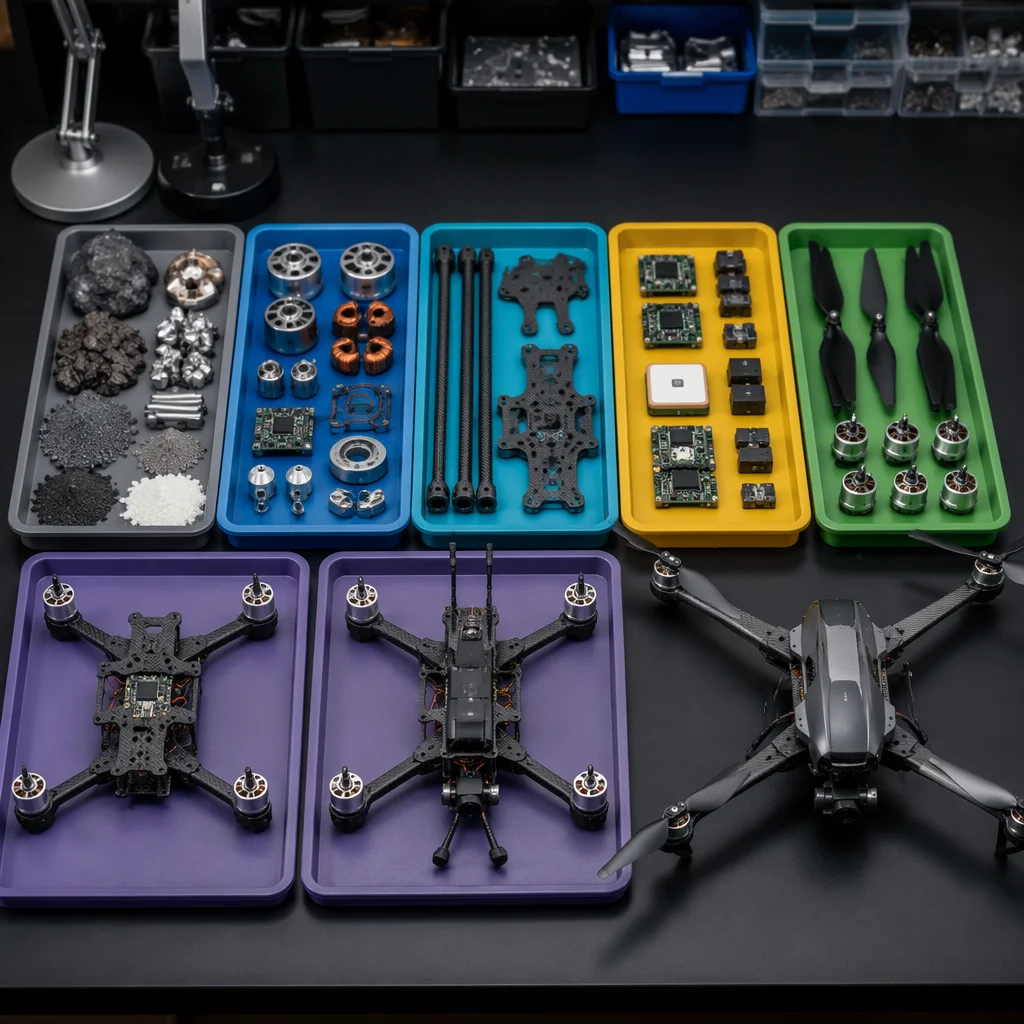
UAV Supply Chain Layers
The tiered supply chain structure — from semiconductor foundries through authorized distributors to grey-market brokers — that determines how quickly an EOL notification reaches the UAV programme manager.
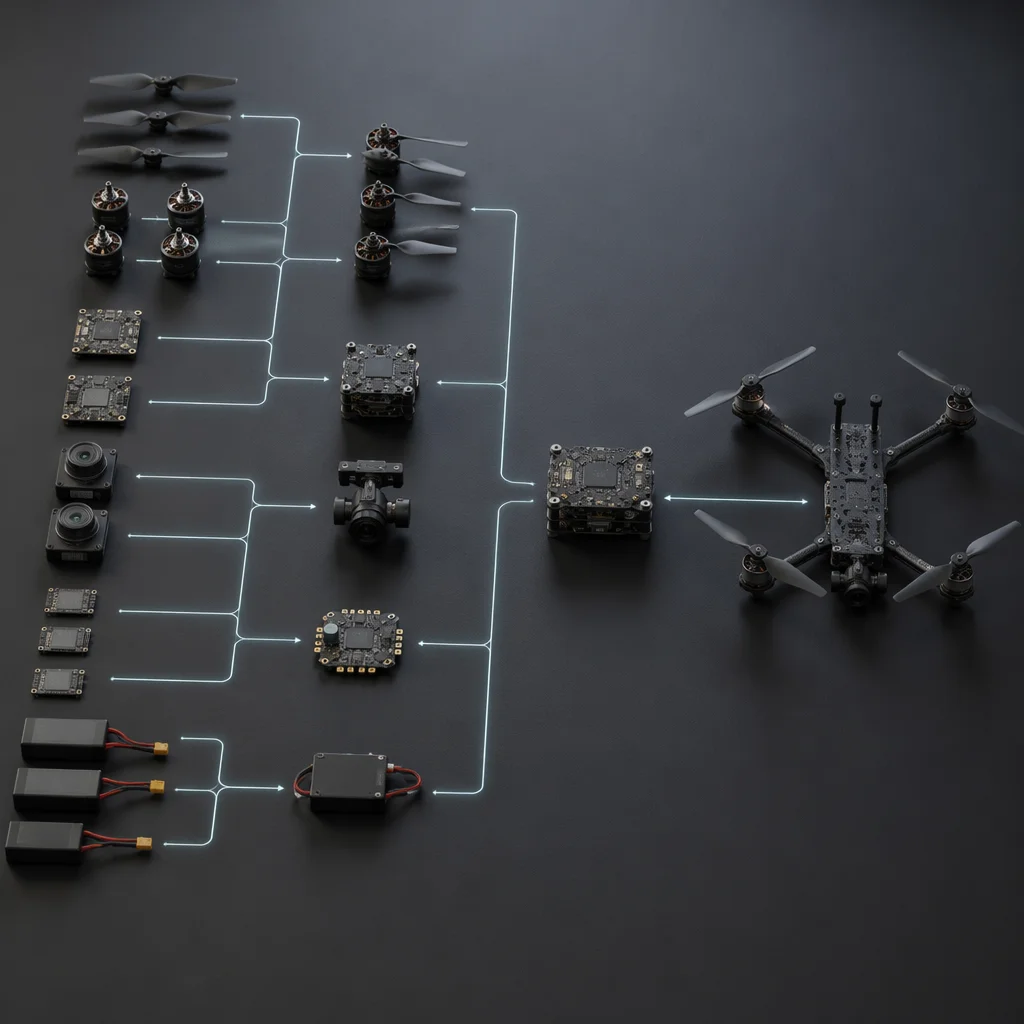
UAV Component Build vs Buy
The total cost of ownership framework — comparing the inventory carrying cost of a lifetime buy against the NRE cost of a redesign, with the break-even analysis that determines which path is cheaper.
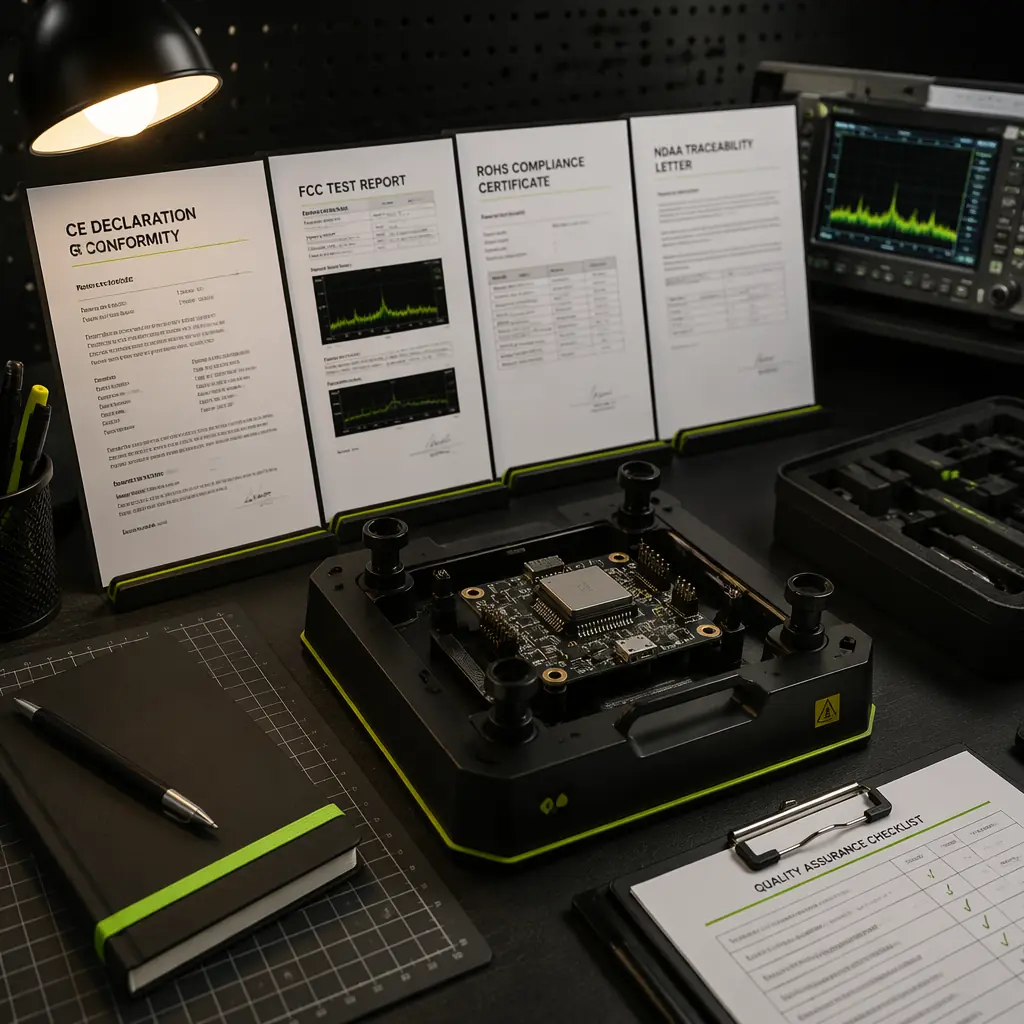
UAV Certification & Compliance
CE, FCC, RoHS, NDAA and ITAR — the regulatory requirements that may be triggered by a component substitution, and the re-certification workflow for defense and dual-use UAV programmes.
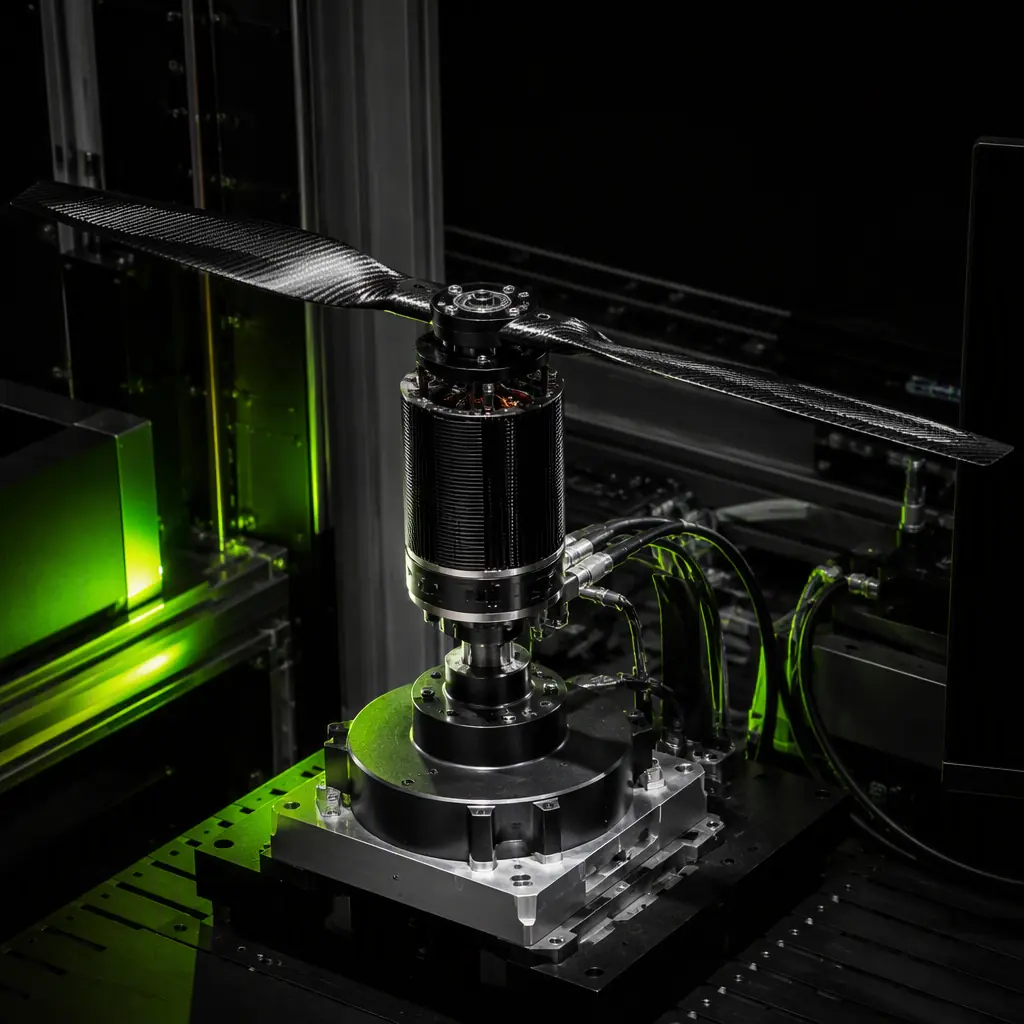
UAV Propulsion Testing & Validation
The system-level acceptance test protocols — thrust stand measurement, thermal validation and endurance testing — that apply to any component change in the propulsion subsystem.