

The gap between a good and a bad component buy is usually written before the supplier is even contacted. Buyers who send a detailed RFP get detailed answers; buyers who send a one-line inquiry get a price list and a datasheet written by the marketing department. The RFP is the instrument that converts a procurement conversation into a comparable, enforceable transaction. And for UAV components, where the difference between a compliant and a non-compliant part can be a crashed aircraft, the written specification is the only thing standing between the buyer's requirements and the supplier's interpretation. The build vs buy guide covers the sourcing decision itself; this guide covers the document that executes it.
Why a written RFP beats a casual inquiry
A casual inquiry optimizes for a fast answer. An RFP optimizes for comparability, accountability and an audit trail, three properties that a multi-unit UAV program cannot live without.
- Comparability. When every supplier responds to the same numbered specification, quotes can be scored against the same criteria. Without an RFP, each supplier answers the question they wanted to answer, and the comparison is between apples and marketing.
- Accountability. A signed response to an RFP is a contractual baseline. "The datasheet says 20 km range" becomes "the supplier confirmed 20 km range under the stated test conditions in response to clause 4.2". A difference that matters when the component arrives and fails the mission test.
- Audit trail. For programs under compliance regimes, export-controlled components, defense contracts, safety-critical certification, the RFP and response become part of the procurement record. The certification and compliance guide lists the documentation trail that procurement records feed into.
- Internal alignment. Writing the RFP forces the buyer's own engineering team to agree on what they actually need, the specification-writing process surfaces disagreements about voltage, protocol, weight and test expectations before they become change orders.
The cost of writing an RFP is a few hours. The cost of not writing one is measured in integration rework, rejected batches and grounded aircraft: typically an order of magnitude more.
 Specification review
Structuring the RFP: the sections that matter
A UAV component RFP has seven sections, and each one exists to prevent a specific failure later in the procurement. The order matters. The supplier reads it top to bottom, and the technical requirements must be unambiguous before commercial questions are asked.
| Section | What it contains | Failure it prevents |
|---|---|---|
| 1. Background and mission | Aircraft class, payload, environment, mission profile | Supplier guessing the application |
| 2. Technical specification | Numbered parameters with tolerances | Vague "high quality" compliance claims |
| 3. Test and acceptance | FAT, sample testing, verification method | Untested hardware shipped as "tested" |
| 4. Commercial terms | MOQ, lead time, price breaks, Incoterms | Scope creep and surprise costs |
| 5. Documentation | Test reports, wiring diagrams, export documents | Missing records at compliance time |
| 6. Timeline | Quote deadline, sample date, production date | Program slippage |
| 7. Evaluation criteria | Scoring weights and decision process | Untransparent supplier selection |
Section 1 is the most skipped and the most valuable: a paragraph describing the aircraft class (multirotor, 5 kg class, inspection), the payload, the operating temperature range and the mission profile tells the supplier more than any parameter list, and lets them flag mismatches before quoting. The supplier evaluation checklist covers the scoring side of the same process.
Writing the specification: datasheet requirements and tolerances
The specification section is where RFPs succeed or fail, and the failure mode is consistent: adjectives instead of numbers. "High-quality flight controller" invites a yes. "Operating input 6–26 V continuous, current draw ≤450 mA at 5 V logic, IMU sample rate 8 kHz, control loop 1 kHz, protocol CAN FD or DShot 1200" invites a datasheet that either matches or does not.
- Every parameter needs a number, a unit and a condition. "20 km range" is meaningless without the test condition, altitude, antenna, line of sight. Write "range ≥20 km in line-of-sight at 120 m altitude with the specified antenna pair" and the answer becomes verifiable.
- State tolerances and limits, not just nominal values. "Operating temperature -20 to +50 °C" means nothing unless the supplier states whether those are survival or continuous limits. Specify: "continuous operation -20 to +50 °C, no derating above 2,000 m altitude."
- Require test conditions on every datasheet claim. The clause: "each datasheet parameter must be accompanied by the measurement method and test condition used to verify it." This single sentence eliminates most datasheet inflation.
- Reference the standards that apply. For electronics, IPC-A-610 and J-STD-001 class 2 or 3; for EMC, the applicable emission and immunity standards. The electronics manufacturing quality guide details the IPC classes and what they change in practice.
- Include the integration interface. Connector pinout, protocol version, firmware version, mounting pattern, weight and CG of the component. The interface spec is what makes the component actually installable on the airframe.
A useful test for the specification section: hand it to an engineer who has never seen the program and ask them to procure the component. If they cannot, the specification is not complete.
Test clauses: what to demand before delivery
The RFP's test clauses define what "tested" means, and they are the difference between receiving verified hardware and receiving hardware with a QC stamp. The clauses that matter for UAV components:
Factory acceptance test (FAT). The supplier tests each unit or a defined sample against the specification before shipment, and delivers the test data with the hardware. For flight controllers, ESCs and RF modules, the test set is functional power-on, firmware version check, calibration verification and a soak test at the rated load, the same critical-component testing that the propulsion testing and validation guide applies to the thrust chain.
Sample testing per batch. For production quantities, demand statistical sampling, an AQL (acceptable quality level) plan, typically AQL 1.0 for critical parameters and 2.5 for minor ones, with the right to witness testing or receive the raw records. A supplier that refuses to state an AQL plan is a supplier that does not have one.
Independent verification rights. The RFP should include the buyer's right to test samples at an independent lab or on the buyer's own test bench, with a defined dispute process if results disagree. For safety-critical components, this clause is non-negotiable.
Test data format. Require the raw data, not a summary. "Tested OK" is not a test report; serial-numbered per-unit records are.
 Acceptance test bench
Acceptance criteria and verification
Acceptance is where the RFP's promises are checked against delivered hardware, and the criteria must be written before the order, not improvised at the receiving dock. Three principles:
- Acceptance is per-component, against the specification. The verification method for each critical parameter is defined in the RFP: measured with what instrument, under what condition, against what tolerance. A parameter without a defined verification method is a parameter that cannot be enforced.
- The documentation package is part of the deliverable. Test reports, wiring diagrams, firmware version records, export documents and certificates ship with the hardware. The RFP should list the package explicitly, the export logistics guide covers the shipping-side documentation that completes the package.
- Non-conformance has a defined process. The RFP should state what happens when a component fails acceptance: an NCR (non-conformance report) process, a correction window, and the buyer's right to reject the batch. Suppliers respond to a stated rejection process by shipping better hardware.
The acceptance section is also where the warranty and RMA guide connects: acceptance records are the evidence baseline for any later warranty claim, and the RFP should reference the warranty terms in the same document so acceptance and after-sales form one continuous chain.
Commercial terms: MOQ, lead time, warranty and obsolescence
Commercial terms are where RFPs protect programs years after the purchase order, and the clauses that matter most are the ones buyers forget when the price looks good.
- MOQ and price breaks. State the quantity bands and ask for per-band pricing. The difference between 50 and 500 units is usually a factor of two or more for manufactured components.
- Lead time with a definition. "4 weeks" should mean "4 weeks from confirmed order and approved artwork/datasheet", with the clock-starting event stated. Ask for lead time by quantity band.
- Warranty scope. Length, what is covered (defects vs misuse), the return process and the response time. The warranty and RMA guide lists the specific questions to ask here.
- Obsolescence and end-of-life notice. For components that will be in production for years, require a minimum 12-month end-of-life notice and a last-time-buy option. The spares and lifecycle planning guide shows why this clause is worth more than the price difference between two suppliers.
- Incoterms and payment. State the Incoterms (FOB, EXW, DDP), the payment schedule (typically 30/70 or 30/40/30 for custom work) and the currency. Ambiguity here is how "the price" becomes a different number at delivery.
The commercial section should also require the supplier to state any assumptions: tooling costs, NRE (non-recurring engineering) charges, minimum batch sizes for custom variants. An RFP that forces assumptions into the open produces quotes that can actually be compared.
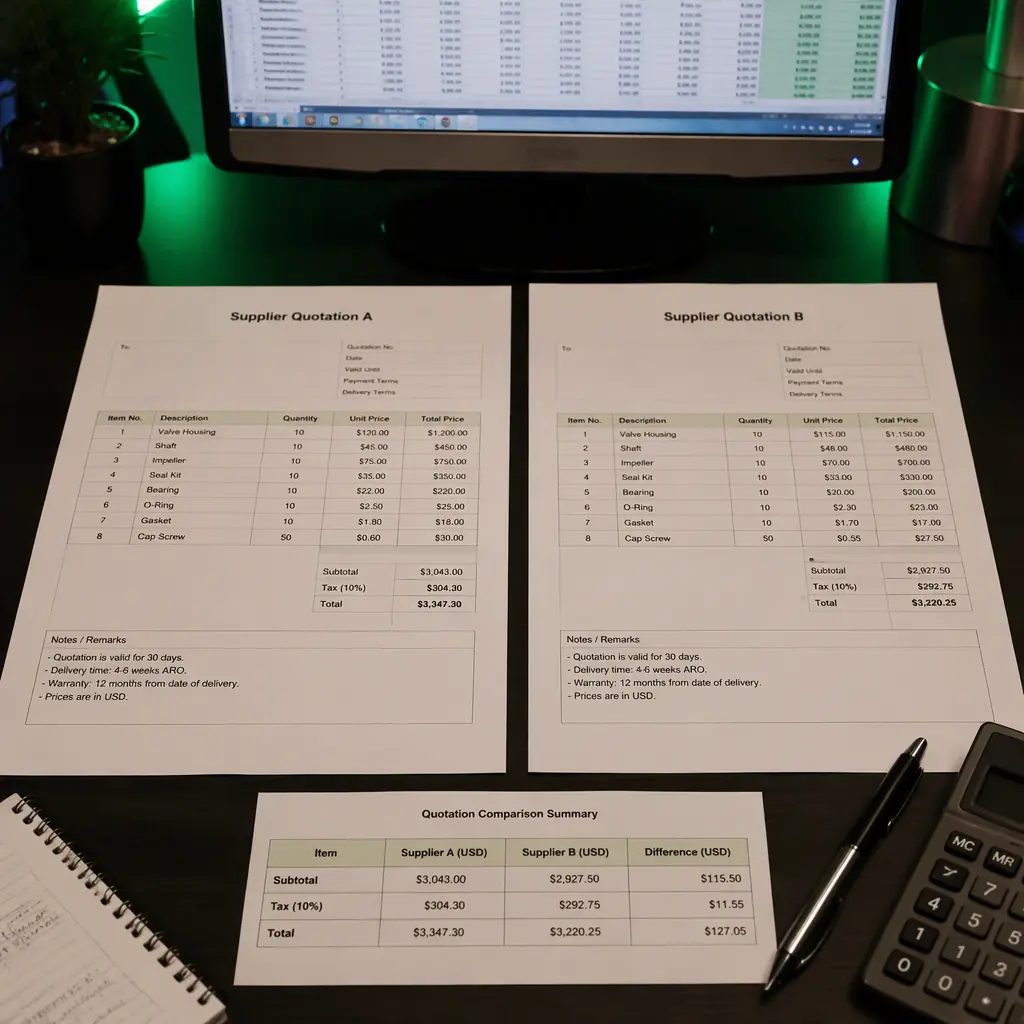 Quote comparison
Evaluating quotes: scoring the responses
The evaluation section of the RFP tells suppliers what they will be scored on, and suppliers read it. A transparent weighted scorecard produces better responses than a black box. A workable weighting for UAV components:
| Criterion | Weight | What to look for |
|---|---|---|
| Specification compliance | 40% | Explicit pass/fail per numbered parameter, no "yes" without data |
| Test and quality plan | 20% | Stated AQL, FAT content, test data format, IPC class |
| Price and total cost | 20% | Per-band pricing, tooling/NRE disclosed, Incoterms stated |
| Delivery and capacity | 10% | Lead time per band, production capacity, buffer policy |
| Support and documentation | 10% | Engineering response quality, documentation package, warranty terms |
Red flags that should sink a response regardless of price: no compliance statement per parameter; datasheets without test conditions; "yes" on every line including contradictory ones; no stated AQL or test plan; and resistance to the documentation requirement. The supplier evaluation checklist provides the full scoring framework, and the build vs buy analysis frames whether the whole exercise should be a purchase at all.
Common RFP mistakes and the final checklist
The mistakes that derail component RFPs are consistent across programs, and most are avoidable in the writing:
- Vague specifications. Adjectives instead of numbers, the supplier fills the gap with their own interpretation, and the buyer pays for it in rework.
- No acceptance criteria. Without defined verification, "tested" means whatever the supplier's QC stamp says it means.
- No timeline. An RFP without dates produces quotes without urgency and deliveries without schedule.
- Single-supplier sourcing. An RFP sent to one supplier is a price check, not a procurement. Three to five qualified suppliers produce the comparison the document is designed for.
- No obsolescence clause. The cheapest quote wins, and the component disappears from production two years in, the lifecycle cost of re-sourcing usually exceeds the price difference.
- Ignoring the mission context. A spec that fits the component but not the aircraft, wrong connector, wrong voltage range, wrong vibration rating, passes compliance and fails integration.
The final checklist: background and mission written (one paragraph) · every parameter numeric with condition and tolerance · test conditions required on all datasheet claims · FAT and AQL sample plan stated · verification method defined per critical parameter · documentation package listed · MOQ, lead time, warranty and EOL notice clauses included · Incoterms and payment terms stated · scoring weights published · three or more suppliers invited. Send that document, and the responses will be comparable, enforceable and, most importantly, true. EMS Drone responds to technical RFPs with per-parameter compliance statements, test data and a stated quality plan. Send the specification, and we will return a compliance matrix, sample test reports and a delivery schedule for the components in your BOM.
Explore custom engineering Back to Blog
EMS Drone manufactures custom component builds under one roof, from component sourcing through production test. If you are specifying for a build, see the full capability set and the tolerances we hold.
Continue Reading

UAV Supplier Evaluation Checklist
The scoring framework that turns RFP responses into a defensible supplier decision.
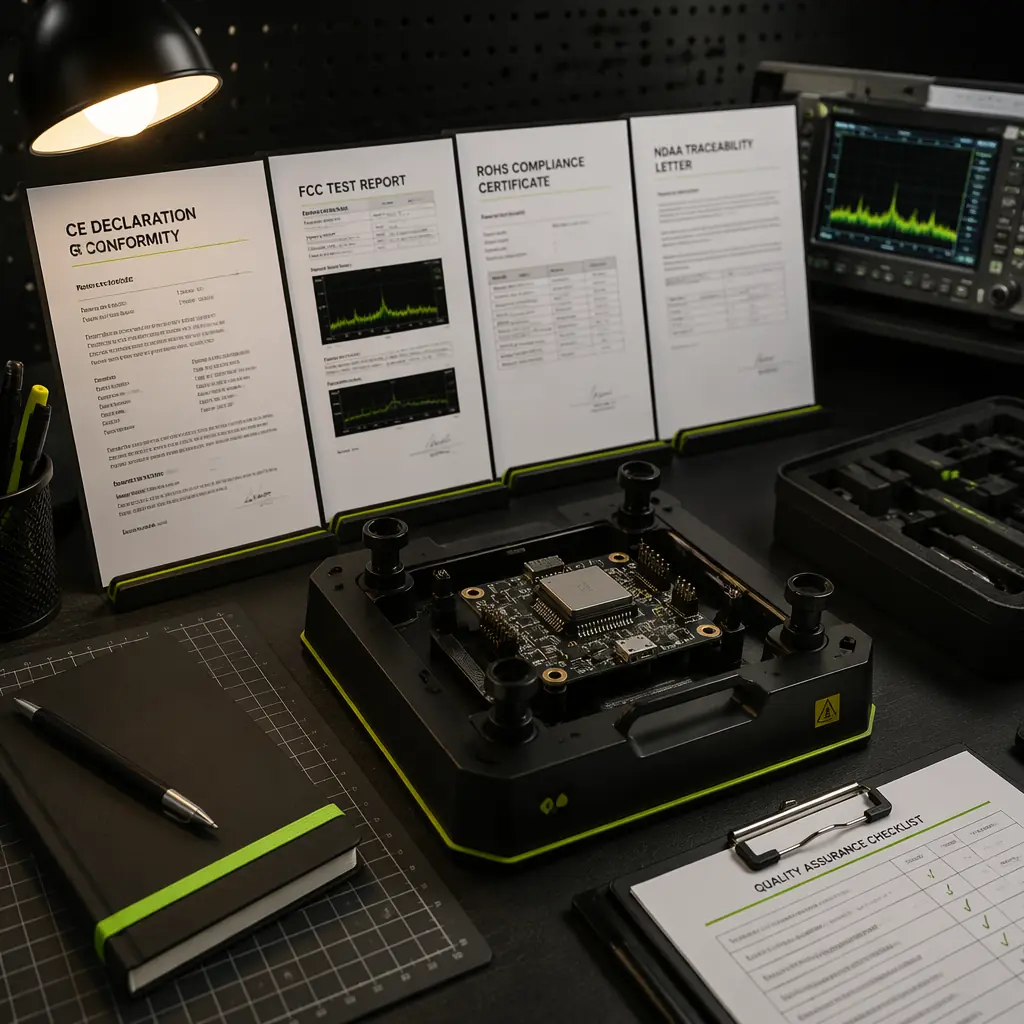
UAV Certification and Compliance
CE, FCC, RoHS and the documentation trail that RFP records feed into.
UAV Component Warranty and RMA
The after-sales clauses to negotiate in the RFP, and the records acceptance creates.
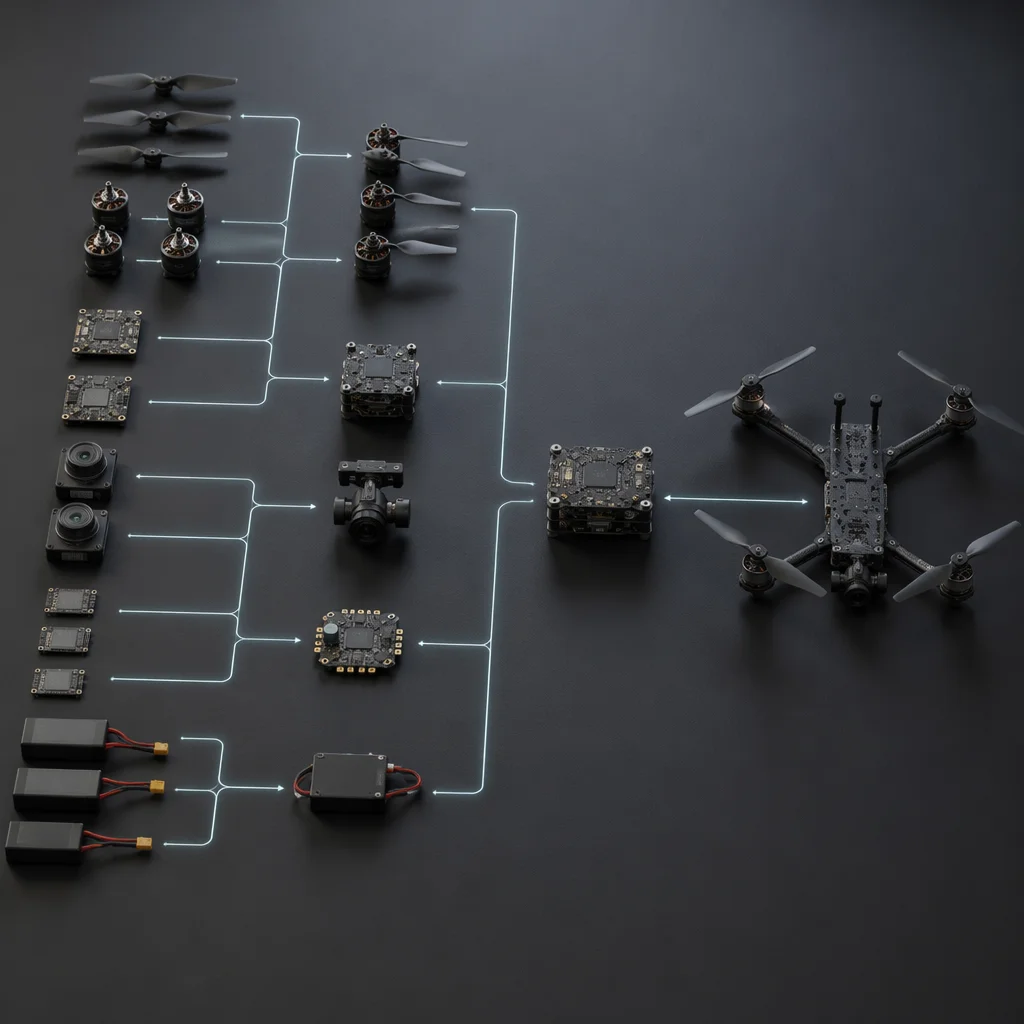
UAV Component Sourcing: Build vs Buy
The sourcing decision that determines whether an RFP is the right instrument at all.

UAV Propulsion Testing and Validation
The test philosophy that the RFP's test clauses should demand from any supplier.