
Electrical integrity
Review polarity, wiring, connectors, power distribution and installation context.
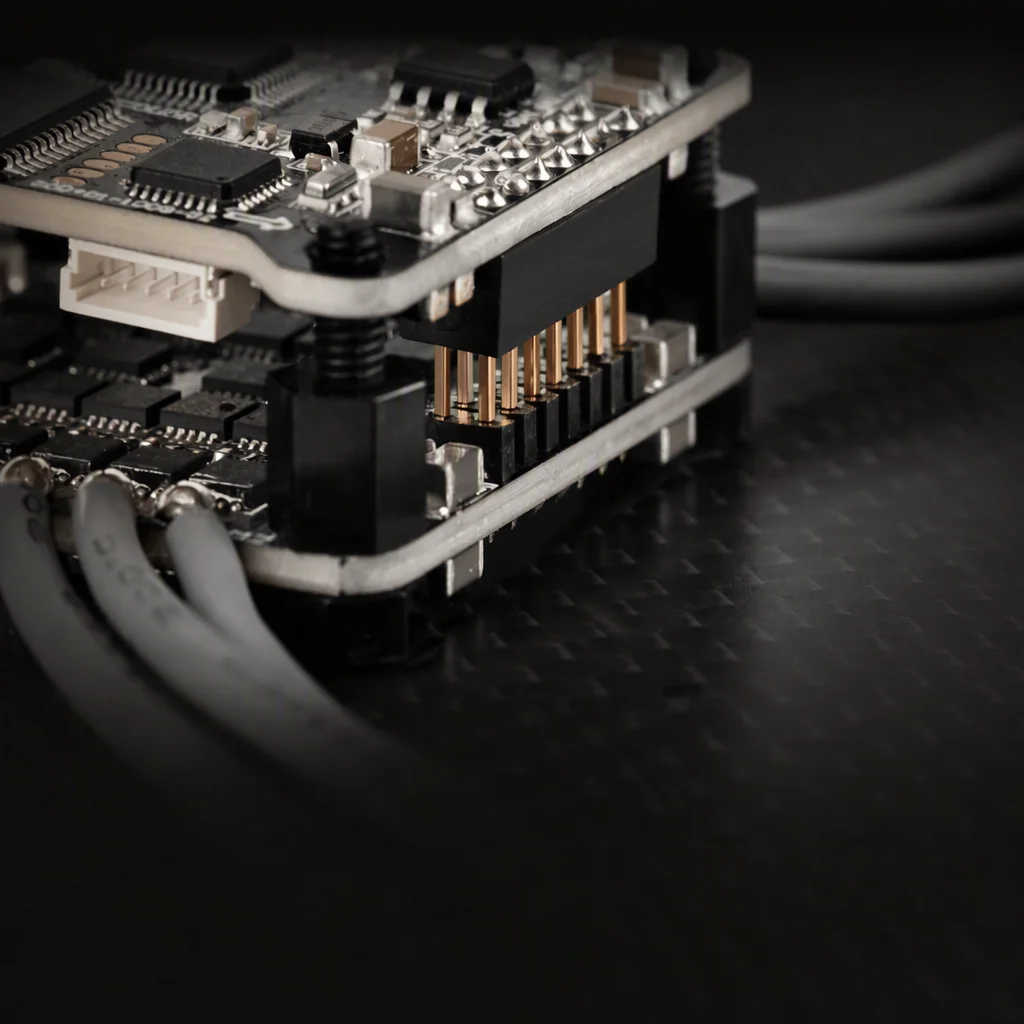
Professional support helps connect wiring, power, control response, communications and configuration before the aircraft is treated as flight-ready.
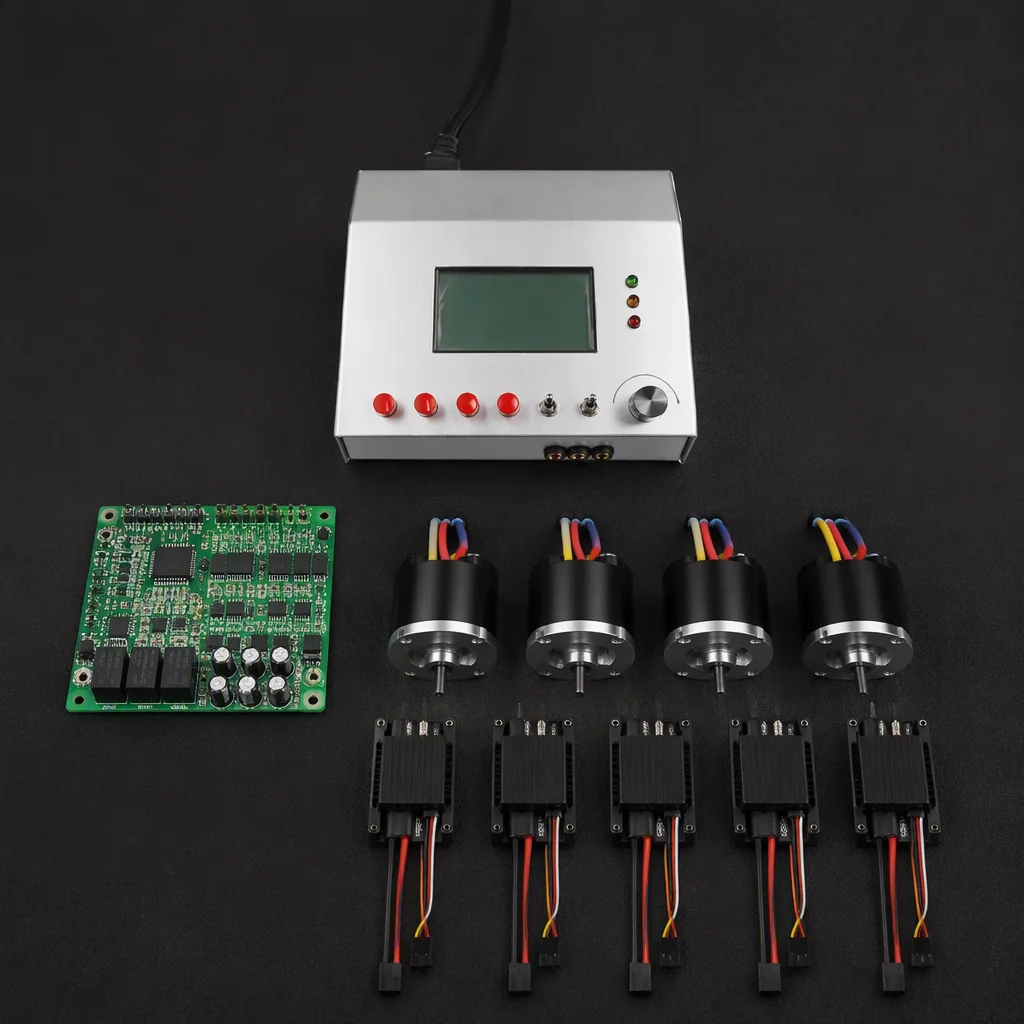
The service path can include interface review, bench checks, firmware parameters and troubleshooting support. The exact validation plan is defined around the selected platform and project scope.
These gates describe the support categories available. They do not imply a certified laboratory or a fixed test standard.
Review polarity, wiring, connectors, power distribution and installation context.
Check ESC response, motor direction and propulsion-system coordination.
Verify sensor, radio, GNSS, telemetry and peripheral communication paths.
Review parameters, system behavior and the project-specific pre-flight checklist.
The final checklist depends on the component architecture, application and delivery depth.
| Incoming check | Component identity, visible condition and project mapping |
|---|---|
| Wiring & power | Polarity, connector fit, distribution path and installation context |
| Propulsion | ESC response, motor direction and system-level matching |
| Control stack | Controller, sensor, navigation and firmware context |
| Communication | Radio, telemetry, GNSS and payload interface checks |
| Readiness | Project-specific checklist, configuration notes and open issues |
Hot spots on ESC MOSFETs, uneven current distribution across parallel paths, and connector resistance issues become visible through thermal imaging before they cause in-flight failures. This is a standard checkpoint for power electronics in the validation sequence.

Some projects need a checked component stack; others need troubleshooting or a complete-platform preparation path.
Review the selected part against the wider architecture and interface requirements.
Coordinate a matched control, power or propulsion subsystem and its bench checks.
Work through electrical, mechanical, firmware and communication issues across layers.
Prepare a project-specific readiness path for an integrated aircraft configuration.
Validation is bought as a service but priced like an engineering deliverable: the bench time, the tooling and fixtures, the engineer hours and the documentation are separate lines, and only some of them repeat per aircraft. The bands below are indicative USD ranges across the professional-class multirotor and VTOL projects we validate, stated as component-and-service cost rather than a resale price.
| Cost element | Indicative band (USD) | Scaling effect |
|---|---|---|
| Component-level bench check (per subsystem) | 150 – 900 | Per subsystem per build; repeats for each ESC, controller or sensor group that is re-validated after a change |
| Electrical integrity and load-path verification | 200 – 1,200 | Per airframe; rises with the number of parallel power paths and with any laminated busbar that has to be instrumented |
| Powertrain behaviour and thermal imaging | 300 – 1,800 | Per airframe type; the load rig can be reused, the thermographic pass and the analysis repeat |
| Radio, GNSS and telemetry link verification | 250 – 1,500 | Per configuration; repeats whenever the antenna layout, frequency band or payload rail changes |
| Control parameter review and tuning | 400 – 2,500 | One-time per airframe type; repeats only when the propulsion, mass or airframe geometry changes |
| Readiness documentation and issue register | 100 – 600 | Per build; the clause set is standard, the filled-in results are aircraft-specific |
| Fixture and rig amortisation | 0 – 4,000 | One-time per airframe family; the harness block, load cells and mounting jig are shared across the units in the programme |
The line buyers most often under-estimate is the one that repeats: the per-subsystem bench check and the link verification scale with every configuration change, while the tuning and the fixture are largely one-time. If a programme plans several build variants from one airframe family, ask which validation lines amortise across the family and which are charged per variant, because that single distinction moves the total more than any hourly rate.
Validation is a joint responsibility, and the boundary is worth fixing in writing before the first bench session. We own the test method, the instrumentation and the recorded result. The customer owns the operating envelope, the intended mission profile and the go/no-go decision that follows the numbers. The table sets out the split that removes the argument later.
| Validation activity | Owned by us | Owned by you (customer) |
|---|---|---|
| Defining the test sequence and acceptance thresholds for each gate | Propose the sequence, the thresholds and the instrumentation from the component set | Confirm the thresholds against the mission profile and the regulatory envelope |
| Bench and thermal verification execution | Run the checks, record the raw data and flag out-of-band results | Provide the true operating ambient, the payload mass and the duty cycle |
| Control parameter review | Review the configuration, identify mismatches and propose parameter ranges | Approve the final parameters and accept the flight profiles they enable |
| Integration issue resolution | Trace electrical, firmware and communication faults to a layer and a fix | Decide whether the fix is worth the schedule or budget impact before it is applied |
| Readiness sign-off | Deliver the recorded results and the open-issue register | Make the flight-readiness decision and hold the operating authority |
| Re-validation after a change | Re-run the affected gates and document the delta | Notify us of any component, firmware or airframe change that invalidates a prior result |
The obligation that causes the most friction is re-validation after a change. A parameter set verified in March does not carry to a June build with a different propeller, and the customer, not the validator, is the party who knows a change happened. Writing "notify the validator of any change that affects a validated gate" into the purchase order turns a re-test dispute into a scheduled task.
The numbers below come from aircraft we have worked through the validation path, and they show what the checks change in practice rather than in principle. Each is a published engineering project on this site with the components and the outcome recorded.
The propulsion stack was validated across six candidate motor, ESC and propeller combinations before the airframe was fixed. Thermal imaging on the ESC rail caught uneven current sharing across two parallel battery feeds, corrected by re-terminating the harness rather than by derating the aircraft. Flight testing then confirmed 38-minute hover endurance at 2.8 kg payload, derating to 31 minutes at 4,500 m.
Heavy-lift inspection buildThe validation priority was the sustained high-current path: eight motors and a pump drew continuous load through a 400 A distribution board. CAN-based ESC telemetry was verified before flight so that motor temperature and RPM data would be trustworthy in service, and the sealed electronics bays were checked against the humid, dusty operating case. Endurance measured 14 minutes at 30 L with an 8 m/s spray speed.
Agricultural spraying buildA long-endurance fixed-wing was validated for cruise efficiency rather than thrust, with the pusher-propeller configuration and the RTK GNSS link verified before the camera payload was integrated. The link verification gate caught a telemetry budget that would not have met the beyond-visual-line-of-sight margin, resolved by repositioning the antenna before the airframe was closed out.
Fixed-wing mapping buildThe individual checks in this sequence are covered in more depth in the engineering library: propulsion testing and validation, hardware-in-the-loop testing, EMC and EMI design compliance, environmental qualification testing and production test fixtures and ATE. Read them alongside the bench work rather than instead of it, because each one explains a gate that a bench session can only confirm.
A validation service is only as good as the requirement it is measured against. These are the clauses we recommend buyers fix before requesting a validation quotation, because each one removes a later ambiguity about what was checked, at what condition, and to what threshold.
Share the component set, wiring context, firmware environment or complete-aircraft goal. We’ll frame the appropriate engineering review.