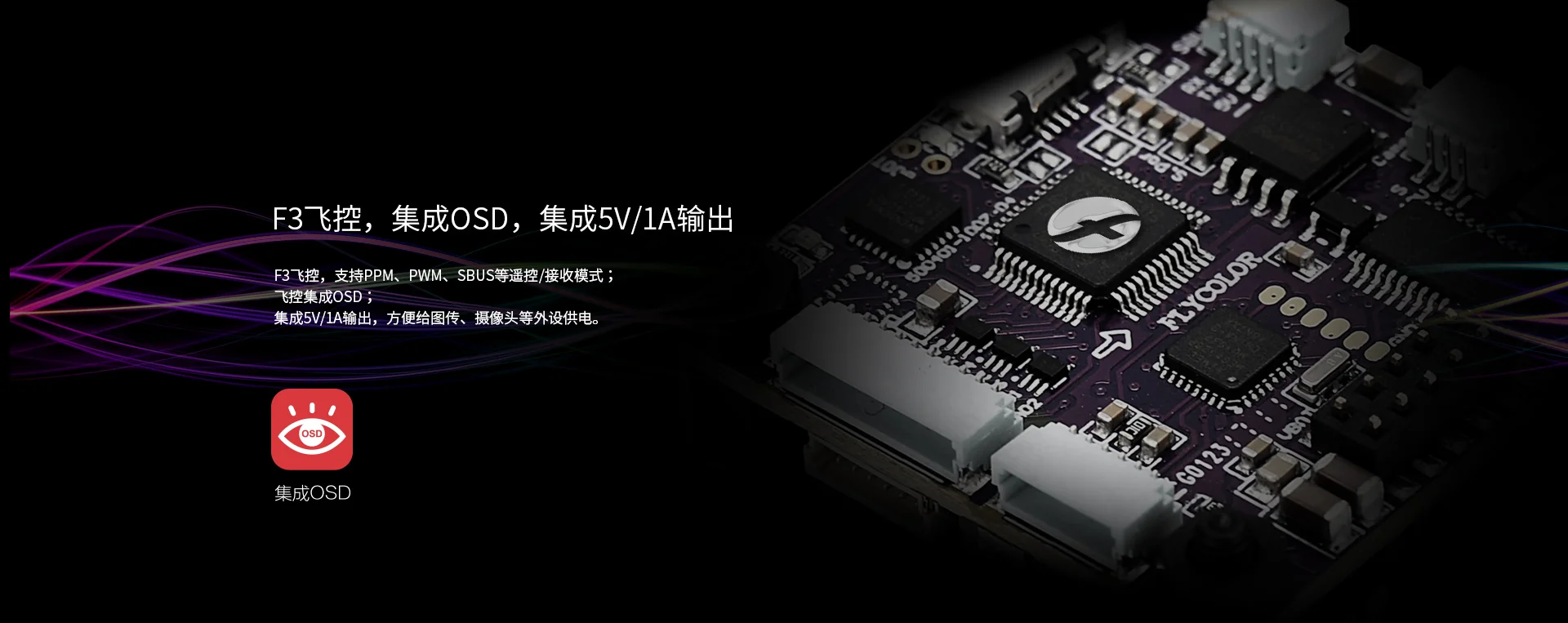
The decision layer: flight controller hardware, sensor integration, navigation architecture and firmware alignment for the aircraft mission.
RoleBrain of the UAV
PlatformsArduPilot / PX4 / Betaflight / INAV
Key InterfacesESC, GPS, Radio, Payload
DepthBoard → Full Stack
Overview
The flight controller is the aircraft's decision center.
Every sensor reading, every pilot command and every autonomous waypoint passes through the flight controller. Selecting the right FC means aligning processor architecture, sensor fusion rate, I/O availability and firmware ecosystem with the mission profile, not just the aircraft size.
FC Platforms
Four firmware ecosystems, each with a distinct strength.
The platform choice determines available flight modes, sensor support, redundancy options and the tooling ecosystem around configuration and tuning.
ArduPilot
Multi-vehicle autonomy
The most mature open-source autopilot ecosystem. Covers multi-rotor, fixed-wing, VTOL, helicopter, rover and boat on a single firmware family. Strong mission planning, geofencing, terrain following and precision landing support. Best choice for industrial applications that need proven autonomous workflow tooling and broad hardware compatibility across STM32H7 and Linux-based flight controllers.
Auto missions
Geofence
Terrain follow
Precision land
Multi-vehicle
PX4
Modular flight stack
A software-in-the-loop-friendly architecture with strong separation between flight core, communication layer and application modules. Preferred in research and development contexts where custom control algorithms, sensor fusion experiments or hardware-in-the-loop testing are part of the workflow. Runs on Pixhawk-format hardware with a growing Linux companion-computer ecosystem for onboard compute.
SITL / HITL
Modular
MAVLink v2
Companion PC
ROS bridge
Betaflight
High-rate control loop
Optimized for multi-rotor agility with sensor fusion rates up to 8 kHz and PID loops tuned for responsive flight. The dominant platform in FPV freestyle and racing, with a large community and wide STM32F4/F7/H7 hardware support. Increasingly used in cinematography builds where precise attitude hold and rapid control response matter more than autonomous mission features.
8 kHz loop
PID tooling
FPV OSD
Wide HW support
INAV
Navigation-focused
Built on Betaflight's control heritage but adds GPS navigation, return-to-home, waypoint missions and altitude-hold modes. A practical middle ground for fixed-wing FPV platforms and multi-rotors that need basic autonomous navigation without the full complexity of ArduPilot or PX4. Strong OSD integration and reasonable position-hold performance on modest hardware.
GPS nav
RTH
Waypoints
Fixed-wing
OSD
Sensor Integration
The FC is only as good as the data it reads.
Sensor selection and placement directly affect stability, navigation accuracy and failover behavior.
Inertial & Attitude
IMU, barometer, compass
The core sensor triplet for attitude estimation. Modern FCs use redundant IMU pairs (ICM-42688, BMI270) with vibration-isolated mounting. Barometers (DPS310, MS5611) provide altitude reference with foam-covered ports to reduce wind noise. External compass modules mounted away from power wiring reduce magnetic interference, critical on larger airframes where high-current paths create significant local fields.
Position & Velocity
GPS, optical flow, rangefinder
Multi-constellation GNSS modules (u-blox M10, F9) provide position and velocity with RTK centimeter-level accuracy where the mission requires it. Optical flow sensors add position-hold redundancy in GPS-denied environments. LiDAR or ultrasonic rangefinders deliver precision altitude data for terrain following, auto-landing and low-altitude hover, selecting the right range and beam pattern for the operating surface.
Key Specifications
Parameters that shape the FC decision.
These are the spec dimensions we review when matching a flight controller to a build.
Processor
STM32H7, F7, F4 or Linux companion, determines loop rate ceiling, sensor fusion complexity and onboard compute headroom for custom algorithms.
4–8 serial ports for GPS, telemetry radio, companion computer, serial RX and debug. Count must cover all peripherals plus one spare.
CAN bus
Enables distributed sensor and actuator architecture, particularly valuable on larger aircraft where wiring distance matters.
PWM outputs
8–16 channels for motor ESCs and servo outputs. DShot-capable outputs preferred for multi-rotor motor control; standard PWM for fixed-wing servos.
Redundancy
Dual IMU, dual barometer, dual power input and triple-redundant sensor fusion (EKF3) for applications where single-point failure is unacceptable.
Firmware & Tuning
Parameters, flight modes and failsafes.
A properly configured FC needs more than default parameters. The tuning process connects aircraft dynamics, pilot expectations and safety behavior.
Parameter configuration
Frame class, motor layout, ESC protocol, sensor orientation, battery monitoring and failsafe thresholds are set at the parameter level. Each platform has hundreds of parameters. But the core set that defines safe flight behavior is manageable when approached systematically. We review these against the aircraft configuration so critical settings are not left at defaults that assume a different airframe type or mission profile.
PID tuning & flight modes
Rate PID loops for multi-rotors, attitude controllers for fixed-wing: each aircraft category has a different tuning methodology. Flight mode setup maps pilot switches to stabilized, altitude-hold, position-hold, auto and return-to-home modes. Failsafe programming defines behavior on radio loss, GPS loss and low battery. Sequenced actions that must be tested, not just configured.
Selection Guidance
Match the FC to the aircraft, not the other way around.
The right flight controller depends on aircraft type, mission autonomy requirements and the interfaces it must serve.
Multi-rotor inspection
ArduPilot or PX4 on H7 hardware with RTK GPS, dual IMU, LiDAR rangefinder and 8+ PWM outputs for motor mixing. Position-hold accuracy and sensor redundancy are the priority.
FPV cinematography
Betaflight on F7/H7 hardware with high-rate gyro, barometer, GPS for return-to-home and BLHeli passthrough. Control responsiveness and OSD quality drive the choice.
Fixed-wing mapping
ArduPilot or INAV with airspeed sensor, multi-constellation GNSS, terrain following and large waypoint storage. Endurance, wind handling and mission reliability are the key factors.
VTOL hybrid
ArduPilot or PX4 on H7 with dual GPS, airspeed sensor, tilt-servo or lift-motor outputs and transition logic. The firmware must handle multi-rotor and fixed-wing control laws with seamless transition.
Research / custom
PX4 with companion computer running ROS 2, MAVLink bridge and custom offboard control. Modular architecture allows replacing or extending control modules without touching the flight core.
Related Capabilities
The FC connects to power, comms and motion.
Flight controller choices ripple into every other subsystem. These are the most tightly coupled layers.
ESC & Power
Protocol and voltage alignment
FC protocol output (DShot, PWM, CAN) must match the ESC input. Voltage monitoring, BEC requirements and power distribution follow from the FC architecture.
FC UART allocation, telemetry radio protocol (MAVLink, CRSF, SmartPort) and RC receiver interface are all defined at the FC level and must be coordinated with the comms architecture.
List price for the autopilot board is the smallest number in the decision. The figures below are the order-of-magnitude bands we see on industrial programmes in the 5-25 kg class, quoted per aircraft and valid for a build of 10 to 50 units. Read them as structure, not as a quotation: the ratio between rows is what governs total cost of ownership, not any single cell.
Cost element
Typical band
Primary driver
FC board + carrier
$140 - $900
IO count, redundancy, SoC class (H7 vs F4)
Sensors, GNSS and RTK
$180 - $2,600
Two- vs three-redundant IMU, RTK accuracy, anti-jam needs
Wiring, connectors, power modules
$60 - $320
Harness count, locking connectors, current sense
Configuration, tuning and HIL
$900 - $4,200
Airframe count in the fleet, fault-injection depth, tuning cycles
Across the programmes we support, the row that is underestimated most often is configuration, tuning and HIL verification, not the avionics itself. A flight controller that is 2x cheaper but needs three extra tuning cycles and a custom harness costs more by the second airframe. The reverse is also true: over-specifying redundancy on an airframe that flies one mission profile wastes budget that belongs in sensor quality.
Flight-control responsibility split: supplier vs operator
Most disputes on a flight-control programme come from an unclear seam, not from a defective part. The table below is the split we write into the supply agreement, so each obligation has exactly one owner and each claim is testable.
Item
Supplier responsibility
Operator responsibility
Parameter set and firmware baseline
Deliver documented parameter file, pinned firmware version and change log
Apply and verify on the target airframe before release to flight
Sensor calibration
Factory calibration records and IMU temperature data
On-aircraft compass and level calibration after any structural change
Redundancy behaviour
Demonstrate failover logic with injection tests
Maintain the health of both sensor paths; log and report failures
Failsafe configuration
Provide fail-safe matrix per flight mode
Validate RTL, land and parachute behaviour in a safe test area
Firmware change and re-certification
Notify and re-qualify any release that alters control law or failsafe logic
Re-run the acceptance tuning and flight-test set before the fleet flies the new build
Crash and incident data
Support log review and store data from the incident flight
Present the airframe and logs in unmodified form
The row that matters most is the firmware change and re-certification clause. It converts a soft "compatibility" promise into a measurable obligation: a firmware build that alters failsafe logic or control law must trigger a defined re-validation, not a silent update. Without that clause in writing, every upgrade resets an implicit argument about who owns the result.
Real reference builds: what these numbers mean on an airframe
Two aircraft we have built and instrumented show why flight-control sizing cannot be copied between platforms.
Our VTOL mapping platform carries a 5 kg sensor payload and a 6S8P 40,000 mAh pack. The flight controller, RTK and radio draw 12 W combined, or under 14% of the 85 W cruise draw. On a small quadcopter the same avionics stack would be the largest continuous load, which is why the same FC board with the same parameter file behaves differently once the power margin shrinks. The lesson for a flight-control buyer: whichever draw is largest, the avionics power rail needs its own regulation and monitoring, not a shared 5 V bus.
Our heavy-lift agriculture platform is a 25 kg MTOW coaxial octocopter with a 1,600 mm folded span, and it needs a flight controller that can hold attitude through a 30 L tank draining from the centre of gravity. Control authority and sensor quality decide whether it holds altitude and heading as the aircraft gets lighter, so the FC choice influences the pump and nozzle layout long before any firmware is written. A supplier with aviation-level process control can align the required control parameters with the actual aircraft, avoiding the extra integration programme that results when the wrong default profile is shipped.
Flight-control RFQ clauses worth writing down
These are the clauses we would ask any flight-control supplier to commit to in writing. Each one is drawn from a real programme issue rather than a specification template.
Named firmware baseline with version pin and change log for any release that alters control law or failsafe logic.
Documented parameter file compatible with the specified airframe configuration and payload mass.
Injection logs demonstrating sensor failover and RC-loss behaviour, with pass/fail result per test.
IMU temperature calibration data over the operating range required by the mission profile.
Failsafe matrix per flight mode: hold, RTL, land and terminate as configured.
Re-qualification requirement on any firmware release affecting control law, with a delivery date for the updated parameter set.
Logging format and toolchain documented and available to the operator for post-incident review.
Behind the clauses is a supplier with a defined verification process: every flight-critical board is tested against its parameter set before shipping, and process control at the PCB-assembly level is what keeps the next production lot behaving the same as the validated prototype. When you specify controls, ask for the verification record, not only the datasheet. Sourcing partners who can hold that discipline both ways tend to be more than parts suppliers, so it is worth settling these clauses against a configured proposal before committing.
Tell us the aircraft category, payload, operating range and autonomy requirements. We will map the FC platform, sensor architecture and interface plan to your build.
Engineering Intake
Start with your mission.
Tell us what you are building and where you need support: component sourcing, a matched stack or a complete UAV.