
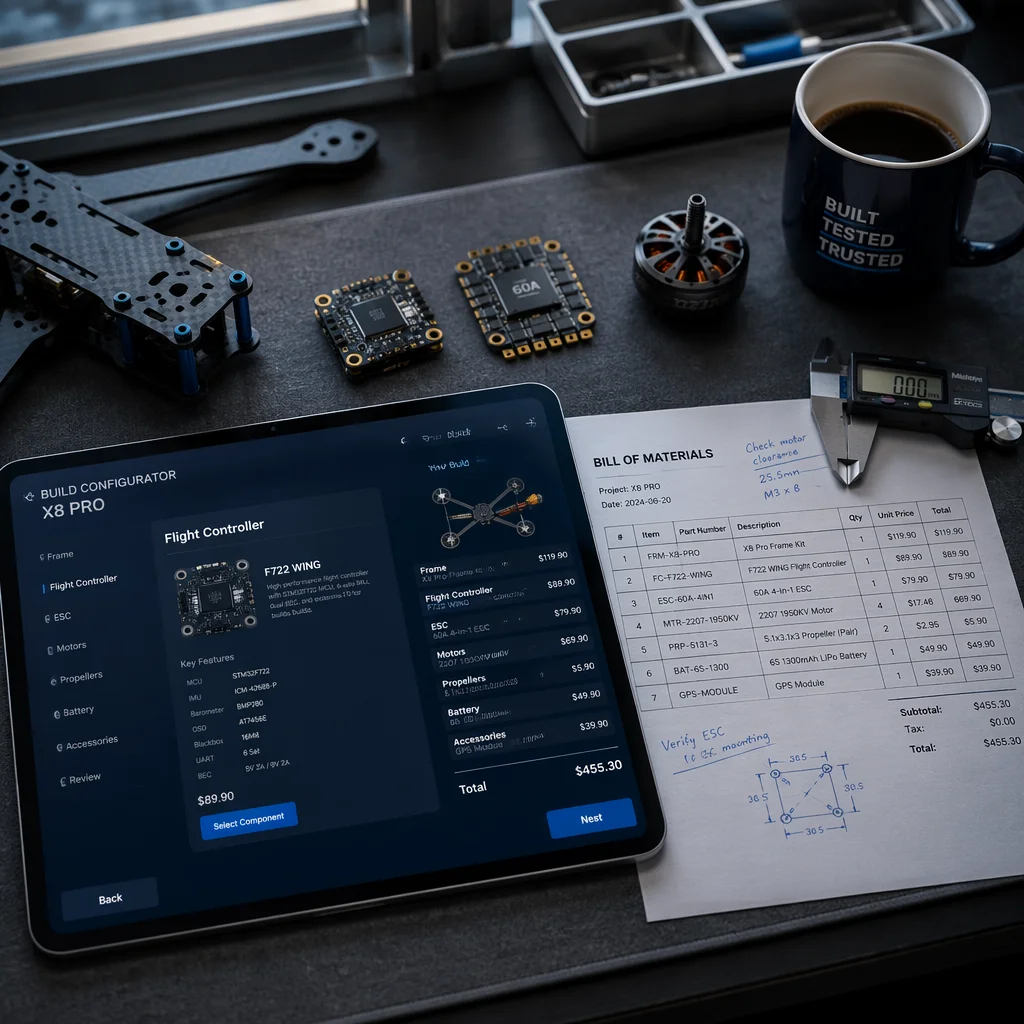
 Concept illustration
Request a Quote
Share your BOM, mission requirements, or aircraft configuration goals. Our engineering team evaluates every inquiry and returns a detailed component recommendation with preliminary pricing.
Quick Quote Request
Fill out the form below with as much detail as you can provide. The more specific your requirements, the more accurate our preliminary assessment. Typical response time is 2-3 business days.
 Concept illustration
Planning
Typical Price Reference
These ranges are informational and reflect typical component-tier market pricing. Final quotation always follows an engineering review of your specific requirements.
Note: Prices are indicative. Final quotation follows engineering review.
Where the money actually goes in a UAV build
The four ranges above answer a first-order question. Procurement teams usually need the second-order one: which line items move a quote by thousands of dollars, and which are rounding errors. The bands below are the cost elements we quote most often, with the driver that moves each one.
| Cost element | Typical band | What moves it |
|---|---|---|
| Flight controller board and carrier | $140 - $900 | IO count, redundancy level, H7 vs F4 class SoC |
| Sensors, GNSS and RTK | $180 - $2,600 | Two- vs three-redundant IMU, RTK accuracy, anti-jam needs |
| Radios and modems | $120 - $2,400 | Band count, data rate, encryption, number of independent links |
| Ground station and tracking | $300 - $4,500 | Manual vs automatic tracker, antenna diversity, recording |
| Wiring, connectors, power modules | $60 - $320 | Harness count, locking connectors, current sensing |
| Configuration, tuning and HIL | $900 - $4,200 | Airframes in the fleet, fault-injection depth, tuning cycles |
| Field re-tune and re-validation | $400 - $1,800 / yr | Firmware releases, payload changes, airframe repairs |
Two consequences follow from this table. First, the integration work and the first-year revalidation together commonly cost more than the flight controller itself, which is why a quote that lists only hardware is incomplete. Our guide to building versus buying a UAV component sets out where that integration cost actually sits. Second, the failure cost of a single event is 3x to 20x the board price once airframe replacement, grounded days and customer liability are counted. That ratio, not the unit price, is the argument for redundancy spending.
What a quote includes, and what it does not
Quotations differ mainly in scope, not in unit price. Comparing two quotes line by line without checking what each side delivers is the most common cause of a surprise later in the programme. This split is the one we hold to.
| Item | Included in our quotation | Customer side |
|---|---|---|
| Component selection and rationale | Shortlisted parts with the engineering reason each was chosen, and the alternatives rejected | Confirm the mission profile the selection was made against |
| Power and thermal budget | Calculated budget at the stated payload and endurance, with margin called out | Provide real payload mass and duty cycle, not catalogue figures |
| Lead times | Per-line lead time from order confirmation, with long-lead items flagged at quote stage | Hold the order date, or tell us the real one |
| Configuration and tuning | Parameter baseline and bench verification for the configuration supplied | Airframe acceptance, flight test and sign-off |
| Regulatory conformity | State the band, power and licence class of each radio supplied | Hold the operating licences and coordinate with other operators |
| Documentation | Datasheets, wiring and interface data for every part on the quote | Keep the quoted revision as the reference for changes |
Flight Controllers
Priced by sensor redundancy, SoC class and IO count rather than by brand. An F4 board with a single IMU and 6 PWM outputs sits at the bottom of the band; an H7 unit with triple-redundant IMU fusion, heated sensors, dual power input and 16 outputs sits at the top.
Typical range: $140 - $900 per board and carrier.
ESCs and Motors
The ESC is priced by continuous current, protocol and telemetry depth: a 20A PWM/DShot unit is a fraction of a 120A FOC controller with CAN feedback and logging. Motors track stator size, KV, bearing class and winding consistency, with matched sets costing more than loose units.
Typical range: Per-unit pricing scales with current rating, protocol and motor class; a full propulsion set for a 25 kg airframe is typically the single largest line in the BOM.
Communications
Radios and modems dominate the link cost, followed by antenna systems and any tracking ground station. A single licence-free telemetry pair is a small line; redundant links on separate bands with an auto-tracking ground station are a different order of magnitude.
Typical range: $120 - $2,400 for radios and modems, $40 - $600 for antennas and feed lines, $300 - $4,500 for a ground station with tracking.
Complete Aircraft
Configuration-dependent, a basic quadcopter kit differs substantially from a heavy-lift hexacopter with redundant systems, custom payload integration and industrial communication links. Propulsion, battery configuration and payload integration complexity are the three largest cost drivers.
Typical range: Highly variable based on aircraft class, payload capacity and redundancy requirements.
Process
What Happens After You Submit
Every quote request follows a structured review pipeline. Here is what to expect.
Initial Review
Our applications engineering team reviews your submission within one business day. If the requirements are clear and complete, we proceed directly to assessment. If we need clarification, we will reach out by email with specific questions: typically about payload mass, target endurance, or operating environment.
Engineering Assessment
We model your requirements against our component database, evaluating multiple candidate configurations. This includes propulsion system matching, power budget verification, structural compatibility checks, and communication link budget calculations. The output is a shortlist of recommended components with rationale.
Quote Delivery
You receive a detailed quotation document including: recommended component list with specifications and quantities, unit and extended pricing, lead time estimates, and an engineering commentary explaining key selection decisions. You can then approve, request modifications, or schedule a design review call.
Common Questions
About the Quoting Process
Do I need a complete BOM to request a quote?
No. Many customers come to us with mission requirements rather than a finalized BOM. Provide your target payload, endurance, operating environment, and any preferred standards or protocols, we will propose a component set from there.
How long does quoting take?
Standard response is within 2-3 business days. Complex projects requiring extensive modeling or supplier coordination may take up to 5 business days. We will confirm the timeline in our initial acknowledgment.
Are quoted prices binding?
Quoted prices are valid for 30 days from the date of issue. Component prices can fluctuate with supply chain conditions, particularly for semiconductors and lithium cells. We proactively communicate any significant changes before order confirmation.
What if I need to modify the quote after receiving it?
Quote revisions are standard. If you need to adjust quantities, swap components, or explore alternative configurations after reviewing the quote, simply reply to the quote email with your requested changes. Minor revisions are typically returned within one business day.
More questions? Visit our FAQ page for additional information on ordering, shipping, warranty, and technical support.
The seven things that send a quote request back
Most quote requests are answerable in 2-3 business days. The exceptions are almost never technical complexity; they are missing inputs that force a round of questions, and each round costs a working day or more. If you are writing a formal tender rather than a first enquiry, the component specification structure for an RFQ covers the same inputs in procurement language. These are the omissions we see most often, and what each one costs.
| What is missing | Why we cannot proceed | Time added |
|---|---|---|
| Payload mass and volume | Propulsion sizing, frame stiffness and power budget all key off it; catalogue mass understates mounted mass | 1-2 days |
| Target endurance and what it means | Hover time, cruise time and mission time differ by 30-50 percent on the same pack; the wrong one oversizes the propulsion system | 1 day |
| Operating temperature and ingress | Decides sensor heating, connector class, sealing and battery chemistry; retrofitting after design is expensive | 1-2 days |
| Quantity and annual volume | Unit pricing, tooling amortisation and lead time all depend on whether this is one unit or a programme | 1 day |
| Required certifications | Conformity route changes the part mix and the documentation set, not just the paperwork | 2-5 days |
| Interface and protocol constraints | An existing autopilot, ground station or payload defines what can interoperate | 1-2 days |
| Budget band and decision date | Not used to pad a price; it decides whether we propose a compliant or a value-engineered configuration | 1 day |
A request that covers all seven is usually quoted without a single clarifying email. If you are comparing several suppliers on the same BOM, the supplier evaluation checklist is the version of this list to send them. If you do not yet have these numbers, send what you have and say which are open: an estimate with a stated assumption is faster to work with than a specification copied from a datasheet. Our design guides cover how each input is derived, and how the engagement runs from RFQ to documented acceptance. For what happens once quantities are agreed, see pilot production and NPI and pre-shipment inspection.
Ready to Proceed
Need a Faster Response?
For urgent project timelines or volume procurement inquiries, contact our sales engineering team directly. We can often provide same-day preliminary estimates for well-defined component requirements.