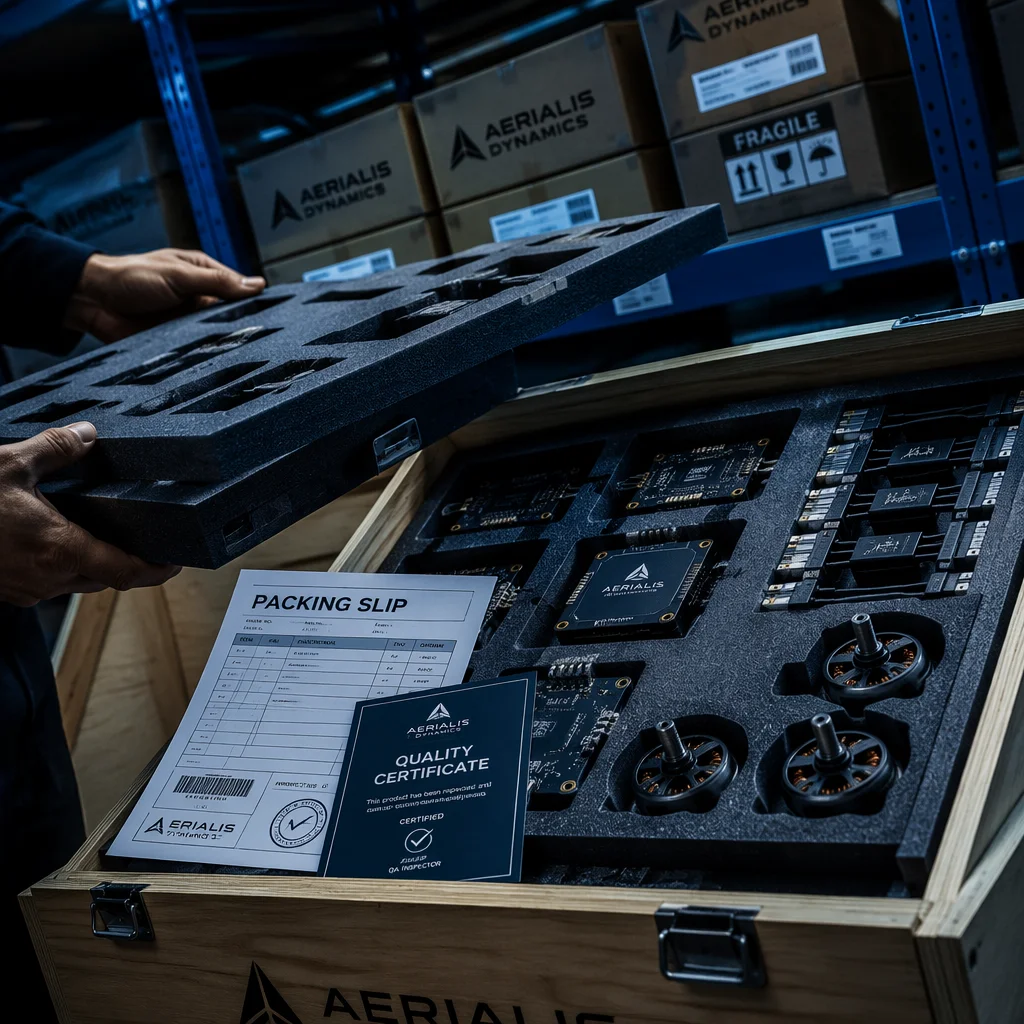
Conceptual global logistics and UAV component shipping hub Concept illustration
Operations / Logistics

Global Logistics

Flexible shipping methods, protective packaging standards and complete export documentation support for UAV components and systems shipped worldwide.

MethodAir / Express / Sea
PackagingESD + Moisture Barrier
DocumentsFull Export Set
CoverageGlobal
Shipping Methods

Choose the freight option that matches your timeline and budget.

Three shipping tiers cover most UAV component and system delivery scenarios. Exact transit times are confirmed per destination at the time of quotation.

METHOD / 01

Express courier

Door-to-door delivery via major international courier networks. Typical transit time is 3 to 7 business days depending on destination. Best suited for sample orders, small-component shipments and time-sensitive prototyping deliveries. Includes real-time tracking and delivery confirmation.

  • 3–7 days
  • Door-to-door
  • Tracked
  • Samples & small lots
METHOD / 02

Air freight

Consolidated air cargo for medium to large shipments. Typical transit time is 5 to 12 business days airport-to-airport or door-to-door depending on routing and customs clearance. Suitable for bulk component orders, subsystem kits and complete-aircraft shipments.

  • 5–12 days
  • Airport or door
  • Bulk suitable
  • Cost-effective volume
METHOD / 03

Sea freight

Ocean freight for high-volume, non-urgent shipments. Typical transit time is 20 to 40 days port-to-port depending on origin-destination pair and sailing schedules. Most economical for large production orders, complete-aircraft batches and long-lead procurement programs.

  • 20–40 days
  • Port-to-port
  • High volume
  • Most economical
Packaging Standards

Every shipment is packed to survive transit and arrive in test-ready condition.

Packaging is not an afterthought. UAV electronics, motors and airframe components each have specific protection requirements.

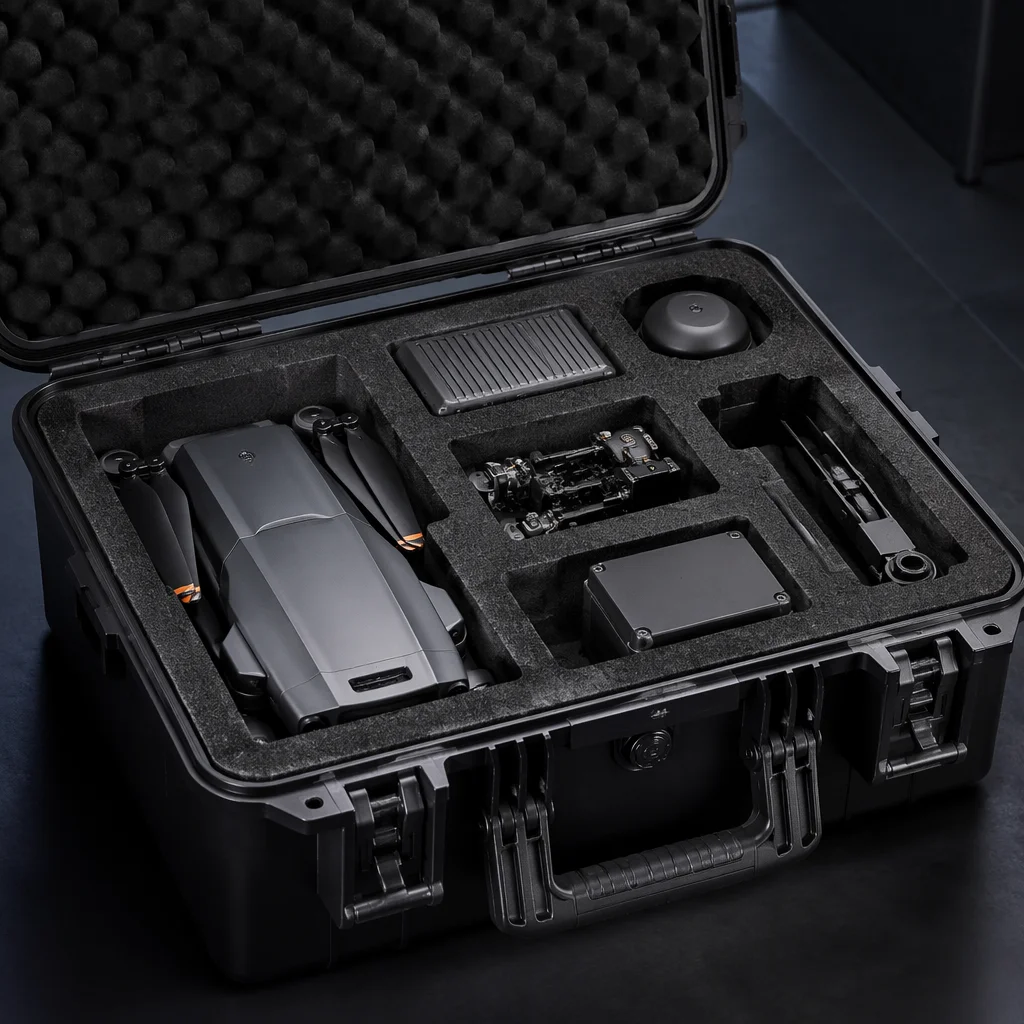
Protective foam-lined shipping case for UAV electronics and components Concept illustration
  • ESD-safe packaging for all flight controllers, ESCs, sensors and communication modules, anti-static bags, conductive foam and grounded handling throughout packing
  • Moisture-barrier bags with desiccant packs and humidity indicator cards for moisture-sensitive devices, sealed immediately after final inspection
  • Shock-absorbing foam inserts custom-cut to component dimensions for motors, airframe parts and assembled subsystems
  • Double-wall corrugated outer cartons with reinforced edges for international transit durability
  • Individual component segregation within shipments: each item wrapped and cushioned separately to prevent transit abrasion
  • Cable and connector protection, terminals capped, harnesses coiled and secured, fragile connectors shielded with rigid covers
  • Battery-specific packaging compliant with IATA dangerous goods regulations for lithium battery shipments (UN 3480 / UN 3481)
  • Complete-aircraft crating with custom foam-lined wooden or reinforced cases for assembled UAV platforms
Export Documentation

Complete paperwork for smooth customs clearance at destination.

Every international shipment is accompanied by a full documentation package. We handle the paperwork so your components clear customs without delay.

DOC / 01

Commercial invoice

Detailed invoice listing each line item with description, quantity, unit value, total value, currency and incoterms. Formatted to meet customs requirements at the destination country.

DOC / 02

Packing list

Itemized packing list with carton dimensions, weights, contents per carton and handling instructions. Organized to support customs inspection without unpacking.

DOC / 03

HS code classification

Harmonized System codes assigned per component category: 8526.91 (navigation), 8501.40 (motors), 8807.30 (UAV parts), 8542.31 (controllers/ICs), 8537.10 (control panels). We provide correct 6- to 10-digit codes for your customs broker.

DOC / 04

Certificate of origin

Certificate of origin issued per shipment, documenting the country of manufacture for each component. Required for preferential tariff treatment under applicable free trade agreements.

Landed Cost

What a UAV shipment actually costs door to door.

Freight is only part of the invoice a component buyer pays. The bands below are working ranges for a typical 12 to 40 kg shipment of UAV components from our Shenzhen facility to the destination region, covering freight, insurance, export handling and an estimated duty or VAT allowance at destination.

Destination regionExpress courierAir freightSea freightDuty / VAT allowance
North AmericaUSD 180 to 420USD 90 to 210USD 45 to 1300 to 25% by HS line, de minimis varies
European UnionUSD 190 to 450USD 95 to 220USD 50 to 140VAT 17 to 27% plus 0 to 4% duty on UAV parts
Middle EastUSD 140 to 340USD 75 to 180USD 40 to 1100 to 5% duty, VAT 5 to 15%
Latin AmericaUSD 210 to 520USD 110 to 260USD 60 to 1708 to 35% duty, tax stacking common
East Asia / ASEANUSD 90 to 240USD 55 to 150USD 30 to 950 to 10% duty, FTA rates apply
Australia / NZUSD 170 to 400USD 95 to 230USD 55 to 1605 to 10% duty, GST 10 to 15%

Three factors move the number more than the freight tier itself. First, lithium batteries: a shipment containing loose batteries above the IATA Section II thresholds must move as Class 9 dangerous goods, which reclassifies the mode and adds a documented-handling surcharge (see the dangerous goods export packaging guidance for the thresholds). Second, declared value: an under-declared commercial invoice creates a customs hold that costs more in delay than the duty it avoided. Third, volumetric weight: a large lightweight airframe crate can bill at three to four times its physical mass, so airframe shipments priced per kilogram should be quoted by volume instead.

Responsibility Split

Who owns which leg, by incoterm.

The single largest source of shipment disputes is an unclear incoterm. This split shows what we do and what the buyer does under the two terms most component buyers request, so the obligation is fixed before the purchase order is issued.

StepEMS Drone (supplier)BuyerDepends on term
Export customs declarationFiles the export declaration and the certificate of originProvides the importer of record and any licenceEXW shifts filing to buyer
Freight booking and carriageBooks and pays carriage under CIF, CIP and DAPBooks and pays carriage under EXW, FCA and FOBYes, term-specific
Transit insuranceArranges to the agreed minimum cover under CIF and CIPArranges own cover under EXW, FCA and FOBCover level is negotiable
Import duty and VATNever borne by supplier under any termAlways the buyer, or the buyer's brokerNo, always buyer
Import customs clearanceSupplies documentation to the buyer's brokerAppoints the broker and clears the entryDDP shifts it to supplier
Last-mile delivery and unloadArranges delivery to address under DAP or DDPUnloads and receives at FCA, FOB and port termsYes, term-specific

Two clauses remove almost all of the remaining ambiguity. Name the exact incoterm with the edition, for example CIF Los Angeles, not simply CIF. And state whether lithium batteries are shipped installed in an assembled system or as loose cells, because that single fact decides the dangerous-goods class and therefore which carrier will accept the booking at all.

Reference Shipments

Two shipments we packed, and what the paperwork had to get right.

The examples below are drawn from aircraft we have built and shipped through this path. Each is a published engineering project on this site with the components and the outcome recorded.

Agricultural Spraying Export

A 30 L octocopter split into three freight cartons

A complete 30 L spraying airframe was shipped air freight as three cartons: folded airframe, sealed electronics bay with the eight-motor propulsion stack separately cushioned, and a 4,000 mAh battery set moved as a standalone Class 9 package with humidity indicator cards in each moisture-barrier bag. HS classification landed across 8807.30 for airframe parts and 8501.40 for motors. The shipment cleared destination customs in two days because the packing list itemized the cartons against the invoice lines, so the broker did not open any case.

Agricultural spraying build
LiDAR Mapping Platform

A fixed-wing mapping payload crated for volumetric billing

A long-endurance fixed-wing platform was shipped sea freight to hold cost on a volumetric-heavy crate: the 2.1 m span was packed in a custom foam-lined crate that billed at roughly 1.6 times physical weight rather than the three to four times a loose carton would have attracted. The RTK GNSS module and the LiDAR head travelled with individual desiccant and an RTK antenna kept off the airframe to protect the connector. The certificate of origin let the buyer claim a preferential rate under the applicable agreement.

LiDAR mapping platform build

The related work behind these shipments is covered in more depth in the engineering library: export logistics and shipping, battery dangerous goods packaging, waterproofing and IP-rated components, carbon fibre tube selection and pre-shipment inspection. Read them alongside the shipping decision rather than after it, because each documents a requirement that belongs on the purchase order.

Logistics Clauses

Shipping terms to write into the purchase order.

A shipping quotation is only as precise as the terms it is measured against. These are the clauses we recommend buyers fix before placing a component order, because each one removes a later argument about who pays, who clears and who is liable in transit.

  • Name the incoterm with its edition and a named place, for example FCA Shenzhen or CIF Rotterdam, so the transfer point is unambiguous.
  • State the destination address and whether unloading is included, because a delivery that stops at the kerb is a different quotation from one that enters a building.
  • Declare whether lithium batteries travel installed or loose, and if loose, their watt-hour rating, since this decides the dangerous-goods class and the eligible carriers.
  • Fix the declared value per line at the true transaction value, because an under-declared invoice is the most common trigger of a customs hold.
  • Specify who appoints the customs broker at destination and who owns the importer of record, so clearance does not stall on an unappointed agent.
  • Agree the transit insurance cover level and the insured party, since CIF sets only a minimum and a high-value payload may need more.
  • Require the full documentation pack on dispatch, commercial invoice, packing list, HS codes and certificate of origin, so the broker can clear without opening cases.
Ship With Confidence

Components packed right, documented right, delivered on time.

Share your shipping destination, timeline requirements and order scope. We will recommend the best freight option and provide a complete landed-cost estimate.