
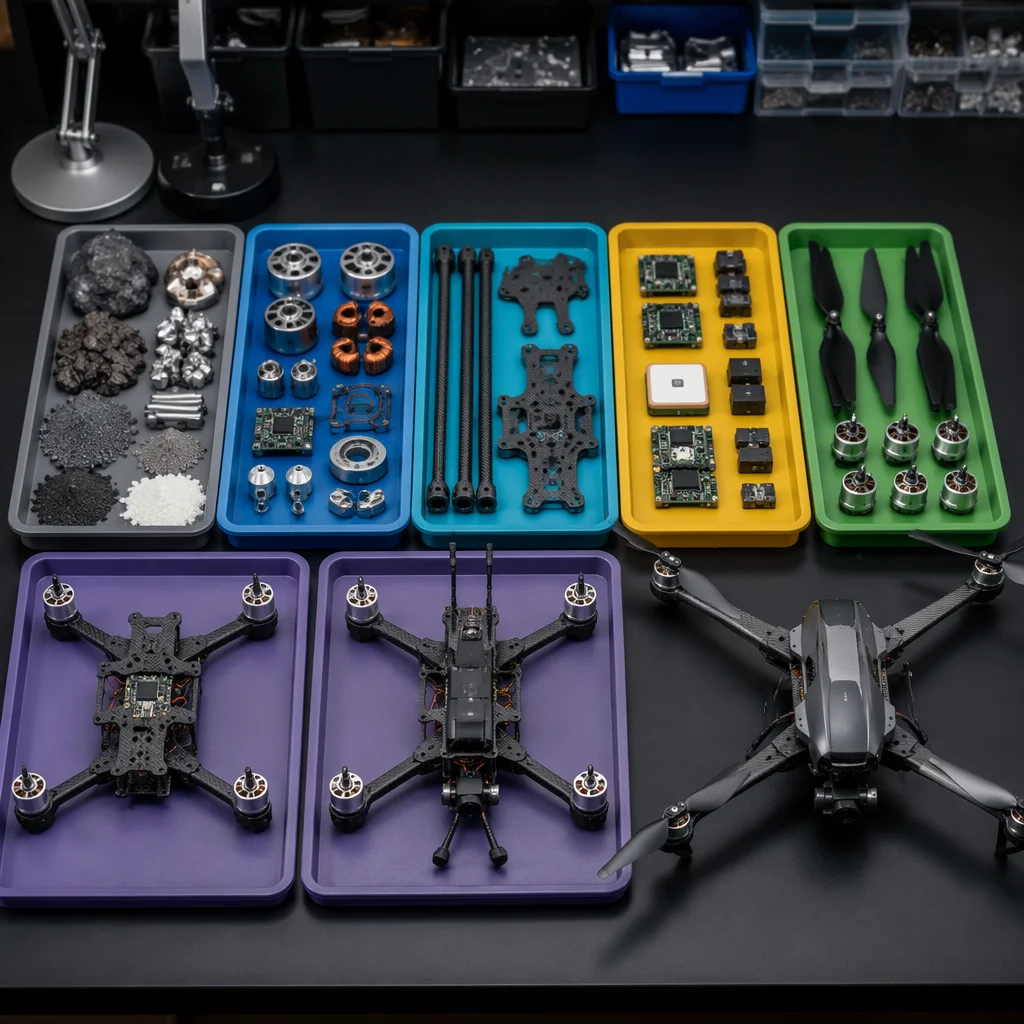
Teams often begin UAV sourcing with a familiar pattern: pick a flight controller, then an ESC, then motors, then a frame. That sequence can work for a known platform. For a new mission profile, it often hides the real risk, mismatched assumptions between layers.
Four layers, one interface map
A practical supply-chain view groups the aircraft into connected layers:
- Control . Sensing, computation, navigation and command generation
- Power . Energy storage, distribution and electronic speed control
- Motion . Motors, propellers and the mechanical structure that holds them
- Mission . Communications, payload interfaces and operating context
Each layer has its own options. The project risk lives in the connections: protocol, voltage, connector pinouts, firmware expectations, mounting geometry and thermal margins.
Why catalog thinking breaks builds
Catalog pages are useful for discovering part families. They are less useful for deciding whether those parts will behave as a system. A controller that looks ideal on paper can still force awkward ESC protocols, radio wiring or sensor placement. An airframe that fits the motors may leave no clean path for harnesses or payload mounts.
Interface-first planning does not require a finished specification. It only requires listing what is known, and what is still open, across layers before locking major parts.
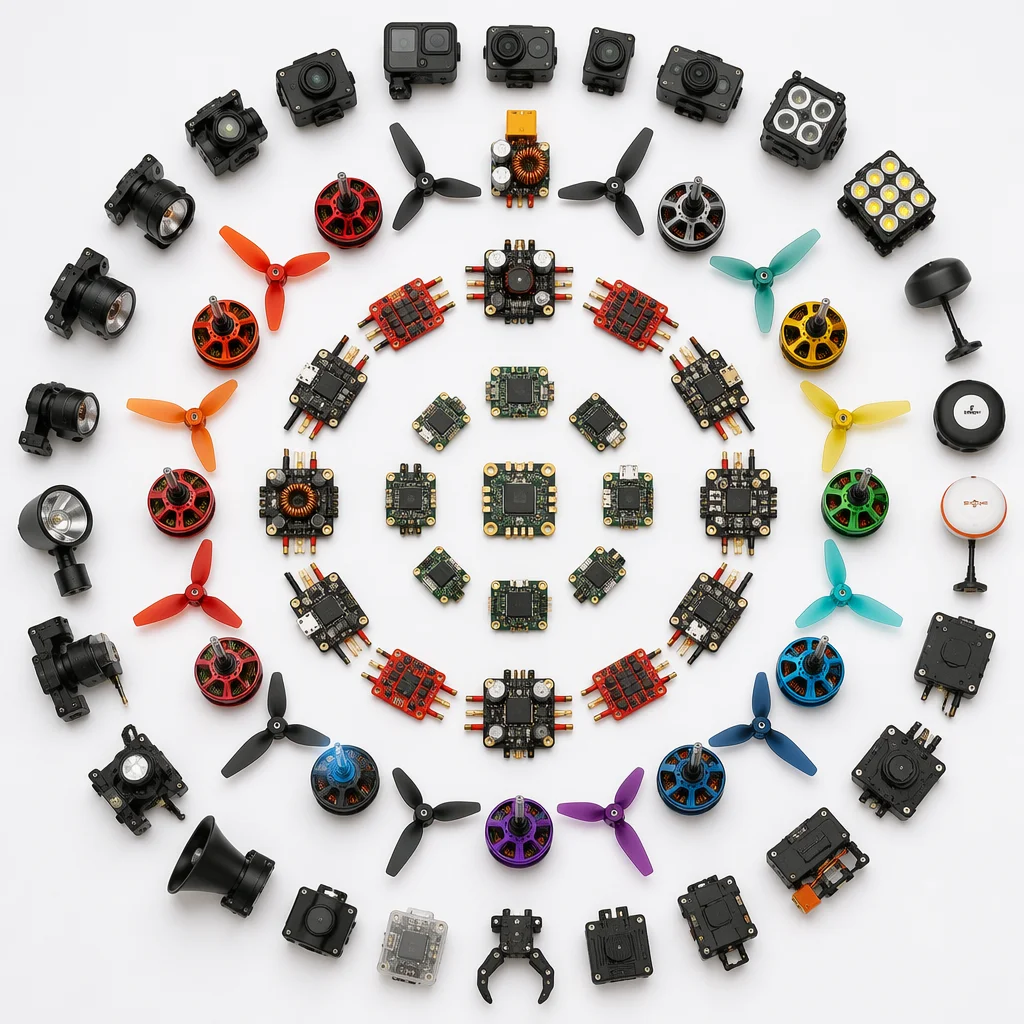 Concept illustration
A lightweight checklist before the BOM
- What mission and environment define success for this aircraft?
- Which layer is already constrained (payload, voltage, frame size, radio stack)?
- Which interfaces must be compatible on day one versus later?
- Are you sourcing a part, a matched stack or a complete platform?
Those answers change the sourcing conversation. A component RFQ, a subsystem configuration and a complete-aircraft brief ask different questions, even when they share the same component taxonomy.
Education, not a case study
This article is an industry primer on how supply-chain layers relate. It does not describe a customer deployment, capacity claim or certified production outcome. Exact options and ranges should be reviewed against your project brief.
What a layered supply chain actually costs to run
The layer model is an engineering abstraction until it meets a purchase order. What follows is the order of magnitude each layer contributes to a program's total cost, and which line most often breaks a budget that was built from component quotations alone:
| Cost element | Order of magnitude | What drives it |
|---|---|---|
| Airframe structure and mechanical | Largest single hardware line | Material choice and tooling: a carbon tube airframe is cheap per part and expensive to fixture, an aluminium frame is the reverse |
| Propulsion (motor, ESC, propeller) | Second hardware line, scaling with thrust class | Thrust target and duty cycle; the ESC current rating is usually over-specified because continuous and burst ratings are confused |
| Control and navigation | Moderate hardware, high engineering hours | Autopilot choice, redundancy requirement, and whether the firmware target already exists for your hardware combination |
| Communications and video | Low hardware, structurally underestimated integration | Whether you must reach a downstream viewer rather than the operator's handset, and whether more than one band is required |
| Interface engineering between layers | Recurring engineering hours, rarely quoted | Every layer boundary needs a specification, a bench test and a pass criterion. This is the line that vanishes from component-level quotes |
| Sustainment: spares, RMA, requalification | Recurring, scales with fleet and site count | Spares holding level, RMA turnaround commitment, and how often a firmware change forces re-validation of the layer interfaces |
The interface engineering line is the one most consistently missing from a bottom-up quotation. A parts list prices the four layers; it does not price the work of proving that the four layers agree with each other, and that work is where schedule slippage and field returns originate. When a supplier quotes a system price, ask which of the six lines above are inside the number.
Layer responsibility: who owns what at each interface
Cross-layer failures are rarely a single vendor's fault, which is exactly why the boundary has to be written down before award. The table below assigns the obligations that decide whether a multi-vendor build survives its first integration cycle:
| Activity | Supplier responsibility | Operator responsibility |
|---|---|---|
| Interface definition at each layer boundary | Publish the electrical, mechanical and protocol parameters of the parts supplied | Freeze and version the interface map before ordering long-lead items |
| Bench validation of a layer pair | Provide the test conditions under which the part's ratings were measured | Run the pair through the real operating envelope, not the datasheet envelope |
| Firmware and protocol compatibility | State the supported autopilot and protocol versions for each part | Re-run interface validation after every firmware change; a version bump is a configuration change, not a maintenance action |
| Thermal and current margin at the boundary | Quote continuous and burst ratings separately with duty-cycle conditions | Measure real current draw and temperature under the mission profile before committing to production quantities |
| Mechanical and vibration integration | Provide mounting dimensions, mass and centre of gravity of each part | Verify the assembly's modal behaviour and isolate sensors from the motor frequency band |
| Obsolescence and second sourcing | Give a lifecycle statement and form-fit-function alternatives | Hold a design freeze review with enough lead time to requalify a replacement |
The firmware row is the one buyers most often leave out. "Compatible" is not a property a part has; it is a property of a part plus a firmware version plus a configuration. Writing the re-validation obligation into the contract turns a vague promise into a measurable one.
Two reference builds: how the layers land in real hardware
Two platforms we build show what the layer model looks like when it becomes physical hardware, and why the interface discipline above is not academic:
- A heavy-lift multirotor built as an X8 coaxial octocopter with a 1,600 mm wheelbase, a 30 litre payload and a maximum take-off weight around 25 kg, delivering 12 to 15 minutes of active work per tank fill. For supply-chain planning the informative number is the wheelbase: coaxial propulsion over a 1,600 mm span buys the same disc area a flat octocopter would need more than 2,100 mm to produce, which changes what fits in a crate, what the shipping volume is, and which arm supplier can serve you. The configuration is documented in the heavy-lift reference architecture.
- A VTOL fixed-wing survey platform with 120 minutes of usable endurance carrying a 5 kg payload, a Hesai PandarXT LiDAR and a 42 MP camera, on an 888 Wh 6S8P pack. Its energy split (roughly 68 percent cruise propulsion, 22 percent payload, 7 percent avionics, 3 percent transition) is the clearest illustration that layers do not draw power evenly, so a power budget assembled per-layer and then summed will misprice the harness and the regulator. See the LiDAR mapping platform reference architecture.
Both platforms sit at the upper end of what a multi-vendor supply chain has to hold together: eight propulsion units, a control layer, a communications layer and a payload layer, every boundary of which is a place where a substitution can go wrong. That is the practical argument for treating the interface map as the primary procurement artifact and the bill of materials as its output.
What to put in the requirement document
A brief that produces comparable, testable quotations has to state conditions alongside figures. The clauses that carry the most weight in a component supply agreement:
- Interface map as a contract deliverable. Require a versioned document listing, for every boundary, the connector type, pinout, voltage band, protocol, and mounting interface.
- Ratings stated with conditions. Continuous and burst current, thermal limits and vibration exposure each quoted with the duty cycle and ambient they were measured at.
- Firmware compatibility matrix. Which autopilot releases support each part, and notice obligations before a part-level firmware change that breaks an interface.
- Re-validation trigger. A written list of changes (firmware major version, motor winding, propeller, airframe stiffness) that obliges both parties to re-run the interface test set.
- Lifecycle and second source. Lifecycle status per line item plus a form-fit-function alternative or a stated last-time-buy window.
- Sustainment terms. Spares holding level, RMA turnaround commitment, and the replacement part numbers covered by the commitment.
- Acceptance evidence. Which interface tests are witnessed, on what hardware, with what pass criteria recorded.
Where the Layers Meet
The seams between supply-chain layers are where most integration problems appear. A motor that is qualified in isolation may still fail when paired with an ESC that switches at a different frequency, and a battery pack that meets capacity specs on paper may sag under the transient load of a heavy-lift throttle change.
Mature distributors handle this by testing at the layer boundaries: motor-ESC pairs on a thrust stand, battery-ESC compatibility under simulated mission profiles, and airframe vibration isolation validated against the actual IMU mounting. Each boundary test catches a class of problems that component-level datasheets cannot reveal.
This is also where documentation pays off. Every layer handoff should specify not just part numbers but the interface parameters that matter, signal protocols, current ratings, mounting dimensions, and thermal limits. Teams that treat layer interfaces as first-class engineering artifacts consistently ship more reliable systems with fewer field returns.
Building the Integration Test Plan
A practical integration test plan starts with a matrix: every layer pair that will be connected in the field gets a test entry. Motor-ESC pairs run on a thrust stand through the full throttle envelope. Battery-ESC pairs run through a simulated mission profile that includes the peak-current segments. Airframe-IMU pairs are tested for vibration isolation across the motor frequency range.
Each test needs a clear pass criterion written before testing begins. For motor-ESC pairs, that might be temperature rise under a defined duty cycle. For battery-ESC, it is voltage sag at peak current. Writing the criterion first prevents the common failure mode of "testing" that is really just informal observation.
The payoff is predictable: teams with a documented integration test plan see fewer field returns, faster root-cause analysis, and higher customer confidence in the distributor's engineering capability. In the UAV component market, that confidence is what separates commodity resellers from trusted system partners.
Whether you are a distributor building inventory or an integrator building systems, the layer perspective keeps the whole picture in view. Define the interfaces, test the boundaries, and document every handoff. That discipline is what separates reliable UAV supply chains from fragile ones.
UAV supply chains that last are built on interface discipline and boundary testing, start there, and the rest follows.
Aligning procurement cadence across layers
UAV programs fail in the supply chain when each layer carries its own lead time and minimum order quantity. The controller, motor, frame, and battery vendors rarely ship on the same cycle, so a single missing component stalls the whole assembly. Practical mitigations include holding safety stock on long-lead items, vetting at least two sources per critical part, and consolidating purchase timing so that a frame order and a motor order land in the same window. Reviewing the BOM against supplier lead times before release prevents the most common program slippage.