
Procurement managers sourcing UAV components from China face a familiar challenge: the supplier landscape is deep, the price spread is wide, and the difference between a competent manufacturer and a parts trader is not visible from a quotation sheet. A flight controller that passes bench tests at the factory may behave differently after 50 flight hours in thermal stress. An ESC rated for 12S continuous may fail the fourth time it sees a 14S burst. These are not theoretical risks, they are the predictable outcomes of qualification gaps.
This checklist is built for procurement teams who need to move beyond price-per-unit comparisons. It structures supplier evaluation around seven dimensions, each with concrete verification steps. The goal is not to reject suppliers but to surface the information that lets you price risk correctly into a sourcing decision. A supplier who cannot provide batch-level test data for an 8 kHz IMU flight controller is not necessarily a bad supplier. But they are a different risk profile from one who ships every unit with a serialized vibration-immunity plot.
Understanding where a supplier sits in the broader UAV supply chain layers is a prerequisite. A Tier-1 manufacturer who owns SMT lines and runs in-house environmental testing operates under fundamentally different constraints than a trading company that aggregates components from multiple sub-suppliers. The checklist items below apply to both, but the pass thresholds should be calibrated accordingly.
Checklist Item 1: Verify certifications and compliance documentation
Start with the paperwork. Not because certificates guarantee quality, but because the absence of expected documentation reveals whether a supplier has ever been through a formal qualification process. The minimum baseline for UAV components entering North American or European markets is CE (EMC Directive 2014/30/EU), FCC Part 15 for intentional radiators, and RoHS compliance. For flight controllers, ESCs and power systems, ISO 9001 certification at the factory level indicates process maturity. But verify that the certificate covers the specific production line your components will run on, not a different division of the same corporate entity.
Ask for certificate numbers, not scanned images. Cross-check CE certificates against the EU NANDO database. Look up FCC grants on the FCC OET Equipment Authorization Search by applicant name or FCC ID. A supplier who provides a valid FCC ID that resolves to a real grant with the correct frequency bands and power levels has passed a non-trivial compliance gate. One who sends a generic CE mark JPEG without supporting documentation has not. If the component includes RF modules, telemetry radios, video transmitters, GNSS receivers, compliance documentation becomes doubly important because non-compliant RF emissions create liability for the integrator, not just the component supplier.
For propulsion components and power systems, request material certifications: motor winding temperature class (minimum Class H / 180°C for industrial UAVs), magnet grade and maximum operating temperature for rotor assemblies, and battery cell UL 1642 or IEC 62133 test reports. A supplier selling 100–600 KV motors for 6S–14S LiPo systems should be able to produce a test report showing winding insulation resistance after thermal cycling.
Checklist Item 2: Audit factory quality systems and production capability
If an on-site audit is not practical, and for many overseas procurement teams it is not, request a virtual factory tour with specific agenda items. Do not accept a polished 3-minute walkthrough video. Ask to see these areas live on a video call: the incoming QC station where PCBAs and raw materials are inspected, the SMT line if the supplier claims in-house assembly, the environmental test chamber where finished units are subjected to thermal cycling and vibration, and the shipping preparation area where units are packaged and labeled.
While observing, ask these specific questions: What sampling plan does incoming QC use, MIL-STD-1916, ANSI/ASQ Z1.4, or an internal standard? What is the first-pass yield on the SMT line for the component you are buying? How many units per batch go through full-functional test versus sample testing? A supplier building 8 kHz IMU flight controllers should be running each unit through a rate-table test that validates gyro and accelerometer noise density against the IMU datasheet, not just a power-on LED check.
For ESCs supporting CAN FD and DShot 1200 protocols, confirm that production testing includes protocol-level validation at maximum signaling rates with worst-case bus loading. An ESC that passes a 50 Hz PWM bench test may fail intermittently on CAN FD at 8 Mbps under electrical noise. The test regime should simulate real operating conditions, not ideal lab conditions.
 Concept illustration
Checklist Item 3: Test component-level performance against your specifications
Never rely solely on a supplier's datasheet. Request production samples, at least 5 units from different production batches, and run them through your own acceptance test procedure before committing to a purchase order. The test plan should be designed around the interface boundaries that matter most for your platform (see matching flight controllers and ESCs for context on why protocol-level compatibility testing is critical).
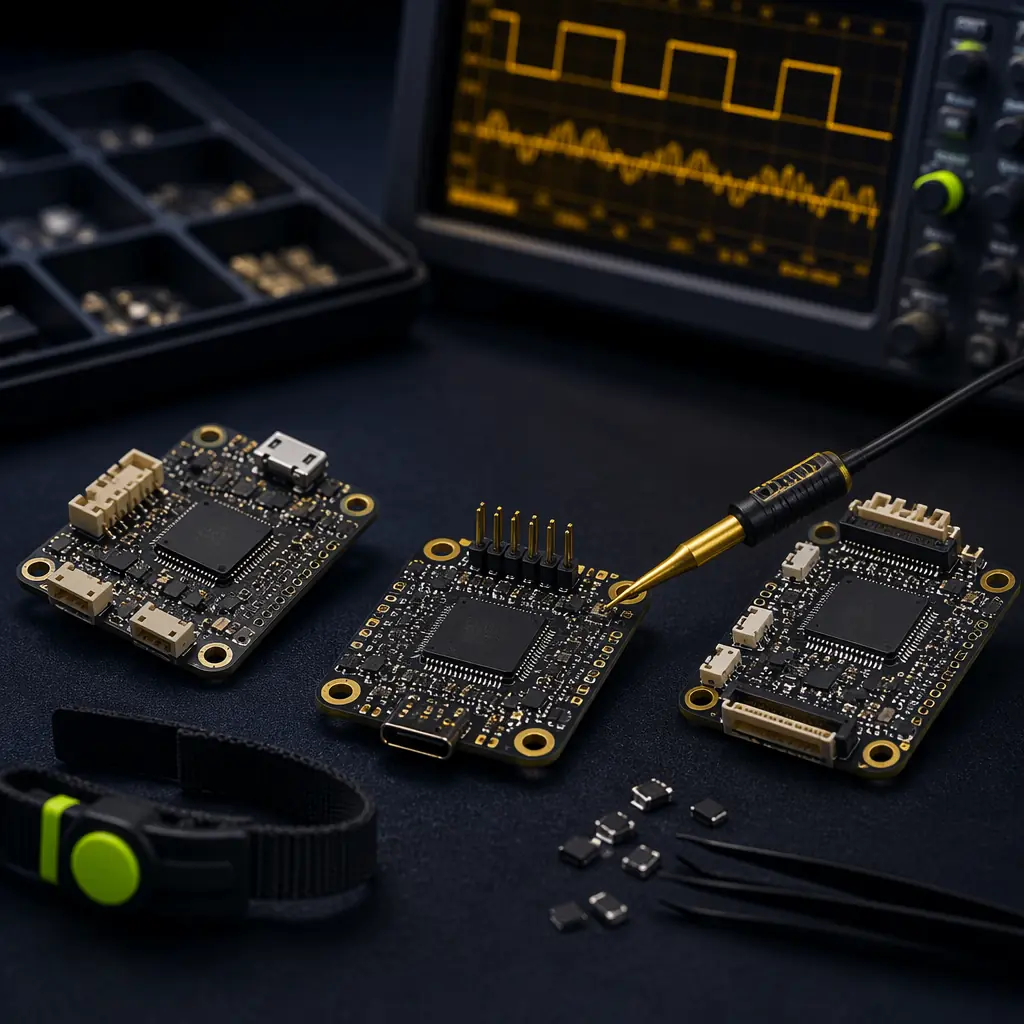
For flight controllers: validate IMU noise density (the 8 kHz update rate is meaningless if the gyro noise floor is 0.15 dps/√Hz instead of the claimed 0.05), barometer drift over a 30-minute thermal soak at 55°C, and PWM output jitter at all channels under full CPU load. For ESCs: measure voltage ripple at the DC link under rapid throttle transients, confirm that the claimed continuous current rating holds for 10 minutes at 45°C ambient without thermal throttling, and verify that DShot 1200 telemetry packets arrive without CRC errors across the full throttle range.
For motors: run a full dynamometer sweep from 30% to 100% throttle with your actual propeller load and compare the efficiency curve against the supplier's data. A motor that meets its KV spec but drops 8% below the claimed efficiency at 70% throttle will burn through your weight budget in battery capacity. For airframes and structural components, the material verification approach covered in the airframe materials guide is directly applicable: pull a sample coupon and verify the claimed carbon fiber layup schedule or aluminum alloy grade.
 Concept illustration
Checklist Item 4: Assess IP protection and supply chain transparency
Intellectual property exposure is one of the most under-assessed risks in cross-border UAV sourcing. The question is not whether a supplier will copy your design, a competent supplier has no need to, but whether your proprietary modifications, calibration data and integration IP are structurally protected. Ask: does the supplier serve competitors whose product lines overlap with yours? Does the supplier have a documented process for segregating customer-specific firmware, test procedures and BOM variants?
Request a written IP handling policy. It does not need to be a 40-page legal document. A one-page statement covering data isolation, employee NDAs tied to specific customer programs, and a commitment to not reuse customer-supplied tooling or firmware for other clients is a meaningful signal. A supplier who cannot articulate how they handle IP segregation is likely treating all customer IP as a shared production resource.
Supply chain transparency matters for the same reason. Ask for a tiered BOM disclosure: which components are manufactured in-house, which are sourced from named sub-suppliers, and which are commodity parts sourced from distribution. A flight controller supplier who designs the PCB, writes the firmware and runs final assembly but sources IMUs from Bosch Sensortec or TDK InvenSense through authorized distribution is transparent. One who claims "in-house manufacturing" for everything but cannot name their IMU source channel is hiding a supply-chain risk you will discover only when a component goes end-of-life. The build vs buy sourcing framework provides additional decision criteria for evaluating make-versus-buy trade-offs at the subsystem level.
Checklist Item 5: Evaluate MOQ flexibility and lead time reliability
Minimum order quantities and lead times are not static contract terms, they are signals about a supplier's production model. A supplier quoting MOQ of 10 units with 2-week lead time on a custom-configured flight controller is running flexible batch production, likely with in-house SMT. A supplier quoting MOQ of 500 units with 8-week lead time on the same spec is aggregating orders to fill a production slot at a contract manufacturer. Neither is inherently worse, but they serve different procurement profiles.
Test lead time reliability by placing a small trial order, 20 to 50 units of a standard configuration, and measuring the actual delivery date against the promised date. A supplier who ships on day 14 of a "10 to 14 day" window has a controlled production process. One who ships on day 28 after three status-update emails does not, regardless of what the quotation said. This trial order also validates packaging quality, customs documentation accuracy, and the supplier's logistics partner reliability. All of which matter more at scale than they do on a single small order.
For MOQ evaluation, separate the technical MOQ from the commercial MOQ. The technical MOQ is the minimum batch that makes production sense given setup costs and process constraints. The commercial MOQ is the minimum that makes the relationship worth the supplier's sales overhead. Understanding which one you are negotiating against lets you structure orders that work for both sides: for example, agreeing to a 100-unit commercial MOQ spread across three SKUs rather than a single 100-unit SKU at a technical MOQ of 30.
Checklist Item 6: Rate engineering support quality and responsiveness
A supplier who treats the sale as the end of the relationship is a liability for any program that involves integration engineering. UAV components do not work in isolation. Flight controllers must interface with ESCs, ESCs must match motor impedance, and the entire stack must behave predictably across voltage sag, temperature drift and RF interference. When integration issues arise, and they will, the supplier's engineering response determines whether the issue is resolved in days or becomes a program delay measured in weeks.
Before placing an order, send three technical questions to the supplier's engineering contact, not sales, and measure the response. Good questions: "What is the gyro noise density at 25°C and 55°C for your 8 kHz IMU flight controller?" or "Can you provide the CAN FD bus timing parameters for your ESC when operating at 5 Mbps with 15 nodes?" A supplier whose engineering team answers with specific values within 48 hours has the technical depth to support integration. One whose sales team replies with a brochure link does not.
Also evaluate documentation quality. A proper datasheet includes: pinout diagrams with signal direction and voltage levels, timing diagrams for communication protocols, thermal derating curves for power components, mechanical drawings with tolerances and mounting specifications, and a known-issues or errata document. A supplier who ships a component with a one-page PDF that lists dimensions and voltage range is treating documentation as marketing collateral. For powertrain components in particular, the matching approach described in the UAV powertrain matching guide depends on having accurate motor constants, ESC timing data and voltage sag curves. None of which can be inferred from a marketing sheet.
Checklist Item 7: Check export compliance and documentation readiness
UAV components sit at the intersection of multiple export control regimes. Flight controllers with navigation-grade IMUs, long-range telemetry radios, and gimbal-stabilized payloads can trigger ITAR or dual-use export controls depending on performance characteristics and destination country. A supplier who has never shipped to your jurisdiction may not understand which documentation your customs authority requires. And discovering this at the port of entry is expensive.
Verify that the supplier can provide: HS codes at the 6-digit level minimum (preferably 8-digit), a commercial invoice formatted to your country's customs requirements, a packing list with net and gross weights per carton, and a certificate of origin if your trade agreement requires preferential tariff treatment. For components containing lithium batteries, confirm UN38.3 test summary availability and that the supplier understands your carrier's dangerous goods declaration requirements before the first shipment.
For programs targeting the low-altitude economy in specific regions, the regulatory landscape is evolving rapidly. A component that ships freely today may require additional documentation six months from now. Choose suppliers who demonstrate awareness of this trajectory, not necessarily compliance with every future regulation, but an organizational capability to adapt documentation and testing as requirements shift.
Putting the checklist into practice: scoring and decision thresholds
Not every checklist item carries equal weight. For a prototype-phase program with engineering staff on hand, Checklist Item 6 (engineering support) matters more than Checklist Item 5 (MOQ flexibility). For a production-scale program with tight margins, the reverse is true. We recommend scoring each supplier on all seven dimensions using a simple 1–3 scale, 1 for "evidence absent or inadequate," 2 for "evidence present but incomplete," 3 for "evidence strong and verified", then weighting the scores according to your program's phase.
A total weighted score below 14 out of 21 should trigger a deeper investigation or a decision to walk away, regardless of price. The suppliers who score 18 or above on this checklist are the ones worth building long-term relationships with, relationships where engineering collaboration, forecast sharing and joint roadmap planning become possible. The cost of qualifying a supplier properly, once, is almost always less than the cost of discovering a qualification gap through field failures.
Checklist item 8: score the cost of ownership, not the unit price.
The seven items above test whether a supplier can build the part. They do not test whether the part is cheap to own, and on a commercial fleet the second question usually decides the outcome. Unit price is roughly a third of what a component costs across a five-year programme; the rest is spares provisioning, repair turnaround, the engineering time to integrate a replacement and the schedule risk carried while a unit is away. The scoring table below converts that into the same 1 to 3 scale used for the other seven items, so the total out of 24 is comparable rather than a separate judgement.
| Ownership cost line | Typical share of 5-year cost | What a score of 3 requires | What a score of 1 looks like |
|---|---|---|---|
| Unit price | 30 to 40 percent | Quoted per line with quantity breaks and tooling shown separately | One bundled number that cannot be compared line by line |
| Spares provisioning | 10 to 15 percent | Recommended spares kit with a stated MTBF basis and a spares holding recommendation | No failure-rate data, so the fleet carries either too much or too little |
| Repair and RMA cycle | 10 to 20 percent | Turnaround committed in business days with freight allocation per direction | Open-ended repair queue, freight decided case by case |
| Engineering integration time | 10 to 15 percent | Integration drawing, connector pinout, protocol documentation and calibration procedure supplied | Documentation requested after the order, integration learned by trial |
| Firmware and configuration control | 5 to 10 percent | Version lock available, change notification with release notes, replacements ship on the configured build | Silent version drift between production runs |
| Schedule risk while a unit is away | 10 to 15 percent | Advanced replacement option, or a spare held locally against a defined trigger | Every failure is a project stoppage |
| End-of-life and last-time buy | 5 percent | Written obsolescence notice period, typically 12 months, with a last-time-buy window | A parts shortage discovered during a build |
Scoring this line changes decisions more often than the other seven because it prices the things that are invisible in a quotation. Two suppliers can differ by 15 percent on unit price and invert the ranking once the spares basis and repair turnaround are counted. The judgement to make is whether the supplier can put numbers on those rows at all: a supplier who can quote a failure rate, a repair turnaround and an obsolescence notice has already done the reliability work, and one who cannot is asking to be trusted on price alone.
What the scoring looks like against two real reference builds.
A scorecard is only useful if the evidence behind a high score can be named. The two reference architectures on this site are documented at component level, and both can be read as evidence of what supplier selection actually decides. They are not customer testimonials; they are engineering references, which makes them a fair test of the checklist because every claim in them can be checked against a specification.
Heavy-lift agricultural spraying platform. An X8 coaxial octocopter with a 1600 mm wheelbase, a 30 L liquid payload and a maximum take-off weight of about 25 kg, flying 12 to 15 minutes of active spray time per tank. Publishing a 12 to 15 minute figure rather than a peak number is itself a selection signal: the platform is specified on the endurance it holds across a full tank, so tank fill time, battery swap and the return leg are part of the same arithmetic. A supplier who answers item 3 with a bench specification instead of a system figure is answering a different question. The propulsion candidate question in that build, whether a coaxial pair needs matched ESCs or one higher-rated unit, is decided at specification time and not at integration. Read the heavy-lift platform reference.
LiDAR mapping and survey platform. A VTOL fixed-wing aircraft with a target endurance of 120 minutes and a 5 kg payload, cruising at 16 to 18 m/s on corridor mapping at 100 to 120 m AGL. Its supply chain is a chain of dependencies rather than a list of parts: the payload interface determines whether the scanner and the RGB camera share a stable mount, the power architecture determines whether the payload has the current margin it needs, and the vibration environment determines whether the point cloud is usable at all. That is the case where item 6, engineering support, carries the most weight, because a supplier who can discuss the interaction between those three is worth more than a cheaper one who supplies the parts and stops there. Read the mapping platform reference.
Both builds point to the same conclusion: the items that separate a good supplier from an acceptable one are the ones that show up after the purchase order, in documentation, configuration control and repair turnaround. Evaluating those before the order is the whole purpose of the scorecard. The engagement sequence describes where each of these checks lands in a programme, and the design guide input standards show what a supplier needs from you before it can answer item 3 properly.
Weighting the eight items by programme phase.
An unweighted total treats a prototype programme and a production line as the same purchase, which they are not. On a one-off research platform the cost of a wrong supplier choice is schedule; on a production programme it is a recall. The weighting below keeps the same evidence standard but changes which items dominate, and it is the version we recommend when the scorecard is used for an actual award decision rather than as a general audit.
| Programme phase | Items that dominate | Items that can be deferred | Why |
|---|---|---|---|
| Prototype or research build | 3 performance, 6 engineering support, 5 MOQ flexibility | 2 factory audit, 8 cost of ownership | Integration advice matters more than unit economics at single-unit volume |
| Low-rate initial production | 2 quality systems, 3 performance, 7 export compliance | 5 MOQ flexibility | Repeatability is the new risk once the design is frozen |
| Full production | 2 quality systems, 8 cost of ownership, 1 certifications | 6 engineering support | Cost of ownership and process control decide fleet economics |
| Regulated or defence-adjacent | 1 certifications, 7 export compliance, 4 IP and transparency | 5 MOQ flexibility | Documentation and origin requirements are pass or fail, not scored |
| Sustainment and spares | 8 cost of ownership, 2 quality systems | 3 performance | The design is set; what remains is how cheaply it stays in service |
One rule should survive every weighting: a score of 1 on certifications or on export compliance is a fail regardless of the total. Those two items are not tradeable against performance or price, because a component that cannot be documented or legally shipped has no value no matter how well it performs on a bench. Everything else can be traded. The technical evidence behind the performance item is set out in the environmental qualification testing guide, and the workmanship standard behind the quality systems item is covered in the IPC-A-610 and J-STD-001 guide.
Four things we will not claim in a supplier evaluation.
A checklist is only as good as the honesty of the answering side. These are the four questions where we give a qualified answer rather than a favourable one, and a buyer should expect the same from any supplier it shortlists.
- We will not quote a single MTBF figure across a product family. Failure rates differ by configuration, environment and duty cycle, and a family-wide number is either conservative to the point of being useless or optimistic enough to mislead spares planning. We quote per configuration with the test basis stated.
- We will not promise identical lead times in every quarter. Allocation on specific semiconductors moves, and a supplier quoting a flat lead time through a component shortage is either holding stock it has not disclosed or is not checking. We quote current allocation and state when it was last verified.
- We will not claim military programme experience we do not have. ITAR-registered work is a specific capability with specific documentation, and claiming adjacency to it is the fastest way to fail a real audit.
- We will not treat a custom configuration as a catalogue part with a different label. A modified build gets its own verification plan, its own acceptance criteria and its own documentation set, and that is priced into the quotation rather than discovered later.
These four answers are also the reason the scoring works: a supplier that refuses to give a convenient number is usually the one that can produce the inconvenient record when it matters. The quality and certification scope we work within is published, and the custom engineering terms describe how a modified build is scoped and verified.
Six questions to ask before the award, not after.
- What is your documented failure rate for this exact configuration, and over what population? A number without a population is a marketing claim. Ask for the denominator, the operating hours behind it and the date of the last update; a supplier who tracks this can answer in a minute, and one who does not will offer a general reliability statement instead.
- Which specification governs acceptance, and who signs the test record? The purchase order should name the standard and the record format. Our position is that every serial leaves with a functional test record on a named firmware build, and the testing and validation scope describes the stages that record comes from.
- What happens, in days and in cost, if a unit fails in month three? The useful answer names a turnaround in business days, an RMA trigger and a freight allocation. An answer that only says the unit is covered has not engaged with the question, and the warranty and RMA guide sets out the clauses to ask for.
- How much advance notice do we get before a part goes end of life? Twelve months is a workable baseline with a last-time-buy window; six months is a redesign on someone else's schedule. The obsolescence management guide covers what a lifetime buy actually protects.
- Who is our named engineering contact, and what is the response time? Not a support address, a person. The second week of an open issue is decided by whether anyone is accountable for it.
- Can you show the documentation set before we order? Integration drawing, connector pinout, protocol reference, calibration procedure, firmware release notes. If the documentation exists it can be shared; if it does not exist yet, that is a finding, not a scheduling detail. Our design guide input standards describe the counterpart on the customer side.
Asking these six before the award takes about an hour and replaces most of the guesswork in the scorecard. The evidence that comes back either exists or it does not, which is why this list is a better predictor of supply performance than any presentation. When the answers are in hand, the quotation request can be written against them so the terms are part of the bid rather than a separate negotiation.
Review our certifications & quality systems Back to Blog
EMS Drone manufactures our manufacturing capabilities under one roof, from component sourcing through production test. If you are specifying for a build, see the full capability set and the tolerances we hold.