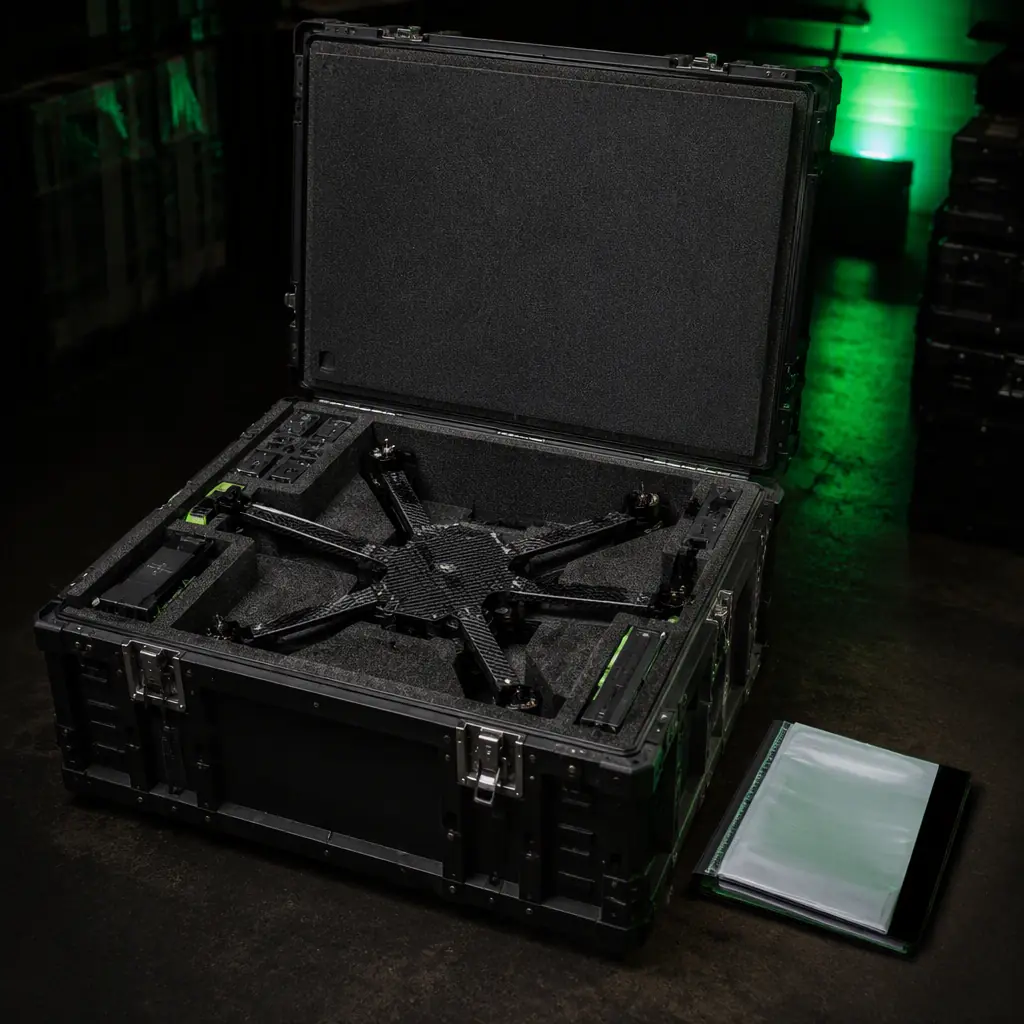
The first thing to understand about exporting UAV components is that the rules follow the item, not the shipper. A flight controller manufactured in Shenzhen and shipped to a buyer in Germany is subject to the export controls of the country of origin, the import controls of the destination country, and — because so much UAV electronics originates from or contains U.S.-origin components — the U.S. export control regime that applies to those components wherever they travel. The UAV supply chain layers guide maps where components come from in a typical build; the export question is which of those layers carries a control obligation, because the answer determines the documentation that has to travel with the shipment.
Export logistics is a specification problem, not a freight problem
Treating export logistics as "call a freight forwarder" is the most common procurement mistake in international UAV programs. Freight forwarders move goods; they do not decide what your goods are for control purposes. Three specification decisions made during component selection determine the export outcome, and each must be made at the engineering level:
The control status of each component. Whether a flight controller, radio or gimbal sits on an export control list decides whether it ships with a simple commercial invoice or with a license or exemption statement. This is a per-component attribute, and it must be collected from the supplier as a data point — not assumed from the product category.
The battery configuration. Whether the shipment includes loose cells, a battery pack, or batteries installed in equipment changes the dangerous-goods classification, the packaging, and the freight options. A UAV with an installed 6S LiPo battery ships under a different rule than the same battery in a separate carton.
The destination and end-use statement. The same component can be exported freely to one country and require authorization for another, depending on the destination, the end user and the end use. The buyer's operating country and mission profile are therefore part of the export specification, not a commercial detail.
These three decisions cascade into the documentation set described below. The engineering consequence: export readiness is a design input, and the component build vs buy decision should include the cost and lead time of export documentation for each sourcing option.
 Concept illustration
ITAR and EAR: locating your components on the control map
The U.S. regime is the most consequential for UAV programs because it follows U.S.-origin items and U.S.-origin content wherever they are incorporated. Two regulations divide the map: the International Traffic in Arms Regulations (ITAR), administered under the U.S. Munitions List (USML), and the Export Administration Regulations (EAR), administered through the Commerce Control List (CCL). The boundary between them matters because ITAR-controlled items require authorization for almost any non-U.S. destination, while EAR-controlled items are mostly eligible for export under license exceptions or no license at all.
Where UAV hardware sits. Manned and unmanned aircraft and their specially designed components are described in USML Category VIII; UAVs that meet the military definition also appear in Category VIII, while certain drones and drone components fall under EAR — notably ECCN 9A610 and 9A612 for "600-series" items (defense articles that migrated from the USML to the CCL in 2020), and ECCN 9A012/9B012/9D012 for civil and dual-use UAVs and related software and technology. A civilian inspection UAV with a commercial flight controller is usually EAR 9A012-classified; the same airframe with a military-rated autopilot and encrypted data link can be 9A610 or ITAR-controlled. The defense and security components guide covers the hardware features — encryption, anti-jam, military-rated ruggedization — that push a component across this boundary.
The de minimis rule. A component manufactured outside the U.S. can still be caught by the EAR if it contains more than the de minimis threshold of U.S.-origin controlled content (10% for 600-series items, 25% for most others). This is why the supplier's declaration of component origin — and the origin of the ICs inside a flight controller — matters: a "made in China" label does not by itself clear an item from U.S. jurisdiction. The certification and compliance guide covers the per-component evidence (CE, FCC, RoHS, REACH) that buyers usually collect; the export control status is a separate declaration that the supplier should provide in the same documentation package.
The practical takeaway for procurement: for every controlled item in the BOM, the buyer should request the supplier's export control classification — the USML category or ECCN — in writing, and verify that the classification matches the item's features. An incorrect classification discovered at customs is a hold, a fine, or a seized shipment; a correct one is a line on a document.
HS classification and customs valuation: the numbers that set your duty
While export controls answer "may this item be shipped?", the Harmonized System answers "what duty and what statistics apply?" The HS code is a 6-digit international commodity code (extended to 8-10 digits by national tariffs) that customs uses to classify every import. For UAV components the relevant chapters are mostly Chapter 85 (electrical machinery: flight controllers, ESCs, radios, cameras) and Chapter 88 (aircraft and spacecraft, which includes complete UAVs in heading 8806 since 2022). The classification subtleties that actually change duty:
Complete UAVs versus components. A complete drone under HS 8806 typically attracts a different (often lower) duty rate than its components shipped separately under 85xx — but the export control treatment of the complete article is the sum of its parts. Buyers sometimes discover that shipping a "disassembled" aircraft as parts changes both the duty and the license picture; the reverse — shipping a complete aircraft to simplify HS classification — can trigger a different control status. The decision belongs in the export specification, documented before the purchase order.
Valuation. Duty is computed on the customs value: transaction price plus insurance and freight (CIF) in many regimes, or the ex-works price plus freight (FOB) in others. Under-valuing to reduce duty is the fastest way to trigger a customs audit; the safe practice is to declare the true transaction value and keep the commercial invoice consistent with the payment records.
Where the buyer's own country adds layers. Beyond duty, most countries add import VAT or GST, and some add UAV-specific registration or import-permit requirements — the Remote ID and BVLOS compliance guide documents the operating-side regulations that frequently interact with customs clearance, since some authorities require proof of type approval before releasing UAV shipments.
The procurement action: request the supplier's HS code per line item, have a freight forwarder or customs broker confirm classification for the destination country, and record the code on the commercial invoice. Classification errors are the single largest source of customs delays in component shipments — not value disputes.
Lithium batteries: the dangerous-goods layer every UAV shipment carries
Almost every UAV shipment contains lithium batteries, and that makes almost every UAV shipment a dangerous-goods (DG) shipment. The governing framework for air freight is the IATA Dangerous Goods Regulations, which implements the ICAO Technical Instructions; the numbers that matter:
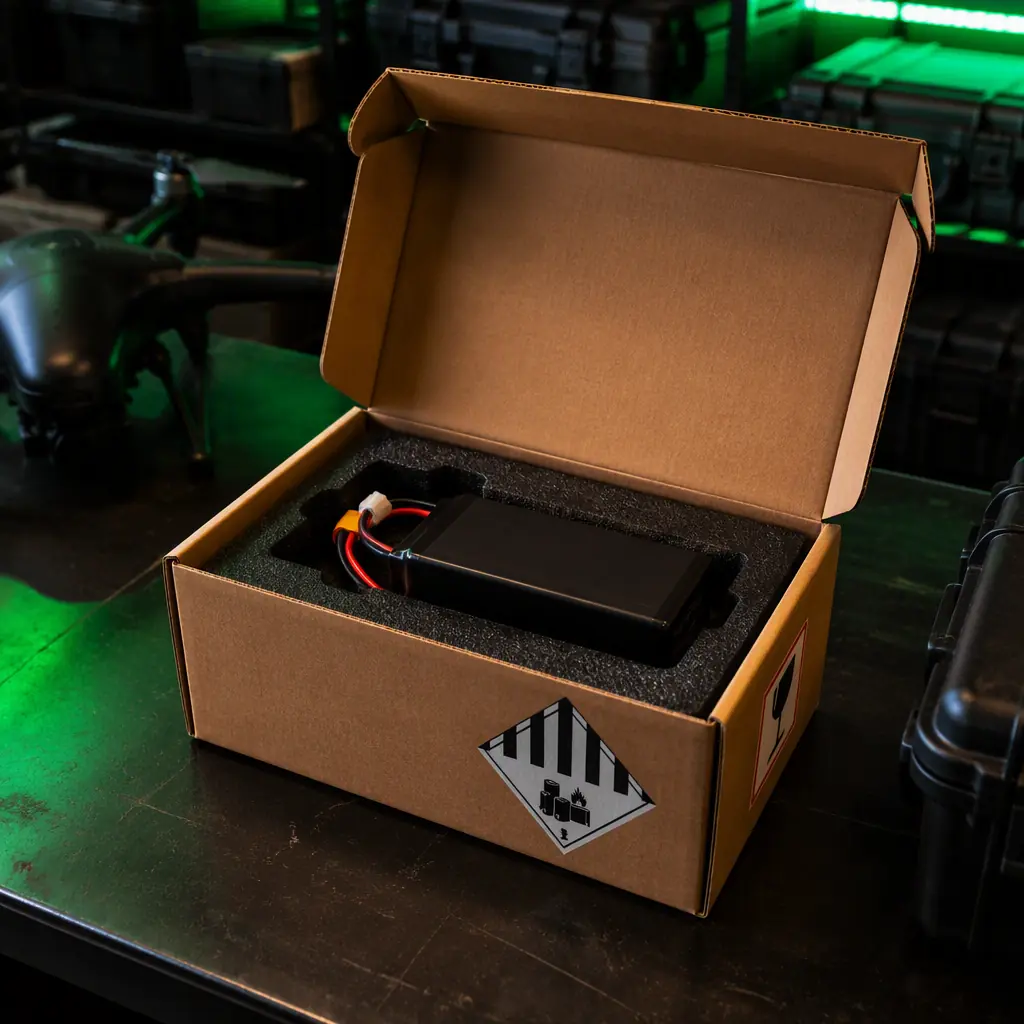
UN numbers. Lithium-ion cells and packs ship under UN 3480 (batteries alone), UN 3481 (batteries packed with equipment, or contained in equipment), and the lithium-metal equivalents UN 3090/3091. A UAV with the battery installed ships as UN 3481 "contained in equipment" — a different (simpler) set of rules than the same pack in a separate carton (UN 3480, which requires a Class 9 label and a more rigorous package test).
State of charge. IATA restricts lithium-ion cells and packs shipped by air to 30% state of charge (SOC), with exceptions for small cells and for batteries required to operate equipment. A 6S LiPo pack air-shipped at full charge is non-compliant; the DG-compliant workflow is to discharge to ≤30% before packing. This is a specification point that belongs in the component datasheet conversation, because it affects how the supplier packs, and whether the battery ships with the aircraft or as a separate consignment.
What the supplier must provide. For every battery in the BOM the buyer should receive: the UN number and transport classification, the battery's watt-hour rating (the UAV battery and power management guide explains how pack capacity maps to Wh), the SOC at shipment, the DG shipper's declaration (for UN 3480), and the package test report if the pack ships in a standalone carton. The thermal management guide is the engineering companion here: batteries that fail thermal runaway tests are not only a safety risk, they are a shipping classification risk, because the UN 38.3 test summary travels with the consignment and customs and airlines do check it.
 Concept illustration
The export documentation set: nine documents that clear customs
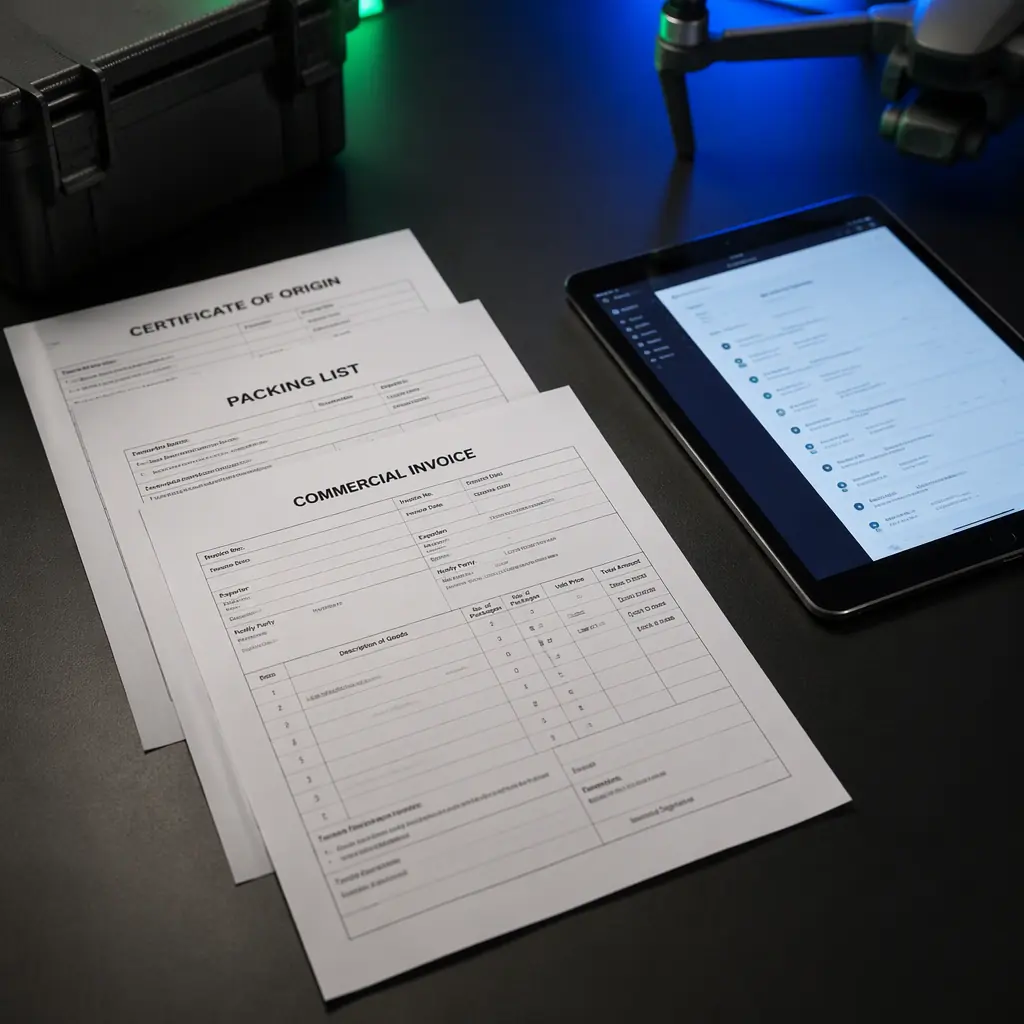
A UAV consignment typically clears customs on the strength of a documentation set, and the set is the same whether the shipment is one development kit or a hundred units. The nine documents:
1. Commercial invoice. The transaction record: seller, buyer, line items, HS codes, unit values, total value, Incoterm, currency. Customs compares it against the payment trail, so it must match the actual transaction.
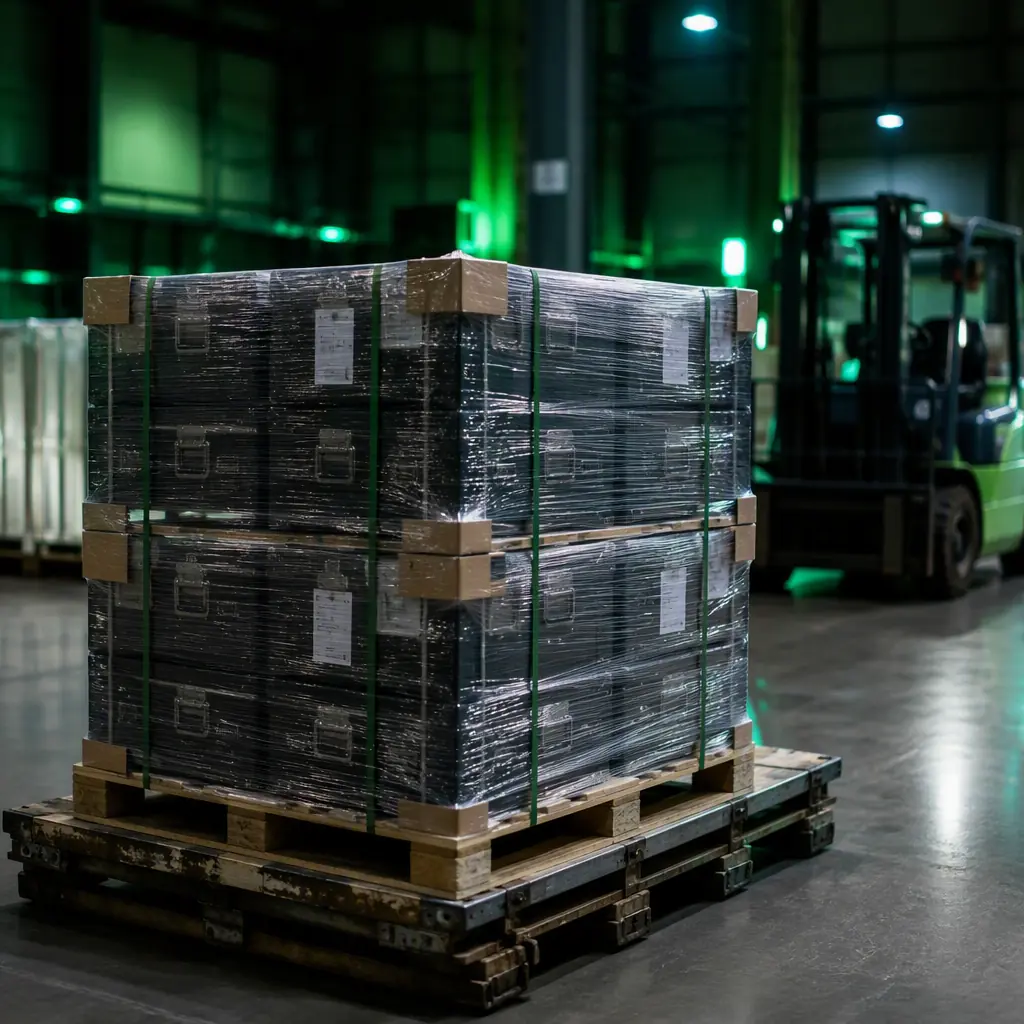
2. Packing list. What is in each carton, with weights and dimensions. For UAV shipments it should name the battery content per carton, because that is what airline screening and customs both check.
3. Certificate of origin. Establishes the country of origin for duty preference programs. The supplier's COO covers the components; the buyer's program may also need a COO for the assembled aircraft.
4. Export license or license exemption statement. For controlled items: the license number, or the EAR/ITAR exemption or NLR (no license required) statement that authorizes the shipment. This is the document that the supplier evaluation checklist should require from any vendor of controlled components — the supplier must be able to provide it, not just claim it.
5. UN 38.3 test summary and DG documentation. For batteries: the test summary, the shipper's declaration for standalone packs, and the SOC statement.
6. Air waybill / bill of lading. The transport contract, issued by the carrier or forwarder, referencing the other documents.
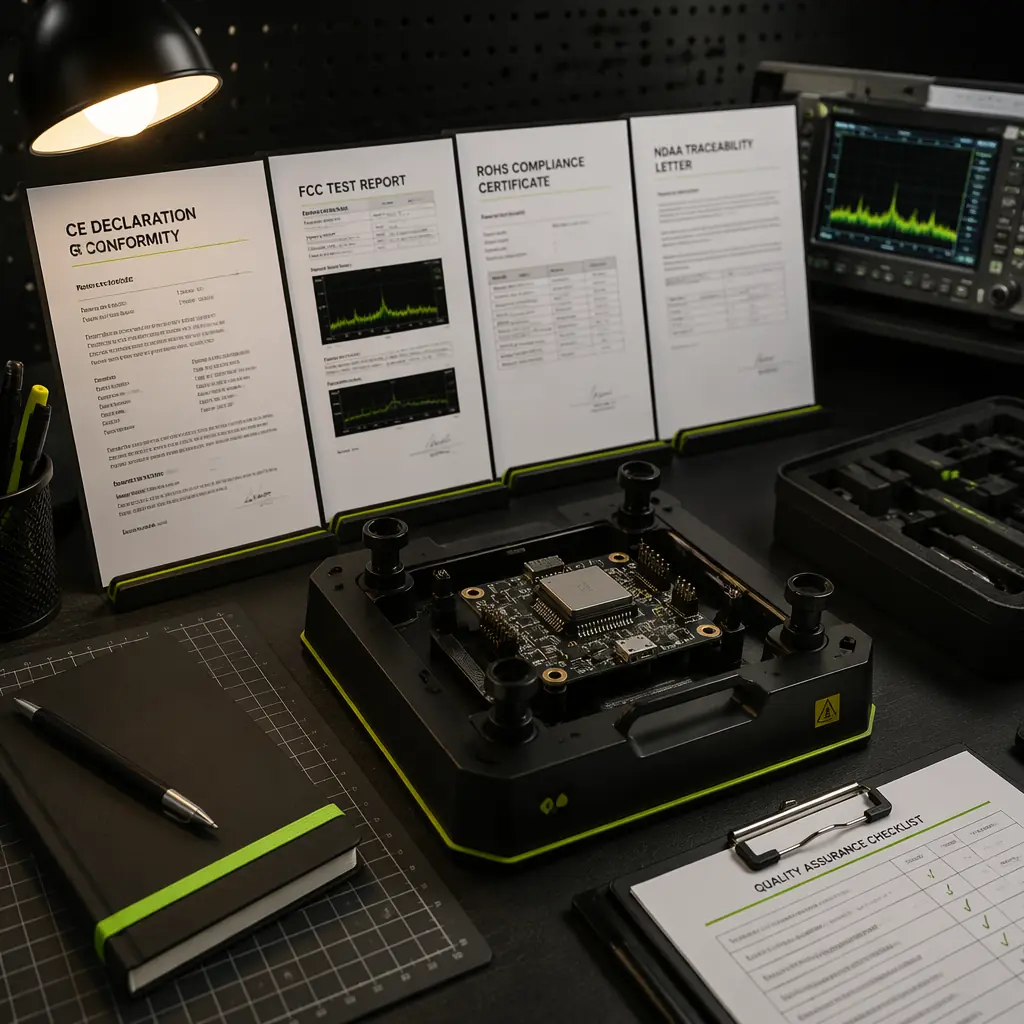
7. Certificate of conformity. For many destinations, proof that the equipment meets local technical regulations — the CE/FCC/RoHS evidence covered in the certification guide is frequently required at import even when the buyer's own certification program covers it downstream.
8. End-user or end-use statement. Required by some export-control regimes for controlled items: who the ultimate consignee is and what the equipment will be used for.
9. Insurance certificate. Cargo insurance evidence when the Incoterm places insurance on the seller or buyer side.
Nine documents sounds heavy; in practice, for an EAR 9A012-classified inspection UAV, the set is the invoice, packing list, COO, NLR statement, battery DG pack and air waybill — the rest appear only when the item is controlled or the destination requires them. The discipline is to know which of the nine apply before the shipment is booked, because every missing document is measured in days of customs hold time.
 Concept illustration
Incoterms and freight: assigning risk and cost at each border
Incoterms 2020 define who arranges and pays for each leg of transport, who clears export and import, and where risk transfers. For UAV component procurement, three terms cover most scenarios:
EXW (Ex Works). The buyer arranges everything from the supplier's door. Maximum control, maximum burden: the buyer's forwarder handles export clearance, DG booking and the documentation set. EXW is common for development quantities but exposes the buyer to every delay in the supplier's process.
FOB (Free on Board). The supplier delivers the goods to the vessel or aircraft at the origin port and clears export; risk transfers at loading. The buyer owns the main carriage and import clearance. FOB is the standard for air freight from Asian manufacturing hubs because the supplier handles export-side DG and documentation where it is most likely to go wrong.
DDP (Delivered Duty Paid). The supplier delivers the goods cleared for import, duty and VAT paid, to the buyer's door. Minimal buyer burden, maximum supplier responsibility — and the supplier must therefore be export-competent in the buyer's destination country, which not all component vendors are.
The selection rule for UAV programs: choose the Incoterm that puts the export-side DG and documentation in the hands of the party best equipped to do them. For battery-carrying shipments from Asia, FOB or DDP with a DG-competent supplier beats EXW with a buyer who has never booked lithium cargo — and the freight cost difference between DG-compliant air freight and non-DG alternatives is small compared to the cost of one customs rejection.
Qualifying a supplier for export readiness
Export readiness is a supplier attribute, and it should be scored in the same evaluation as price and lead time. The qualification questions:
Can the supplier state the export control classification of every component they sell? A vendor that cannot produce an ECCN or USML category for a flight controller cannot support an export program — the classification will be discovered, expensively, at customs.
Does the supplier ship lithium batteries compliantly? Ask for the UN 38.3 test summary, the DG shipper's declaration format, and their SOC-at-shipment policy. The supplier evaluation checklist formalizes this as a scoring line item, because battery handling is the most common single cause of UAV shipment holds.
Does the supplier document origin and traceability? COO, component origin declarations, and the IC-level origin data that the de minimis analysis needs. The obsolescence management guide covers the parallel requirement — the component-level lifecycle data that the same suppliers must maintain — and the two documentation streams (origin and lifecycle) usually come from the same quality system.
Does the supplier's quality system produce the certificate set? COC, test reports and batch traceability documents that customs and the buyer's own compliance program both require. The four-step QC chain (IQC to OQC) and the 100% functional pre-test on flight controllers, ESCs and radios are the internal processes that make those certificates truthful.
The framing matters: export readiness is not a favor the supplier does for the buyer. It is a deliverable, priced into the component, and it should appear as a line item in the RFQ so that the buyer is not paying for a customs delay later.
The RFQ checklist: 10 line items for export-ready procurement
The following line items turn the export path into an RFQ requirement. They apply to any consignment of UAV components crossing a border, and each item names the evidence the supplier should provide with the quotation.
1. Export control classification per line item. The supplier states the ECCN or USML category (or a documented NLR basis) for every controlled component. Verification: written classification statement per SKU.
2. Component origin declaration. Country of origin per line item, including the origin of controlled ICs where relevant. Verification: origin declaration matching the BOM.
3. HS code per line item. The supplier's proposed HS classification and the basis for it. Verification: code confirmed by the buyer's customs broker for the destination.
4. Battery documentation. UN number, Wh rating, UN 38.3 test summary, SOC at shipment, and the DG packaging type for every battery in the consignment. Verification: test summary and DG declaration included with the quotation.
5. Documentation set. The supplier confirms which of the nine export documents they provide and at what lead time. Verification: document checklist attached to the order confirmation.
6. Incoterm and DG booking. The quoted Incoterm and the supplier's DG-capable freight arrangement. Verification: the freight quote references the DG classification.
7. Certificate of conformity. CE, FCC, RoHS and any destination-specific certificates travel with the consignment. Verification: certificate copies in the shipment pack.
8. Export license support. For controlled items: the supplier's policy on license applications, exemption statements and end-use documentation. Verification: written export policy from the supplier.
9. Lead time including documentation. The quoted lead time explicitly includes export documentation and DG booking time — not just manufacturing. Verification: delivery date with documentation milestone.
10. Traceability and audit trail. The supplier maintains the classification, origin and test records for a stated retention period. Verification: records policy and a sample record.
The export path connects to the rest of the procurement stack: the build vs buy analysis decides which items you source at all, the supplier evaluation checklist scores the vendors who ship them, and the supply chain layers guide shows where each layer's documentation originates. Specify the export path once, in the RFQ, and the border becomes a formality instead of a risk.
Explore custom engineering Back to Blog
Continue Reading
UAV Component Certification & Compliance
The CE, FCC, RoHS and NDAA evidence stack that sits beside the export documentation set.
How to Evaluate a UAV Component Supplier
The scoring framework that includes export readiness as a supplier qualification line item.
UAV Defense & Security Components
The hardware features — encryption, anti-jam — that push a component across the export control boundary.
UAV Component Obsolescence Management
The lifecycle data stream that runs parallel to origin and classification documentation.
How UAV Supply-Chain Layers Connect
Where each layer's components and documentation originate in a typical international build.