
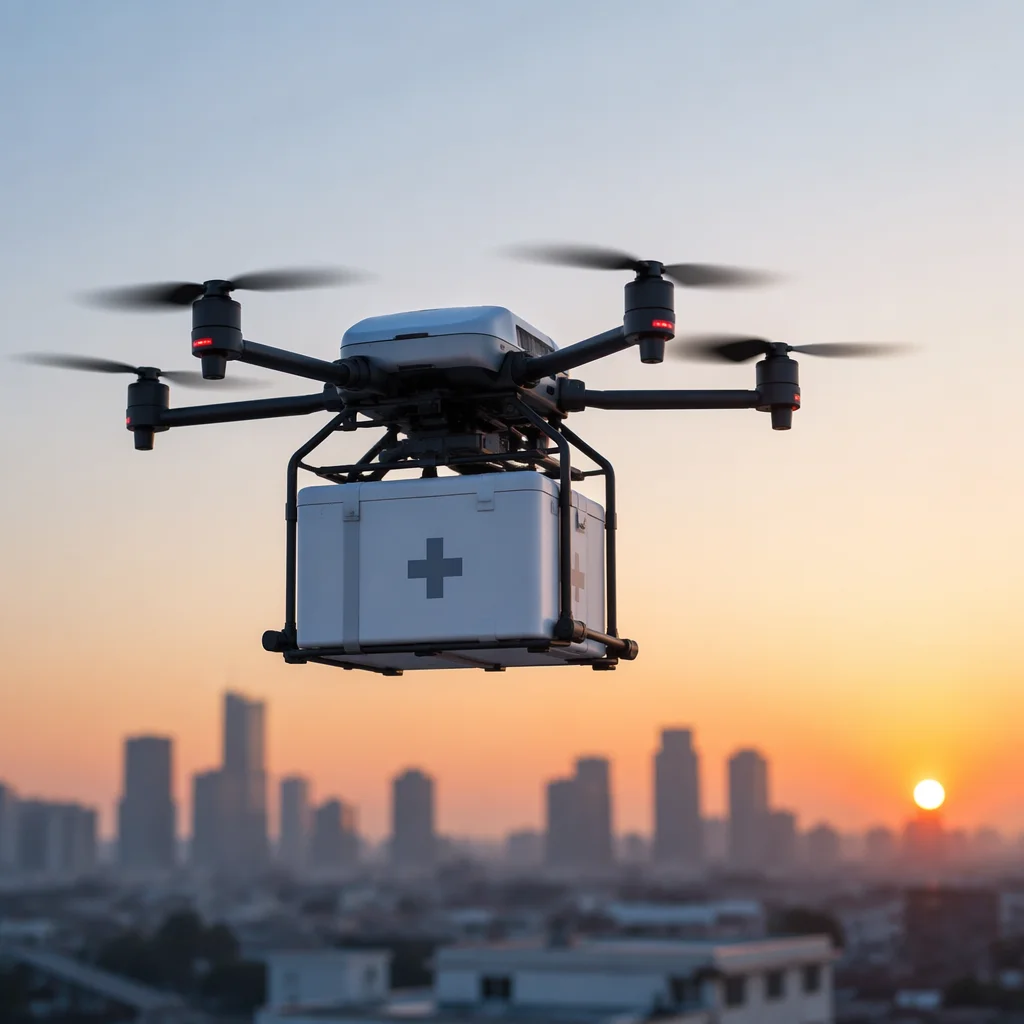
The low-altitude economy is a useful label for civil UAV work taking shape in inspection, mapping, logistics development, agriculture, public-safety support and research. Those applications do not share one “best drone.” They share a need to translate operational language into component and interface decisions.
Mission first, catalog second
A generic multirotor BOM rarely answers the questions that matter for an application:
- What work does the aircraft perform, and in what environment?
- What must it carry, and how does that payload connect electrically and mechanically?
- What communication and navigation path is required for the job?
- Do you need parts, a matched stack, integration support or a complete platform conversation?
Those answers reorder the priority list. Inspection may emphasize stability, sensor interfaces and access-oriented structure. Mapping may emphasize navigation consistency and data-link reliability. Logistics development may elevate payload, power and structural fit earlier than imaging accessories.
Where component attention usually concentrates
Across many civil UAV concepts, four clusters show up early:
- Flight control & sensing . Mission-appropriate navigation, firmware context and peripheral I/O
- ESC & power path . Voltage architecture matched to endurance and thrust assumptions
- Airframe & mounting . Space for payload, protection, harness routing and service access
- Communications & payload interface . Radio, telemetry, data link and mechanical/electrical attachment
Propulsion, batteries and accessories remain essential. The point is sequence: decide which constraints are load-bearing for the application before optimizing secondary part families.
 Concept illustration
Industry context, not a deployment claim
Application examples on this site are industry contexts. They are not claims of completed EMS Drone customer deployments, market share or certified production capacity. Use them as a framing tool when you describe the work the aircraft must do.
Turning an application into a brief
A useful first brief does not require a finished specification. Mission type, payload notes, operating environment, known component constraints and target build depth are enough to open a system conversation. From there, the component architecture can be mapped without pretending every option is already locked.
What a low-altitude program actually costs to run
The headline hardware number is the smallest part of a low-altitude program budget. What separates a program that reaches service from one that stalls is where cost accumulates after the purchase order. Figures below are planning ranges for a 25 kg class multirotor in low-rate series production, not quotations; request a quotation against your own application to get a program-specific split.
| Cost driver | Individual components | Matched subsystem | Complete aircraft |
|---|---|---|---|
| Hardware at point of purchase | Lowest per line item | 2 to 6 percent above the sum of parts | Highest, but bundled |
| Integration engineering | 60 to 140 hours per new airframe | 20 to 50 hours, at subsystem boundaries | 4 to 12 hours for payload fit only |
| Interface debug and rework | Uncapped, driven by protocol and pinout mismatches | Bounded by the vendor's tested envelope | Near zero on the airframe itself |
| Spares and second-source effort | Full responsibility, every part family | Shared with the subsystem vendor | Vendor responsibility |
| Time to first flight | 12 to 24 weeks | 6 to 12 weeks | 2 to 5 weeks |
| Cost of a single late design change | Highest: ripples across every interface you own | Moderate: contained at the subsystem boundary | Lowest on the airframe, highest on the payload |
The pattern is consistent: buying at component level pushes cost to the right of the table, where it is harder to forecast. The per-unit saving is real only when your team can absorb the integration hours and the rework risk without slipping the program schedule.
Program responsibility: who owns what at each boundary
When an application program stalls, the cause is usually an interface nobody was contractually responsible for. Splitting responsibility explicitly, before the order, is the cheapest risk control available. The rows below hold across every civil application, from inspection to precision agriculture; only the responsible party changes.
| Interface | Supplier owns | Operator owns |
|---|---|---|
| Power rail budget | Continuous and burst ratings at a stated duty cycle and ambient | Total load summing, harness gauge, connector derating |
| ESC timing and protocol | Supported pulse protocols and configuration ranges | Motor selection within the declared envelope, throttle curve tuning |
| Firmware and autopilot compatibility | Stating which autopilot releases each part supports | Re-qualification after any firmware change, including minor releases, and flight-test sign-off |
| Structural mounting interface | Mounting pattern, hole tolerance, fastener torque figures | Vibration isolation choice and frame-side stiffening |
| RF and antenna placement | Radio ratings, connector type, gain figures | Installation geometry, separation from power and noise sources |
| Temperature and environmental limits | Operating and storage ranges with measurement conditions | Enclosure, airflow path, cold-start and de-icing provisions |
| Documentation deliverables | Versioned interface map, pinout, firmware matrix | Configuration control when any element is substituted |
The firmware row is the one buyers most often leave out. "Compatible" is not a property a part has; it is a property of a part plus a firmware version plus a configuration. Writing the re-validation obligation into the contract turns a vague promise into a measurable one, and it is the clause that most often decides who pays when a flight is lost after an update.
Two reference builds: how an application becomes real hardware
Two platforms we build show what a low-altitude application looks like once it becomes physical, and why the component discipline above is not academic. Both are multirotor and VTOL architectures assembled from the component and subsystem layers described in our capabilities overview:
- A heavy-lift multirotor built as an X8 coaxial octocopter with a 1,600 mm wheelbase, a 30 litre payload and a maximum take-off weight around 25 kg, delivering 12 to 15 minutes of active work per tank fill. For sourcing, the informative number is the wheelbase: coaxial propulsion over a 1,600 mm span buys the same disc area a flat octocopter would need more than 2,100 mm to produce. That changes what fits in a crate, what the shipping volume is, and which arm supplier can serve you, so it is a sourcing constraint before it is a design preference. The configuration is documented in the heavy-lift reference architecture.
- A VTOL fixed-wing survey platform with 120 minutes of usable endurance carrying a 5 kg payload, a Hesai PandarXT LiDAR and a 42 MP camera, on an 888 Wh 6S8P pack. Its energy split (roughly 68 percent cruise propulsion, 22 percent payload, 7 percent avionics, 3 percent transition) shows that the layers do not draw power evenly, so a power budget assembled per-layer and then summed will misprice the harness and the regulator. See the LiDAR mapping platform reference architecture.
Both platforms sit at the upper end of what a multi-vendor supply chain has to hold together: eight propulsion units, a control layer, a communications layer and a payload layer, every boundary of which is a place where a substitution can go wrong. That is the practical argument for treating the interface map as the primary procurement artifact and the bill of materials as its output.
What to put in the requirement document
A brief that produces comparable, testable quotations has to state conditions alongside figures. The clauses that carry the most weight when an application program moves from concept to hardware:
- Interface map as a contract deliverable. Require a versioned document listing, for every boundary, the connector type, pinout, voltage band, protocol and mounting interface.
- Ratings stated with conditions. Continuous and burst current, thermal limits and vibration exposure each quoted with the duty cycle and ambient they were measured at.
- Firmware compatibility matrix. Which autopilot releases support each part, and notice obligations before a release is deprecated.
- Re-qualification obligation. Written confirmation of who re-tests after a firmware or component revision, and what evidence closes the change.
- Second-source and last-time-buy notice. A minimum notice period before a part reaches end of life, with a documented form-fit-function alternative.
- Acceptance criteria per layer. The measurement that proves each subsystem meets its stated performance, agreed before the order rather than after delivery.
- Documentation set and revision control. Which drawings, test reports and certificates ship with each unit, and how revisions are tracked.
- Escalation path for interface disputes. A named technical contact on both sides, and a defined window to resolve a boundary disagreement. The way we scope and stage that work is set out on the how we work page.
The Component Stack That Scales
Low-altitude economy deployments share a common procurement pattern regardless of vertical: integrators standardize on a small set of proven components and scale them across missions. The core stack starts with a reliable mid-size motor and matching ESC, a battery pack sized for the endurance target, and a GNSS module with RTK capability for the precision positioning that city-scale operations demand.
Payload integration follows the same logic. A single standardized gimbal mount and a common power rail let operators swap cameras, sensors, or delivery mechanisms between missions without redesigning the airframe. This modularity directly reduces the number of SKUs a distributor must stock, which is why the most successful low-altitude programs treat the component catalog as a system design exercise rather than a parts list.
For distributors, the practical takeaway is to carry the full stack, not just the airframe. Customers building low-altitude solutions buy motors, ESCs, batteries, GNSS modules, and radios together. And they expect one supplier who can validate that the combination works. That is the difference between selling components and selling a working low-altitude system.
Procurement Strategy for Low-Altitude Programs
Program-level buyers rarely start with a single component. They begin with a mission profile, inspection routes, delivery radius, or survey area, and work backward to a component specification. Understanding this workflow changes how distributors position their catalogs: the sales conversation should open with mission capability, not with motor KV ratings.
Lead time is the second critical factor. Low-altitude economy programs in regulated markets often face certification deadlines that are fixed by airspace regulators, so a component with a six-week lead time can block an entire program. Distributors who keep buffer stock on the top ten components, motors, ESCs, batteries, GNSS modules, and radios, convert that reliability into a pricing premium.
Finally, expect a certification cascade. When one component changes, the whole airframe may need re-validation, so program buyers value component stability almost as much as performance. Distributors who document version history and support long product lifecycles win repeat business in the low-altitude economy.
The low-altitude economy rewards preparation over improvisation. Operators who standardize their component stack, test at layer boundaries, and keep buffer stock of critical parts consistently outperform those who optimize each purchase in isolation. Start with the mission profile, work backward to the component specification, and let the integration test plan catch problems before they reach the field.
Balancing cost against certification and payload
For operators entering the low-altitude market, component spend rarely maps one-to-one to flight performance. A lighter airframe that saves 300 g of payload often costs more than heavier alternatives, and that weight budget usually goes to a larger battery or a more capable camera. The practical rule is to fix the mission first, then allocate budget in three wedges: safety-critical hardware (ESC, power distribution, redundant IMU), payload, and airframe. Certification or local airspace rules can also force specific radios or beacons, which should be priced before the BOM is frozen rather than added in a late revision.