
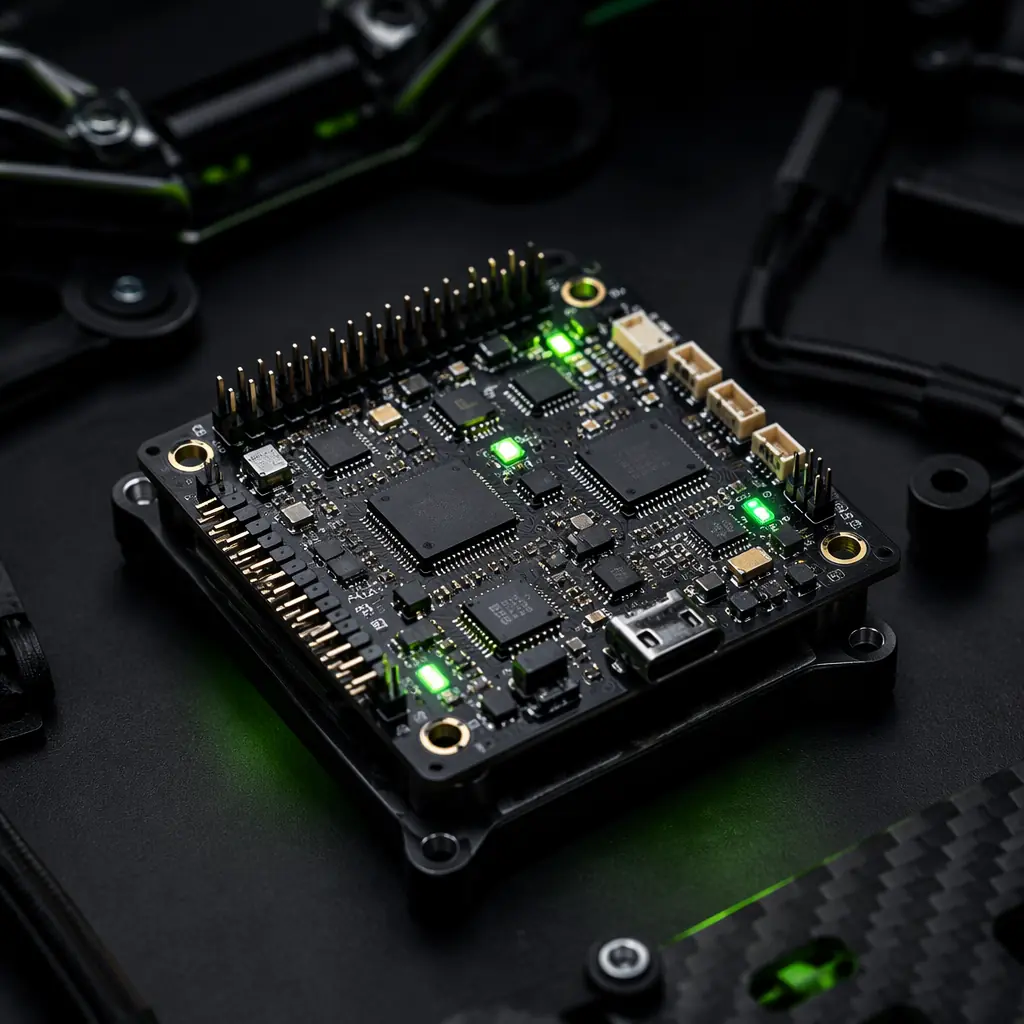
Procurement teams building industrial UAV programs face an early architectural decision that echoes through every subsequent hardware choice: which autopilot software stack will govern the aircraft. Two open-source platforms dominate the landscape, ArduPilot and PX4, and while both can fly a multirotor from waypoint A to waypoint B, the operational differences become stark when you push into the mission profiles that industrial UAVs actually execute: 30 km BVLOS corridors, autonomous precision landing on moving platforms, GNSS-denied navigation inside infrastructure, and multi-vehicle swarm coordination.
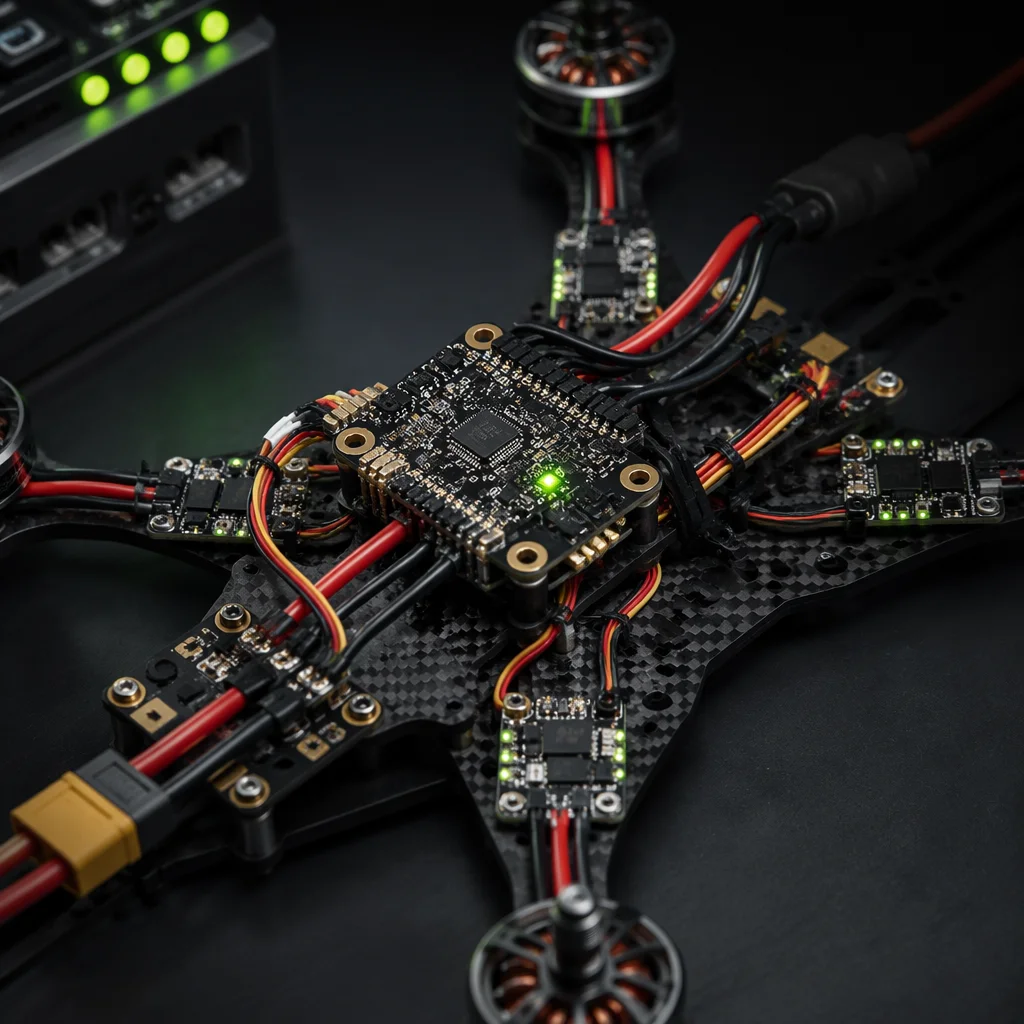
This is not a "which one is better" article. It is a procurement decision framework that maps the architectural differences between ArduPilot and PX4 onto the selection criteria that matter for an industrial UAV program: what flight modes your mission requires, which flight controller hardware is compatible, what the developer ecosystem looks like for customization, how safety-critical features compare, and what the operator training burden will be. If you have already worked through flight controller and ESC matching, the autopilot software choice is the logical next layer in your stack decision.
Architecture fundamentals: what separates the two platforms
ArduPilot and PX4 share a common ancestry, both trace their roots to the ETH Zurich Pixhawk project, but they have diverged into fundamentally different architectures. ArduPilot runs a monolithic firmware model where all control loops execute in a single process space with direct hardware access. The flight controller runs one binary that contains the IMU drivers, the EKF (Extended Kalman Filter) state estimator, the guidance and navigation controllers, and the motor mixer, all compiled together and flashed as a single image. This design prioritizes deterministic timing: the 1 kHz attitude control loop and the 8 kHz IMU sampling run on a predictable schedule because there is no inter-process communication overhead imposing variable latency.
 Concept illustration
PX4 uses a modular, RTOS-based architecture built on NuttX where each subsystem, the commander, navigator, position estimator, attitude controller, and mixer, runs as a separate thread communicating through uORB (micro Object Request Broker) publish-subscribe messaging. This architecture provides fault isolation: a crash in the obstacle avoidance module does not take down the attitude controller. It also makes the system more extensible. Adding a new sensor driver or control mode means writing a new module that subscribes to the relevant uORB topics, without touching existing code. The cost is higher inter-process communication latency and a larger firmware footprint, which historically limited PX4 to flight controllers with at least 2 MB of flash memory.
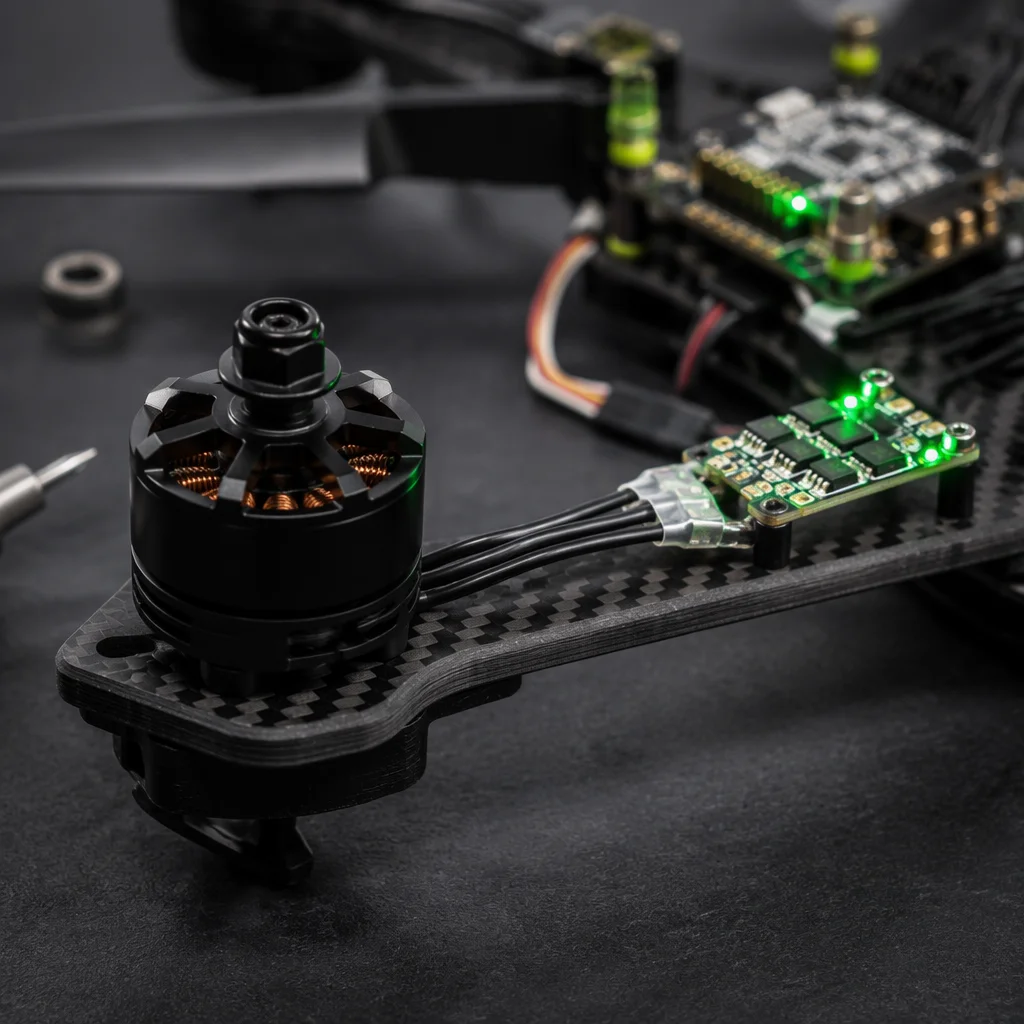
For procurement, the architectural difference matters in two concrete ways. First, ArduPilot's monolithic design means that every supported flight controller runs essentially the same feature set, if a feature exists in the codebase, it works on your hardware, provided there is enough flash and RAM. PX4's modular design means that board support packages can selectively enable or disable modules, so the feature set on a Pixhawk 6X may differ from that on a Holybro Kakute H7 even though both run PX4. Second, ArduPilot's deterministic timing makes it the preferred choice when you need guaranteed control-loop cadence, precision agriculture spraying at 3 m above crop canopy, or heavy-lift logistics where a 50 kg payload means a 200 ms control-loop gap translates to measurable position error. The UAV powertrain matching guide covers how control-loop timing interacts with ESC protocol selection and motor response, which becomes relevant when tuning either platform.
Flight mode coverage: what each platform can actually fly
Both platforms support the standard set of multirotor modes, Stabilize, Altitude Hold, Loiter, Position Hold, Auto (waypoint mission), Return to Launch, and Land. The differences emerge in the specialized modes that industrial UAVs depend on for specific mission profiles.
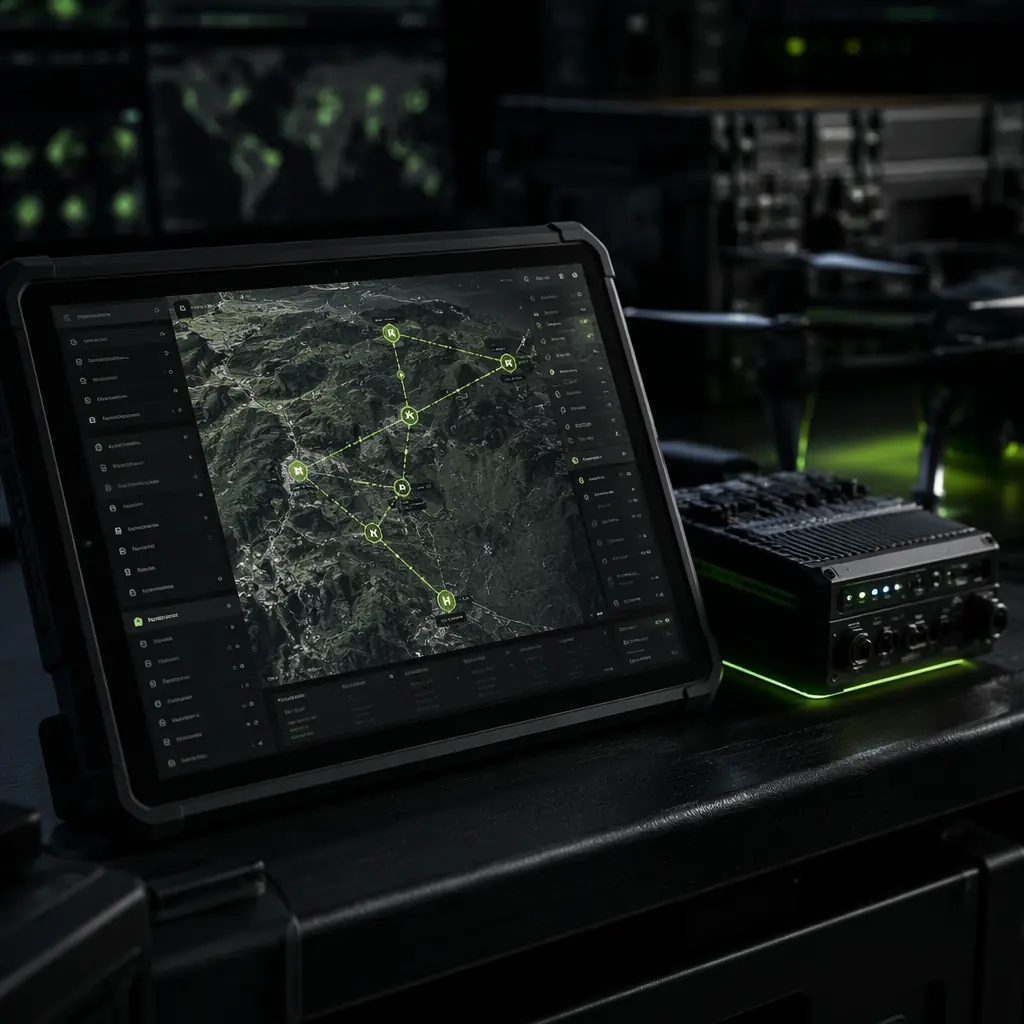
ArduPilot's mode library is larger and more mission-specific. It includes modes like AutoTune (automated PID tuning from in-flight frequency sweeps), Spline waypoint navigation (curved trajectories for cinematic or inspection flight paths), Follow Me (vehicle tracks a moving ground station), Circle (orbits a point at configurable radius and speed. Useful for tower inspection), Guided (external companion computer takes position/velocity commands via MAVLink), and a mature Precision Landing system that uses IR-Lock or AprilTag visual fiducial tracking for centimeter-accuracy touchdown. For mapping and survey missions, ArduPilot's Terrain Following mode uses SRTM elevation data to maintain constant AGL altitude over variable terrain, a critical feature for corridor mapping along power lines that cross hills and valleys.
 Concept illustration
PX4's mode architecture is cleaner but narrower. It defines a smaller set of core modes, Position, Altitude, Manual/Stabilized, Acro, Orbit, Hold, Return, Mission, Takeoff, Land, Follow Me, and Offboard, where Offboard is the primary extensibility path. Rather than adding specialized flight modes, PX4 expects complex behaviors to be implemented in a companion computer communicating through MAVLink or ROS 2, with the flight controller executing the low-level stabilization. This is a philosophically different approach: ArduPilot puts intelligence on the flight controller; PX4 puts the flight controller in a servant role to a companion computer. For programs that already plan to integrate a Jetson Orin or Raspberry Pi for onboard AI processing, PX4's Offboard mode is a clean interface. For programs that want an all-in-one flight controller solution with no companion computer, ArduPilot's mode library is more immediately useful.
A practical procurement consideration: if your mission requires Beyond Visual Line of Sight operations, both platforms support BVLOS workflows, but ArduPilot's ecosystem has a longer track record of FAA and EASA BVLOS waiver approvals. The UAV Remote ID and BVLOS compliance guide covers the regulatory hardware requirements that apply regardless of autopilot choice.
Hardware compatibility: which flight controllers run which stack
The hardware ecosystem is the axis where the two platforms diverge most visibly for procurement. ArduPilot supports an exceptionally wide range of flight controller hardware. From the STM32F4-based boards that have been in the field for a decade to the latest STM32H7 dual-core processors with 2 MB flash and 1 MB RAM. The officially supported hardware list includes the entire Pixhawk family (Pixhawk 1 through Pixhawk 6X), the Cube Orange and Cube Blue carrier boards with their modular carrier-board architecture, the CUAV V5+ and X7 series, the Holybro Durandal and Kakute H7, and dozens of smaller manufacturers. Critically, ArduPilot also supports non-Pixhawk-standard boards like the Matek H743 series and the ReadyToFlyer line.
PX4 supports a narrower but well-curated hardware set, focused primarily on the Pixhawk standard. The Pixhawk 6X (STM32H753, dual-core Cortex-M7 at 480 MHz with Cortex-M4 co-processor) is the reference platform. The Cube Orange+, Holybro Durandal, and CUAV X7 Pro are also supported. PX4's hardware requirements are more stringent, a minimum of 2 MB flash and 512 KB RAM, which eliminates the lower-cost STM32F4 boards that ArduPilot still flies on. For procurement, this means the minimum viable flight controller for PX4 carries a higher unit cost, but also guarantees more headroom for future firmware updates and onboard processing.
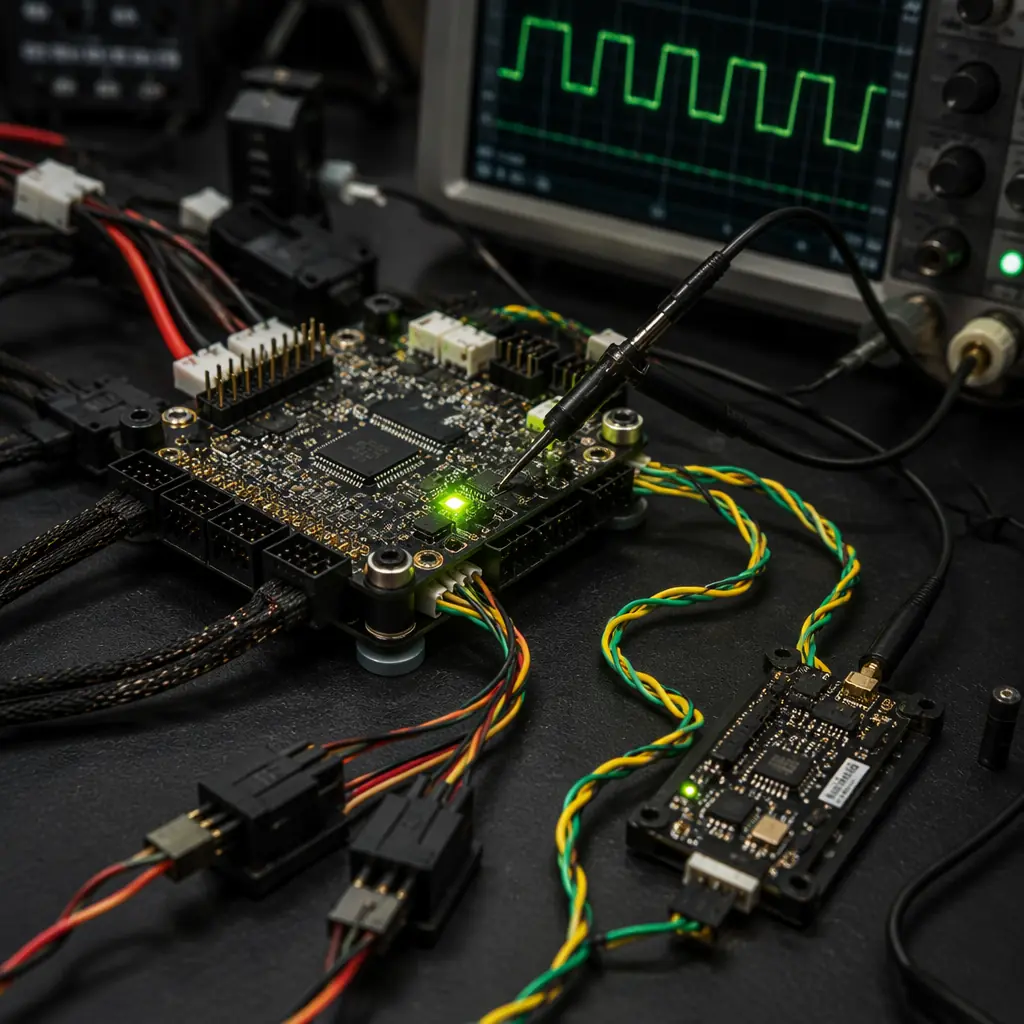
Both platforms support 8 kHz IMU sampling rates and 1 kHz control loops on H7-class hardware, which aligns with the component specifications we maintain for industrial-grade UAV communication protocols where CAN FD at 8 Mbps and DShot 1200 demand real-time processing headroom. For dual-redundant IMU configurations, where the flight controller cross-checks two independent IMU streams for sensor failure detection, both platforms support the feature in hardware, but ArduPilot's EKF3 implementation includes a built-in IMU voting mechanism that PX4 achieves through its modular sensor-hub architecture.
Safety architecture: failsafe behavior under fault conditions
Safety features are where autopilot selection has direct operational consequences. Both platforms implement the expected failsafes, radio loss triggers Return to Launch, low battery triggers Auto Land, geofence violation triggers an altitude climb followed by RTL, but the depth of configurability differs.
ArduPilot's parameter system (over 1,200 configurable parameters) exposes almost every safety threshold to the integrator. The battery failsafe can be configured with two-stage voltage thresholds, a separate capacity-consumed trigger, and independent actions for each stage: Return to Launch at stage 1, Land Now at stage 2. The geofence system supports circular, polygonal, and altitude fences with independent breach actions. The EKF failsafe can trigger a mode fallback, switch from Loiter to AltHold if the position estimate degrades, or initiate an autonomous landing if the IMU health indicators cross a configurable threshold. For industrial UAVs operating in GNSS-challenged environments, ArduPilot's EKF3 includes a built-in optical flow and visual odometry fusion path that maintains position hold when GPS drops out, provided the flight controller has an attached optical flow sensor or companion-computer vision pipeline.
 Concept illustration
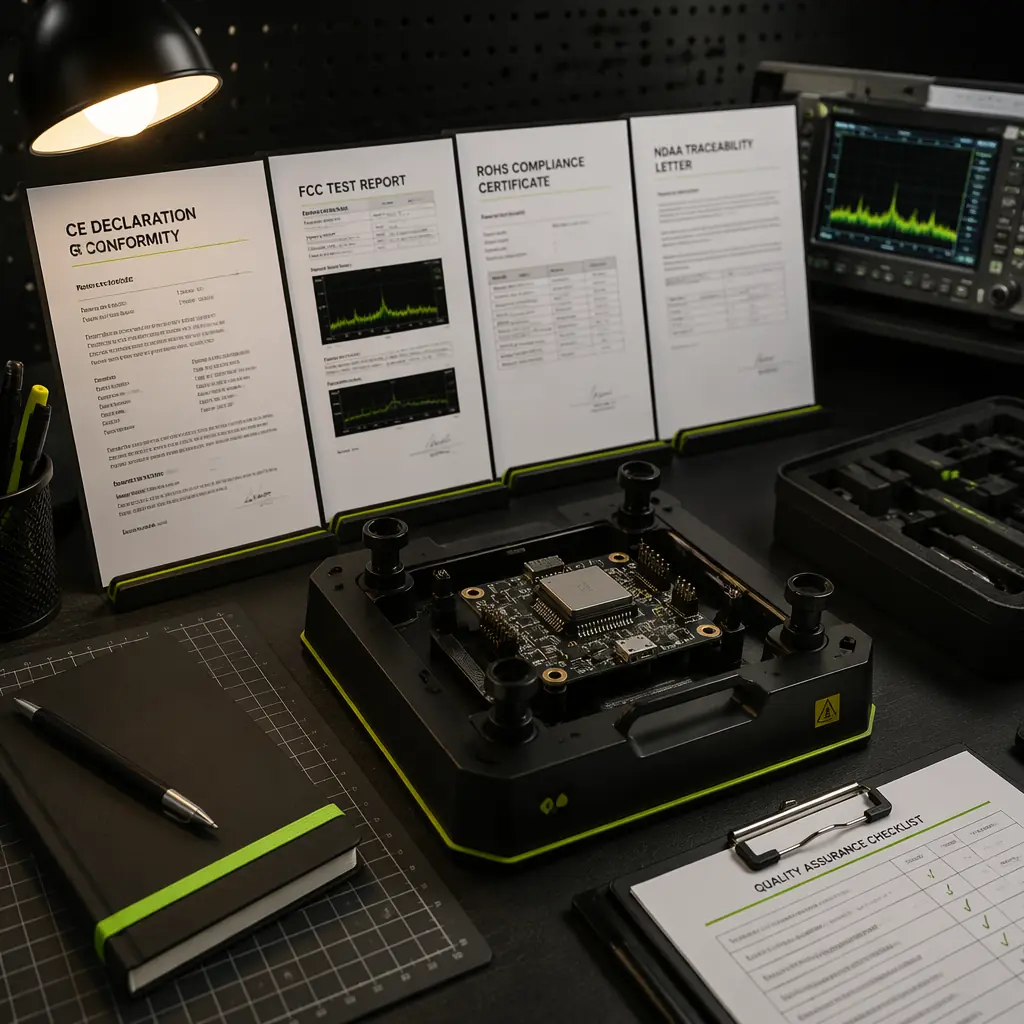
PX4's safety model is structured around a formal Commander state machine with well-defined transitions: the vehicle is always in exactly one state (Manual, Stabilized, Position Control, Mission, Return, Land, etc.) and failsafe events trigger deterministic state transitions defined in the airframe configuration. This is architecturally cleaner and easier to audit for safety certification. For programs pursuing DO-178C or equivalent software assurance levels, PX4's modular architecture and formal state machine make the certification argument more straightforward than ArduPilot's monolithic codebase. Though neither platform is certified to any aviation safety standard out of the box. Both require a program-specific certification effort, and the component-level UAV certification and compliance guide covers the broader regulatory landscape that applies regardless of autopilot software choice.
Developer ecosystem and customization pathway
The developer experience differs significantly, and this matters for procurement because it determines how quickly your engineering team can modify the autopilot for mission-specific behaviors. ArduPilot's codebase is larger, approximately 1.2 million lines of C++, and the learning curve for meaningful customization is steeper. The build system uses Waf, the parameter system is defined through a custom metadata format, and the codebase includes substantial vehicle-specific branches (Copter, Plane, Rover, Sub, Blimp, Antenna Tracker) that share a common library layer. For a team that needs to add a custom flight mode, say, an automated power-line tracking behavior that uses an onboard camera, ArduPilot gives you the hooks but requires navigating a large codebase to find them.
PX4's codebase is approximately 600,000 lines of C++ with a CMake build system, and its uORB messaging architecture means that adding new functionality often involves writing a standalone module that subscribes to the topics it needs, without modifying existing flight-critical code. For a team integrating a custom sensor, a specialized gas analyzer for environmental monitoring, or a proprietary RF direction finder, PX4's driver framework is more approachable. The ROS 2 bridge is also more mature in the PX4 ecosystem, which matters for programs that plan to run perception, planning, and decision-making algorithms on a companion computer. The UAV R&D components guide covers the hardware side of the companion-computer integration that either platform can support.
Ground control station compatibility is another procurement factor. Both platforms work with Mission Planner and QGroundControl, but the experience differs. Mission Planner was built for ArduPilot and exposes the full parameter set with descriptions, range limits, and incremental-change highlighting. QGroundControl was built for PX4 and provides a cleaner UI for PX4-specific features like airframe configuration wizards and MAVLink inspector tools. Either GCS can connect to either autopilot, but the feature coverage is asymmetric: using Mission Planner with PX4 means some PX4-specific parameters show as raw numeric IDs, and using QGroundControl with ArduPilot means some ArduPilot-specific flight modes are not selectable from the UI.
Decision framework: which platform for which mission profile
The procurement decision reduces to a matrix of mission requirements. Here is the framework we use when advising clients on autopilot selection:
Choose ArduPilot when your mission demands any of the following: precision agriculture with terrain-following spray passes at 3–5 m AGL, long-endurance mapping missions covering 500+ hectares where spline waypoint trajectories reduce unnecessary maneuvering, BVLOS corridor operations with a proven regulatory track record, heavy-lift logistics where deterministic control-loop timing at 1 kHz is non-negotiable, or automated precision landing on moving platforms using IR-Lock or AprilTag. ArduPilot's AutoTune feature alone saves engineering hours, rather than manually tuning PID gains across the flight envelope, you run a 10-minute automated flight that excites each axis and computes optimal gains.
Choose PX4 when your program involves: a companion-computer architecture where the autopilot is a low-level stabilizer and the intelligence runs on a Jetson or Raspberry Pi, a ROS 2 or DDS-based software pipeline where PX4's native ROS 2 bridge simplifies integration, a safety certification pathway where PX4's modular architecture and formal state machine reduce the certification argument complexity, or a multi-vehicle swarm where PX4's uORB messaging architecture naturally extends to inter-vehicle communication through MAVLink routing. PX4's airframe configuration wizard in QGroundControl also reduces the initial setup time for standard multirotor and VTOL configurations, which matters if your program involves rapid prototyping across multiple airframe variants.
For programs operating in both camps, a heavy-lift logistics UAV that also needs ROS 2 integration for onboard obstacle avoidance, the decision is not exclusive. Some teams run ArduPilot as the primary flight stack and use a companion computer running ROS 2 for perception, with MAVLink bridging the two. The integration engineering effort is higher, but the result is the best of both architectures. The key procurement insight is that the choice of autopilot software should precede, not follow, the choice of flight controller hardware. Buy the flight controller that runs your chosen stack well, not the flight controller that a vendor's marketing team promotes. The hardware differences between a Pixhawk 6X running ArduPilot and the same board running PX4 are nil, the software determines the operational behavior. ESC firmware selection is the next logical decision in the stack, as the autopilot's output protocol (DShot, PWM, CAN) must match what your ESCs accept.
Explore flight controller options Back to Blog
What certification and support actually cost
Both stacks are free to download. Neither is free to put on an aircraft that has to be supported for a decade. The bands below are what we see industrial programs spend on the autopilot layer - hardware, engineering and the ongoing support burden - in absolute USD, for a fleet of 10-50 aircraft.
| Cost line | Indicative band (USD) | Notes |
|---|---|---|
| Flight controller hardware per aircraft | 180 - 900 | Set by I/O count, redundancy architecture and environmental rating, not by which stack you run |
| Integration and tuning engineering, first aircraft | 4,000 - 14,000 | The dominant first-unit cost. Falls steeply for units 2-10 once the airframe and gains are settled |
| Per-unit tuning and acceptance, production | 400 - 1,200 | Includes the acceptance test run and the configuration record for that serial number |
| Annual engineering support contract | 6,000 - 25,000 | Priced on fleet size and on whether you need a named engineer rather than a forum |
| Re-qualification after a major version upgrade | 2,500 - 8,000 per fleet | Only ArduPilot's slower release cadence makes this an annual line item rather than a twice-a-year one |
The pattern that matters is the shape of the curve, not the absolute numbers: the first aircraft costs an order of magnitude more to integrate than the tenth, and the annual support line is what separates a supported industrial fleet from a hobby project that grew. A program that budgets for hardware only will discover the integration and re-qualification lines after the first upgrade.
Who owns what: vendor versus integrator on the autopilot layer
Open-source autopilot licences are clear about copyright and silent about airworthiness. That gap has to be closed contractually between whoever supplies the flight control stack and whoever operates the aircraft.
| Scope | Supplier owns | Integrator / operator owns |
|---|---|---|
| Configuration baseline | A documented parameter set tied to a hardware revision and firmware version | Configuration control: that the aircraft in the field matches the documented baseline, serial by serial |
| Upgrade decision | Release notes identifying changes to control-loop timing, estimator behaviour or failsafe logic | The decision to upgrade at all, and re-running the acceptance set before release to the field |
| Failsafe behaviour | The parameter semantics and their documented defaults | Defining and testing the behaviour for your mission: what happens on link loss, GPS loss, battery sag, at your altitude and airspeed |
| Regression testing | Upstream CI coverage of the flight stack | Regression testing on your airframe, because upstream CI does not know your control surface authority or your payload mass |
| Support | Community channels, or a paid contract with a response time | Whatever the mission needs beyond that, including out-of-hours support if you fly commercially |
| Certification evidence | Build provenance and reproducible build instructions | The compliance case itself: the means of compliance, the test evidence and the authority submission |
The certification row is where the two stacks diverge most in practice. ArduPilot's slower, more deliberate release cadence makes a frozen baseline easier to defend and easier to keep frozen. PX4's faster cadence gives you better support for new sensors sooner, at the cost of a heavier configuration-control burden. Neither is a compliance shortcut: both leave the means of compliance and the test evidence with the operator. Related component-level documentation is covered in the UAV certification and compliance guide.
Two fleet scenarios and what they chose
- Agricultural spraying fleet. The 30 L X8 platform we build runs eight 80 A 12S CAN ESCs, four 100 KV motors, dual 6S 22,000 mAh packs at roughly 25 kg MTOW and 12-15 minutes per tank. Spray fleets prioritise a frozen configuration and long service intervals over new sensor support, because a mid-season firmware change costs a spraying day across the fleet. That profile favours the slower-cadence stack. Full configuration on the heavy-lift agricultural reference build.
- Survey VTOL program. A 5 kg payload on an 888 Wh pack at 120 minutes, with about 68% of energy in cruise, 22% in payload, 7% avionics and 3% transition. Survey programs are sensor-driven: when a new LiDAR or a new GNSS receiver arrives, they want support in the flight stack within a release cycle rather than a year. That profile tolerates a faster cadence and the re-qualification work it implies. See the LiDAR mapping platform reference.
In both cases the autopilot choice followed the mission and the support model. It did not lead it.
Clauses for an autopilot supply agreement
- Named baseline. The agreement must name the hardware revision, firmware version and complete parameter file, and require written notice before any of the three changes on a delivered aircraft.
- Reproducible build. Require the build provenance for the exact binary shipped, so the aircraft in the field can be rebuilt from source if the supplier disappears.
- Upgrade policy. State the cadence at which you accept upgrades (for example annually, or only for a named safety fix), and that the supplier must support the frozen version for a stated period.
- Re-qualification scope. Define, in advance, which changes trigger a full re-test and which trigger a bench-only check. Without this every release becomes a negotiation.
- Failsafe test evidence. Require documented evidence of link-loss, GNSS-loss and low-battery behaviour on your airframe, not on a reference airframe.
- Support response time. A forum is not support. If the aircraft earns revenue, specify a response time and an escalation path, and price it.
- Exit terms. The ability to take the configuration, the fixtures and the build environment to a second integrator is what keeps the first integrator honest, and it costs nothing to agree at signature.
Whichever stack you land on, the autopilot only behaves as well as the components around it behave. See matching flight controllers and ESCs for the interface side, and sensor fusion and redundant navigation for the estimation side.
Continue Reading
FC & ESC Matching
Protocol-level compatibility between flight controllers and ESCs.

ESC Firmware Selection
BLHeli_32, AM32 and FOC, which protocol for your motor type.
UAV Powertrain Matching
Matching motors, props, ESCs and battery into a coherent system.
UAV Communication Protocols
CAN, DShot, PWM, SBUS and CRSF for industrial integration.
Certification & Compliance
CE, FCC, RoHS, NDAA and ITAR requirements for export UAVs.