
Why battery shipments fail at the airline counter, not at the border
Almost every UAV battery shipment that gets rejected is stopped before it ever reaches customs. It is stopped at the freight forwarder's acceptance desk, by a dangerous-goods clerk reading a shipper's declaration that does not match the pack in the box. The paperwork says UN 3481, the pack is loose in a foam-lined case with no equipment, and the shipment is either reclassified, repacked or refused. The same shipment will clear customs without a question once the classification, state of charge and packaging are right.
This guide covers the part of the export chain that the export logistics guide deliberately keeps brief: the physical AND regulatory layer around the battery itself. It covers how lithium packs are classified and limited, what state of charge does to your legal shipping route, how a crate has to be built to survive a multimodal journey, and the documents that have to travel with it.
It is written for the procurement and logistics manager who has to get a build from a factory to a flight test site in another country and cannot afford a shipment sitting on a dock while a compliance question is answered.
The classification decision: UN 3480, UN 3481 and what is actually in your box
Lithium batteries ship as Class 9 dangerous goods under two UN numbers, and the number is decided by what the battery is packaged with, not by the battery itself.
| UN number | Proper shipping name | When it applies | Practical UAV case |
|---|---|---|---|
| UN 3480 | Lithium ion batteries (including lithium ion polymer batteries) | Cells and packs shipped alone, not installed in and not packed with equipment | Spare packs ordered as a separate line item; replacement battery shipments |
| UN 3481 | Lithium ion batteries packed with equipment | Packs in the same box as, but not installed in, the equipment they power | A UAV body shipped in one crate with its spare packs in a separate tray inside |
| UN 3481 | Lithium ion batteries contained in equipment | Packs installed in the equipment and shipped with it | The normal case: aircraft shipped with its packs installed and secured |
The distinction matters because the three cases carry different packaging instructions, different state-of-charge rules in some modes, and different treatment by the forwarder. The most common error in UAV exports is shipping spare packs loose in the same crate as an airframe and declaring UN 3480, when the correct entry is UN 3481 packed with equipment. That single mismatch is enough for a forwarder to refuse the shipment at acceptance.
Two measurement figures drive the rest of the classification. A cell is limited to a watt-hour rating, and a pack is limited by the sum of its cells. Worked example for a common 12S platform: 12 cells at 3.7 V nominal and 22,000 mAh each gives 81.4 Wh per cell and therefore 977 Wh per pack. That figure, not the pack's mass or its capacity in amp-hours, is what every threshold in the regulations is written against.
 Concept illustration
State of charge: the one number that changes your legal shipping route
A lithium ion cell shipped at 100 percent state of charge carries more stored energy and is more prone to thermal runaway under a crush or short-circuit event than the same cell at 30 percent. Regulators solved this by capping state of charge for air transport. For UN 3480 cells and packs shipped alone by air, state of charge must not exceed 30 percent of rated capacity. For UN 3481 packed with or contained in equipment, the requirement is that the battery be protected against short circuit and, where the equipment is packed, that it be secured against movement.
That 30 percent cap is the single most operationally disruptive rule in UAV export, because it lands directly on the customer's first flight. A pack that arrives at 30 percent has perhaps two or three minutes of hover in it. The build arrives, and it cannot fly until it is charged.
| Requirement | Applies to | What it means for a UAV build | Planning consequence |
|---|---|---|---|
| State of charge 30 percent or less | UN 3480 cells/packs, air transport | Pack must be discharged before packing; a full pack cannot fly | Add a discharge step and an SOC record to the build process |
| Protected against short circuit | All lithium shipments | Terminals taped or capped, packs in an inner packaging that prevents contact | Inner packaging becomes a specified line item, not an afterthought |
| Secured against movement | Batteries contained in equipment | Installed packs need a mechanical restraint, not just a strap | Battery bay retention is a shipping feature and a flight feature |
| Charger available in country | Any SOC-shipped pack | Customer must own a charger compatible with the pack BMS | Charger ships with the build or the destination needs its own |
The practical answer is to specify the shipping state of charge in the purchase order, require the measured value for each pack on the packing list, and ship a compatible charger in the same shipment or confirm one at destination. The battery power management guide covers how a BMS reports state of charge; that reporting is what makes a 30 percent shipment verifiable rather than a promise.
Section II, watt-hour thresholds and when you need a full DG declaration
Not every lithium shipment needs a fully declared dangerous-goods consignment with trained shipper certification. The regulations provide a reduced-requirement route for smaller batteries, and knowing where your pack sits against the thresholds decides how much process you have to buy.
For air transport, small lithium ion cells and packs below the watt-hour thresholds can move under the reduced provisions commonly referred to as Section II, which relaxes the shipper's declaration requirement but does not remove the packaging, state-of-charge or labelling obligations. Above the thresholds, the shipment becomes fully regulated: a dangerous-goods declaration, trained and certified shipper personnel, compliant packaging that has passed a drop and stack test, and a forwarder that handles Class 9 cargo.
UAV platforms sit awkwardly across that line. A small inspection quadcopter with 6S packs of a few hundred watt-hours can often move under reduced provisions, cutting cost and lead time substantially. A 12S heavy-lift or agricultural platform sits firmly in fully regulated territory, and the difference in process between the two is large enough that it should be designed into the export plan at quotation stage, not discovered at the dock.
 Concept illustration
ISPM 15: the wooden crate rule that stops shipments at the border
Here is the requirement that catches UAV exporters most often, because it has nothing to do with batteries and everything to do with wood. Solid wood packaging material entering most countries must comply with ISPM 15, the international phytosanitary standard for wood packaging, which requires the wood to be heat treated or fumigated and stamped with the IPPC mark. An unstamped solid wood crate can be refused, quarantined, fumigated at the exporter's cost or returned, regardless of how well the contents are packed.
For a UAV build this changes the crate material decision. Plywood, oriented strand board, particle board and processed engineered wood are generally treated as processed materials and fall outside the solid wood requirement in many jurisdictions. Solid sawn timber and the pallet underneath it are the exposure. A crate built from site-fabricated solid timber with an untreated skid is exactly the shipment that gets held.
| Crate material | ISPM 15 position | Practical guidance for UAV builds |
|---|---|---|
| Plywood, OSB, engineered board | Generally considered processed; outside the solid wood rule in many jurisdictions | Lowest regulatory friction; suitable for airframe and component crates |
| Solid sawn timber, timber skids and bearers | In scope; requires heat treatment or fumigation plus IPPC stamp | Use compliant suppliers; insist on the stamp, not a verbal assurance |
| Moulded foam, aluminium flight case, rigid plastic | Not wood packaging; ISPM 15 does not apply | Cleanest option for high-value builds and repeat shipments |
| Composite crate with timber base | Mixed; the timber element is in scope | Specify a compliant base or switch the base to a processed material |
Two more packaging realities share this section. First, an export crate is handled by machines, not people: it must survive a forklift, a stack of identical crates in a container and an unload at the destination, which means rated stacking strength rather than visual robustness. Second, the crate has to be openable at destination for customs inspection and resealable, which argues for a bolt-and-clip design over a nailed lid, and for the contents to be packed so that a customs officer can see every item without unpacking the whole build. The pre-shipment inspection guide covers the release tests that should be complete before the lid goes on.
Shock, vibration and condensation: engineering the inside of the crate
A multimodal UAV shipment is a vibration and shock test that nobody wrote a specification for. Components pass a road, a forklift, a container stack, possibly an aircraft hold and a final-mile road leg, and the acceleration events along the way are the ones the airframe's own qualification testing never covered because they happen to the box, not the aircraft.
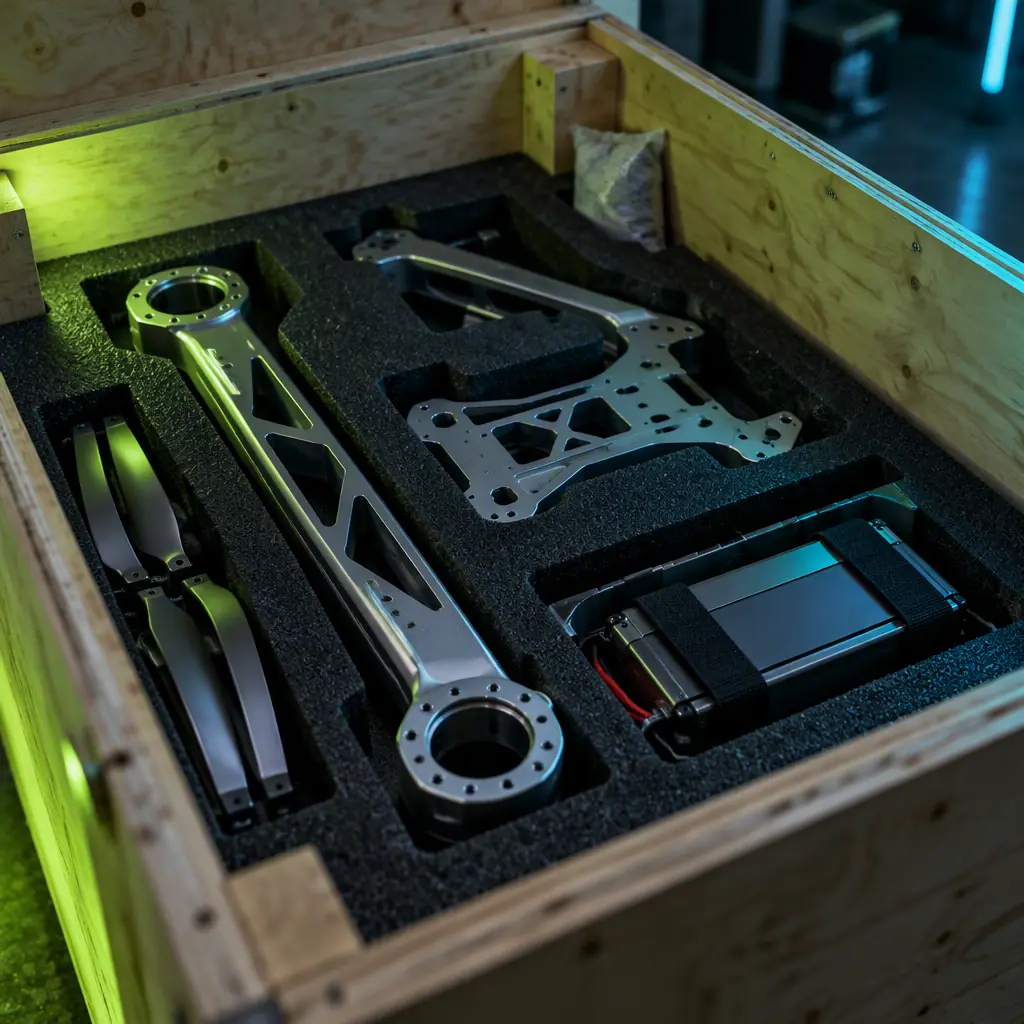
The controls that work are structural, not decorative. Every heavy item, motors, battery packs, gimbal assemblies, gets foam-blocked into a recessed cavity so it cannot travel, rather than floating in loose filler. Long items, booms, wings, landing gear legs, get supported at two points minimum and preferably four, with the support at the natural frequency nodes rather than the tips. Sensitive payloads get isolated from the crate structure with closed-cell foam or a small elastomeric mount. The vibration isolation guide covers the isolation side in detail; here the point is that shipping isolation and flight isolation are both about keeping a component away from a resonant input.
Condensation is the failure that shows up a week after delivery, when corrosion has already started inside a connector or on a board. A sealed crate that travels from a cold hold to a warm humid warehouse condenses moisture on every cold metal surface inside it. The defences are a desiccant load sized to the crate volume and the journey duration, a sealed barrier bag for electronics and bare metal, and the assumption that a crate without a humidity indicator card cannot be shown to have been protected. If the crate is sealed, desiccant is not optional.
 Concept illustration
Shock and tilt indicators, and why they belong on a UAV crate
A shock indicator is a small, single-use device on the outside of a crate that changes state permanently when it sees an acceleration above its rated threshold. A tilt indicator does the same for an over-angle event, which matters for anything with a precise alignment, a large propeller assembly or a gimbal that has been shipped assembled.
For a component build the case for indicators is not insurance theatre, it is claim evidence. Without an indicator there is no way to distinguish damage that happened in transit from damage that was present at packing, and the dispute resolves against whoever has the weaker record. With an indicator, a lit device plus matching damage inside the crate is a documented transit event. The indicators cost a few dollars and they also discipline the packing process, because the person packing knows the crate is instrumented.
The same logic applies to a tamper-evident seal and a photographed packing sequence. Photographs of the inside of the crate before it closes, with the serial numbers of the units visible, are the record that supports both a transit claim and a warranty discussion. The warranty and RMA guide covers what happens if a failure does escape; the packing record is what makes the difference between a warranty replacement and a contested fault.
The document set that travels with the crate
Documents that exist only as an emailed PDF do not clear a border. The set that matters physically travels with the shipment, in a pouch fixed to the outside of the crate where a customs officer and a forwarder can both reach it, with a duplicate copy inside the crate for the case where the external pouch is opened and not resealed.
| Document | What it must contain for a UAV build | Common failure mode |
|---|---|---|
| Commercial invoice | Line-by-line description, HS classification, unit values, Incoterms, currency, country of origin | Vague descriptions such as aircraft parts, which trigger inspection |
| Packing list | Every item, quantity, mass, serial numbers, plus per-pack battery state of charge | No serial numbers, so a component cannot be traced to a transit event |
| Dangerous goods declaration | UN number, proper shipping name, class, packing instruction, net quantity | Declaration signed by untrained personnel, refused at acceptance |
| Test summary or conformity certificate | Functional and battery test results for the shipped serials | Certificate from a different production lot, discovered at destination |
| Packing list of battery charger | Charger model, input voltage range and plug type | Charger shipped for the wrong mains standard, build cannot fly on arrival |
The charger line deserves emphasis because it is the one that turns a compliance-correct shipment into a non-flyable one. Shipping to 30 percent state of charge is only workable if the destination has a charger that speaks the pack's BMS protocol and matches the local mains. Specify the destination mains voltage and plug type in the order, and ship the charger with the build when the destination has no compatible unit.
What to put in the RFQ so a shipment arrives legally and intact
Export compliance is specification work like any other part of a component order. The difference is that shipping failures cost weeks instead of a rework cycle, and they are almost always traceable to a line that was never written into the requirement.
A workable clause set for a UAV component or complete-build shipment:
- Battery classification: UN number and proper shipping name stated for each battery line, with the watt-hour rating per pack and the basis of calculation.
- Shipping state of charge: the cap to be applied, the measured value reported per pack on the packing list, and the method used to establish it.
- Reduced or full DG route: which regulatory route applies, and who holds the trained shipper certification and signs the declaration.
- Packaging material: crate material and ISPM 15 status, inner packaging for cells and packs, and terminal protection method.
- Internal retention: foam specification, recessed cavities, two-point support for long items, and separation of batteries from airframe structure.
- Moisture control: desiccant quantity, barrier bag specification and the presence of a humidity indicator.
- Transit instrumentation: shock and tilt indicator thresholds, and who owns the claim if they activate.
- Documentation: the full set travelling with the shipment, in the external pouch and inside the crate.
- Charger compatibility: destination mains voltage, plug type and charger model shipped with the build where required.
- Photographic record: serial-numbered photographs of the packed crate interior before closing.
None of these lines is unusual in an industrial purchase order. Applied to a UAV build, they turn a shipment that might be refused at a forwarder's desk into one that clears, and a crate that might arrive with a cracked boom into one whose transit damage, if any, is documented and recoverable. The supplier evaluation checklist covers the qualification questions to ask before placing that first export order, and the pre-shipment inspection guide covers the release testing that should be complete before the crate is closed.
Continue Reading
UAV Export Logistics and Shipping
The customs, HS classification, Incoterms and documentation layer this shipping guide sits inside.
UAV Battery Power Management
Pack architecture, BMS and thermal limits that set what you are legally shipping.
UAV Pre-Shipment Inspection
AQL sampling and functional release tests that should pass before anything is packed.
UAV Field Charging and Power
Shipping to 30 percent state of charge means the first charge in country matters more.
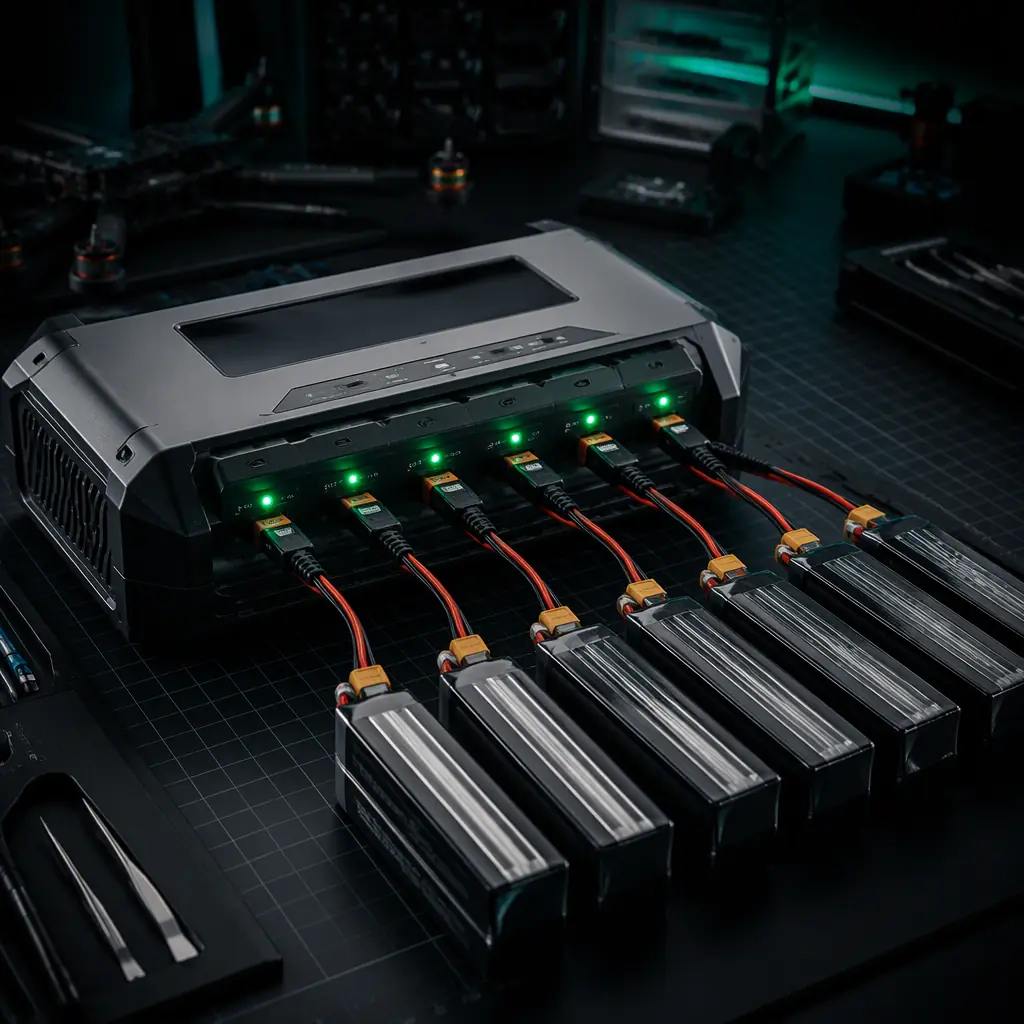
UAV Battery Charger Selection
Chargers that read BMS state of charge, the hardware that makes an SOC-shipped pack usable.