
A search and rescue sortie is the only UAV mission profile where the customer is not the person buying the aircraft. That changes what "good enough" means. A mapping drone that lands 15 minutes early has lost efficiency; an SAR aircraft that drops a video link at the wrong moment has lost the search.
The failure data supports treating SAR as its own component category rather than as an inspection variant. Across published SAR UAV incident reviews, the dominant in-flight failure modes are video link degradation (the single largest cluster), followed by operator loss of situation awareness due to insufficient thermal resolution at the flown standoff, and then endurance shortfall against the intended search area. Note the pattern: two of the three are detection and datalink failures, not airframe failures. The aircraft flies fine. The mission fails anyway.
That is why SAR component selection should start at the sensor and the radio, and only then work back to the propulsion system that has to carry them. The layer model is the same one described in the UAV supply chain layers framework, but the weighting is inverted: on an inspection aircraft you optimise for payload stability, on an SAR aircraft you optimise for the probability of detection across the widest possible conditions.
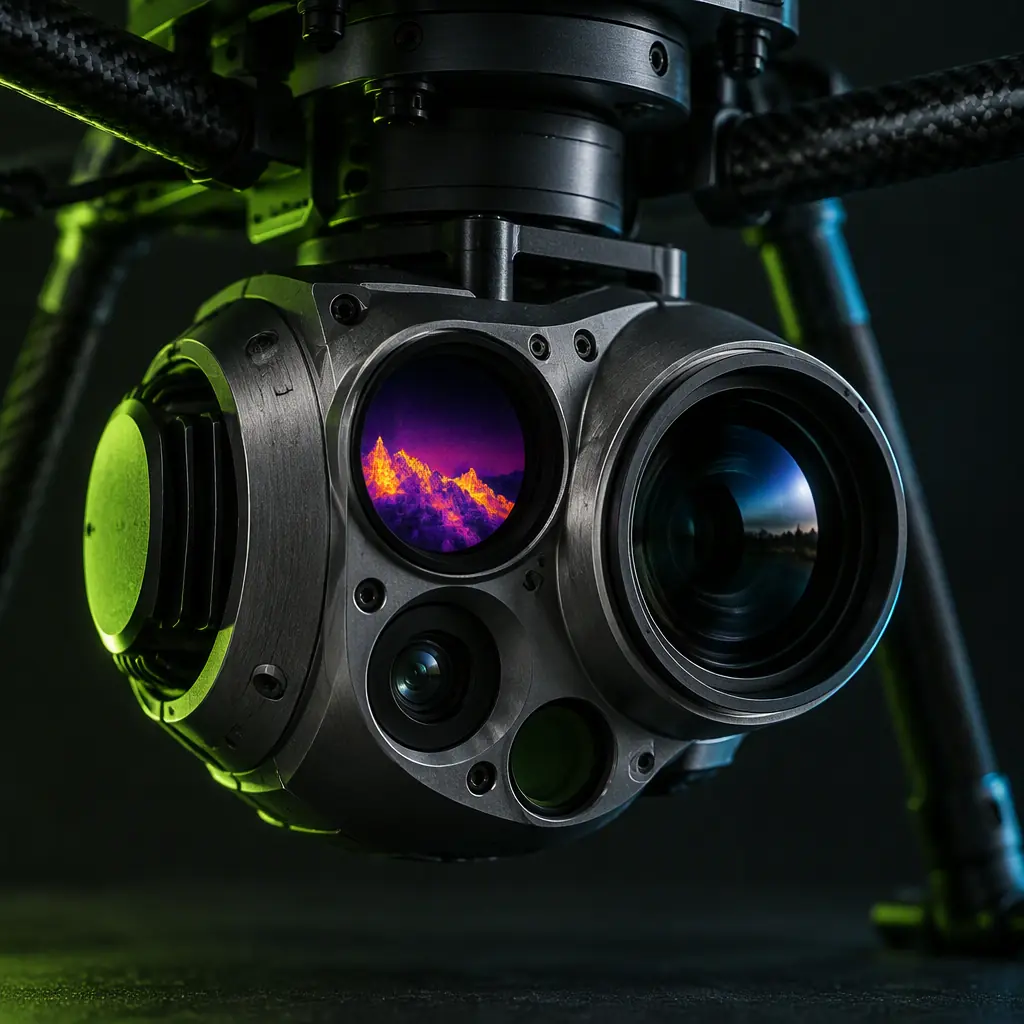
Thermal gimbal resolution is a standoff decision, not a sensor specification
The most common procurement error in SAR hardware is buying a thermal camera by its pixel count. A 640×512 microbolometer and a 1280×1024 microbolometer do not differ by "twice as good", they differ by the standoff at which a human-sized target still occupies enough pixels to be classified by an operator under time pressure.
The working rule for a human target is that you need roughly 4–6 pixels across the critical dimension of the object for an operator to classify it, and 12 or more IFOV samples to reliably recognise posture (standing, seated, prone). For a 0.5 m wide human torso, at a 640×512 sensor with a 13 mm f/1.0 lens, that puts the practical classification standoff at approximately 120–160 m. Fitting a 25 mm lens on the same sensor pushes the useful standoff to roughly 230–300 m but narrows the horizontal field of view to around 17°, which at 120 m altitude covers only about 37 m of ground swath, far too narrow for a systematic search pattern.
This is the trade that must be written into the RFQ: state the search altitude, the required ground swath and the target classification distance, and let the sensor-lens pair be solved from those three numbers. A vendor who quotes a camera model without asking for the swath is quoting a component, not a solution. The complementary hardware, two-axis stabilised gimbals, payload power isolation and mounting interfaces, is covered in the camera and gimbal selection guide and the payload mounting interface guide.
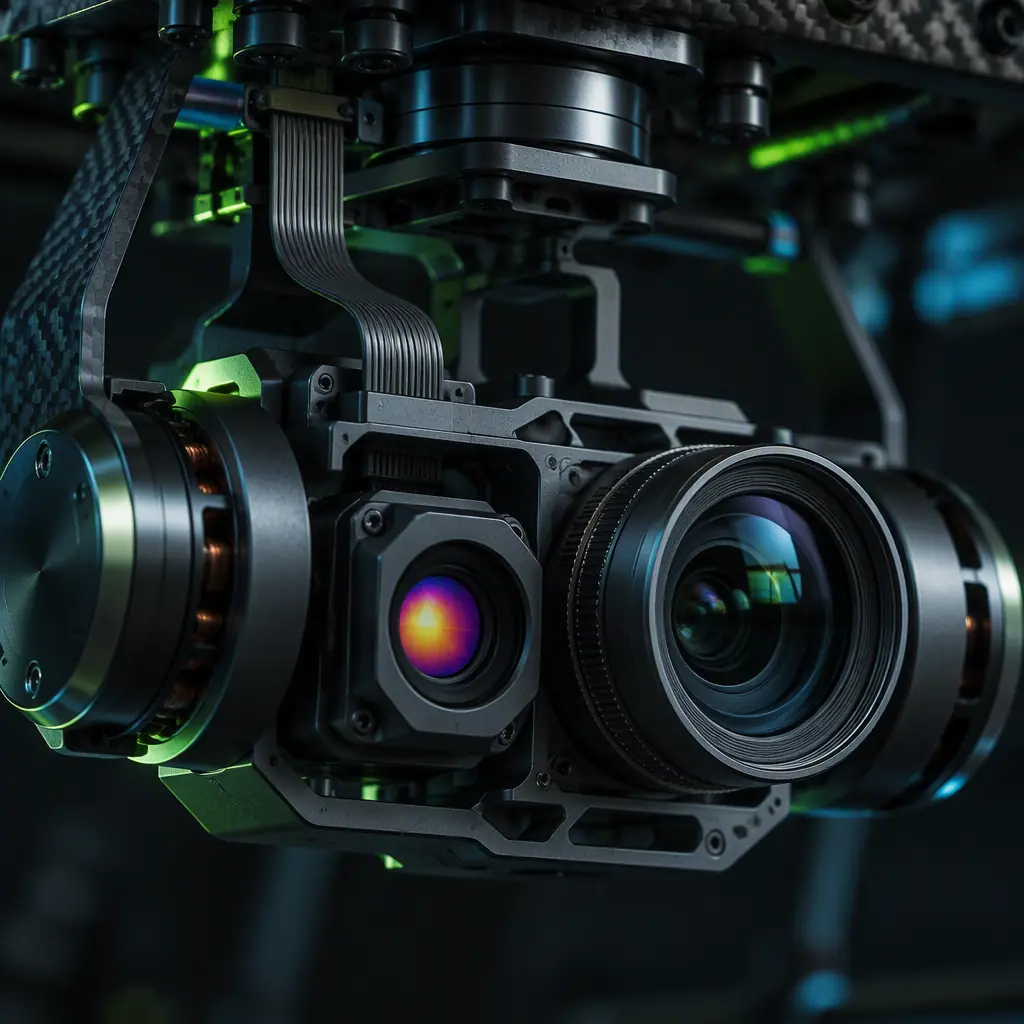
Two gimbal properties matter more in SAR than in any other application. The first is stabilisation residual. The uncompensated angular error that remains after the controller has done its work. A gimbal rated at 0.01° residual on a 25 mm lens produces about 0.25 m of image smear at 1500 m; on a 640-pixel-wide sensor with a 17° field of view, that is roughly 3–4 pixels of blur, right at the edge of what an operator can hold steady enough to identify a shape. The second is thermal drift of the gimbal's own IMU: a unit that holds its zero reference at 20 °C but drifts 0.3° at −5 °C will lose its horizon precisely on the cold night sorties where SAR demand peaks.
For those cold-weather operations specifically, the component layer around the gimbal matters as much as the gimbal: lens heaters, humidity control inside the turret, and coatings that do not fog when a warm aircraft descends into a cold inversion layer. The cold-weather and de-icing component guide covers the heater and coating choices in detail.
Communications: three links, three different failure modes
SAR operations routinely run under a waiver that assumes a redundant datalink, and procurement documents usually express this as "dual-link capability." In practice a genuinely robust SAR communications loadout is a triple-band arrangement, because the three bands fail for unrelated reasons:
| Link | Primary job | Fails when | Minimum spec |
|---|---|---|---|
| 868/915 MHz telemetry | Command and control, telemetry | Terrain masking in valleys, urban canyon | 10–30 km LOS, RSSI and LQ telemetry to GCS |
| 2.4/5.8 GHz video | Low-latency operator video | Rapidly, with range and obstruction | 1080p < 120 ms glass-to-glass, dual-band diversity |
| 4G/LTE bonded | Beyond-LOS video and coordinate relay | Cell congestion, coverage gaps, tower outage | Dual-SIM, sub-second handover, ≤ 8 Mbit/s sustained |
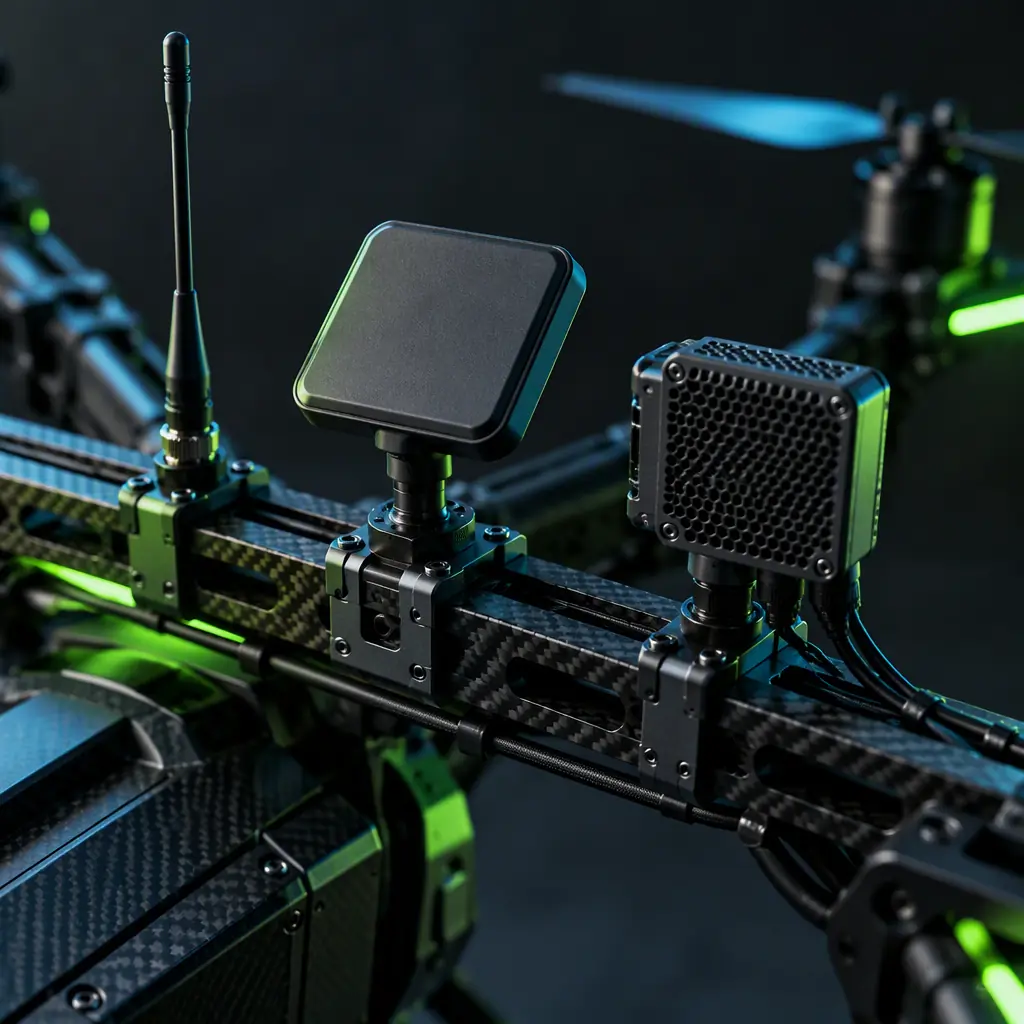
The critical procurement point is that these three links must not share a failure domain. If the LTE module and the video transmitter are fed from the same 5 V rail, a rail brownout takes out both simultaneously and the aircraft is effectively single-link. If the antenna elements are co-located within a few centimetres, the desense from the transmit chain will raise the effective noise floor of the receiver chain and quietly reduce all three link margins. Physical separation, independent power branches and, critically, per-link battery or supercapacitor holdup of at least a few hundred milliseconds so that a propulsion transient does not reset the modem, are the specifics that separate a real triple-link design from a three-antenna design. Frequency planning and separation rules are covered in the RF communication systems guide and the antenna selection and placement guide.
For the people in the search area, the aircraft's RF signature is not the only consideration. Anti-collision lighting that makes the aircraft visible to manned aviation without washing out the operator's night-adapted vision is a real component decision with a real specification: the anti-collision lighting guide works through the strobe patterns and intensities involved.
Endurance must be budgeted against the search box, not the hover time
Manufacturers publish hover endurance. SAR crews consume transit endurance plus search endurance, and the second number is always smaller. A useful planning identity for a multirotor SAR platform is:
usable search time = (0.80 × rated endurance) − transit to box − 20% reserve − hold time on task
Three things make the difference between a design that meets this and one that does not, and all three are component-level:
- Pack specific energy on the mission profile, not the cell datasheet. A 6S Li-ion pack rated at 250 Wh/kg will deliver roughly 200–215 Wh/kg at the 2–4C discharge an SAR aircraft actually pulls in a climb, because internal resistance is a function of both temperature and C-rate. Below 5 °C the loss is larger still. The battery and power management guide covers the BMS architecture that keeps the pack inside a usable temperature window.
- Propulsion efficiency at the actual all-up weight. SAR aircraft carry a heavier, more complex payload than an inspection aircraft of the same class, and a powertrain chosen at a lighter weight will run its motors and ESCs outside the best-efficiency region. The powertrain matching guide sets out how to match motor, propeller and ESC to a known AUW and cruise speed.
- Payload and avionics power budget. A thermal camera with a cooled detector, a bonded LTE modem, a downward searchlight and a video encoder can together draw 35–60 W: often 8–12% of total aircraft power. The payload power budgeting guide shows how to account for this as an endurance cost rather than treating it as a rounding error.
On the airframe side, SAR imposes a structural requirement that inspection does not: the aircraft must survive a controlled descent into vegetation or a hard landing on broken ground, because the crew will push the aircraft lower and the terrain is unknown. Landing gear with sacrificial or energy-absorbing elements, rather than a rigid frame, is the difference between a recoverable aircraft and a total loss. The landing gear and recovery components guide covers the trade-offs.
Environmental qualification for the sortie environment, not the catalogue environment
SAR aircraft operate in the two conditions that consumer and prosumer UAVs are least tested for: precipitation and cold. The relevant specifications to demand, with the numbers that matter:
- IP rating on the electronics enclosures. IP54 is adequate for dust and splash; anything expected to fly in active rain needs IP65 or better on every avionics enclosure, including the gimbal turret and the antenna feed points. An IP-rated airframe with an unsealed gimbal and an unsealed battery connector is not an all-weather aircraft.
- Cold-start and soak performance. Specify operating range to −20 °C minimum and soak test at that temperature for at least two hours, not merely a cold-start check. Battery heaters, LCD/OLED display behaviour on the ground station, and lubricant viscosity in gimbal bearings all behave differently after a soak than after a cold start.
- Vibration and shock. A SAR aircraft is transported in vehicles over unimproved roads and launched from improvised sites. Random vibration testing to a defined profile, plus a 40 g shock qualification on the payload and avionics, is a reasonable floor. The rationale and the test method are set out in the environmental qualification testing guide.
- EMC against the aircraft's own radios. Co-located transmit and receive chains in a dense payload make self-interference likely. The EMC and EMI design guide covers the filtering, shielding and layout rules that prevent the aircraft from jamming itself.
What to demand at acceptance, and what to write into the purchase order
An SAR component order should be accompanied by acceptance tests that reproduce the failure modes above rather than a generic functional check. The tests that have proven worth the schedule time:
- Link-failure drill. With the aircraft on a test stand, remove each of the three datalinks in turn. The aircraft must hold position, transmit its last-known-state, and either revert to a documented failsafe or continue on the remaining link. Any configuration where removing one link causes loss of the other two is a rejected design.
- Thermal classification range test. Fly the target classification distance from the RFQ against a human-sized thermal target at a known ΔT (a 10 °C ΔT against background is a fair proxy). Record the distance at which the operator loses reliable posture recognition. This is the number that belongs on the datasheet, not the sensor's native resolution.
- Endurance at mission weight. Confirm hover and cruise endurance at actual all-up weight with the full payload drawing power, not at the airframe's bare weight.
- Cold soak, then immediate operation. Two hours at the minimum rated temperature, then start and operate without warm-up. Record any gimbal drift and confirm battery heater function.
Deployability is the other half of the SAR problem: an aircraft that takes 40 minutes to assemble at the staging point is useless on a task with a two-hour search window. Tooling-free assembly, single-connector payload mounting and a documented pre-flight checklist that a non-engineer can complete in under ten minutes are all procurement requirements. The quick-release mounting guide deals with the mechanical side of rapid deployment.
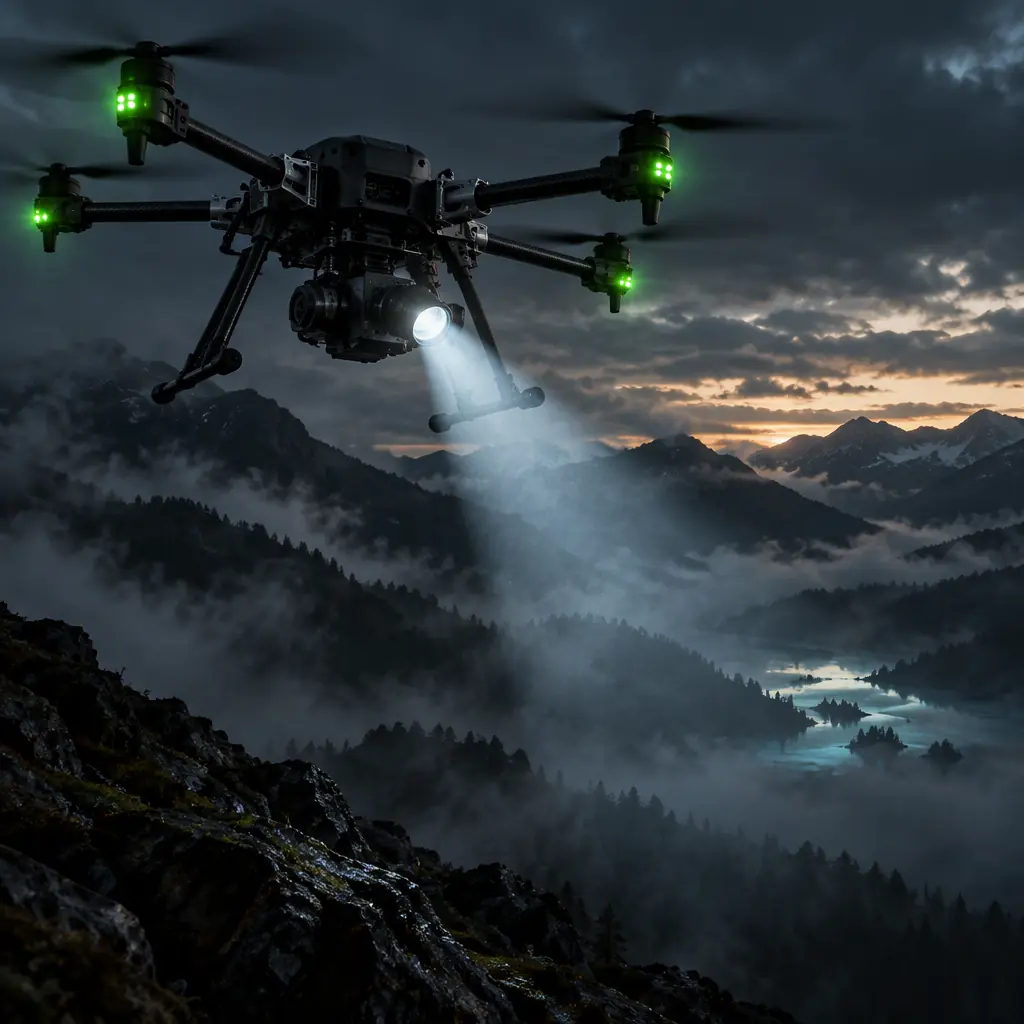
Where SAR hardware sits relative to adjacent missions
SAR shares component requirements with two neighbouring mission classes and should be specified with the overlaps in mind. It shares the long-endurance, multi-sensor payload discipline of industrial inspection platforms, and it shares the hardened, encrypted communications discipline of defense and security platforms. Where it is genuinely unique is the combination of a human-detection sensor payload with a land-anywhere structural requirement and a deployment time constraint measured in minutes.
The practical consequence for procurement is that a SAR bill of materials assembled entirely from either neighbouring category will be wrong in one direction or the other: an inspection-derived airframe will be under-protected for a forced landing, and a security-derived airframe will be over-specified on hardening and under-specified on detection range. Specify SAR as its own platform class.
Search and rescue platforms overlap heavily with two commercial mission classes, public safety operations and infrastructure inspection, and buyers for those missions often specify from the same component families. If your requirement sits closer to one of those, start from the matching industry page rather than a generic platform brief.
The SAR tender: cost structure and the responsibility split
A search and rescue platform is usually bought through a public tender or a grant-funded procurement, which means the cost breakdown has to be defensible line by line and the responsibilities have to be explicit before award. Two things consistently decide whether the programme stays on budget: whether flight endurance was specified against the search box rather than the datasheet, and whether the communications and sustainment costs were included in the same envelope as the aircraft.
An order-of-magnitude cost structure for a single SAR aircraft with its ground segment:
| Cost element | Order of magnitude | What drives it in a SAR programme |
|---|---|---|
| Airframe and propulsion | Largest single line | Endurance requirement and payload mass; a platform sized for a thermal gimbal plus a delivery mechanism is fundamentally larger than an observation-only aircraft |
| Thermal and daylight sensor payload | Often approaches the airframe cost | Whether radiometric temperature data is required for the report, not just a recognisable image |
| Communications and video return | Materially under-budgeted in most first proposals | Requirement to stream to an incident command post rather than only to the operator's handset |
| Delivery and lighting payload | Low hardware cost, high integration cost | Interlock architecture, drop certification and the safety case for releasing a mass over an active scene |
| Batteries, chargers and field power | Recurring, per-team | Number of airframes per team and whether the vehicle carries its own generation |
| Training and sustainment | Recurring, frequently underestimated | Crew turnover in volunteer and shift-based organisations; spares holding and RMA turnaround |
The communications and sustainment lines are where SAR budgets most often break, because they are recurring and they scale with the number of teams rather than the number of aircraft. A tender that specifies the aircraft in detail and the ground segment in one sentence will produce bids that are not comparable.
Who is responsible for what once the aircraft is in service
SAR operations run under an incident command structure, and the boundary between what the supplier guarantees and what the operator owns needs to be written down while the contract is being drafted, not after the first mission that does not go to plan.
| Activity | Supplier responsibility | Operator responsibility |
|---|---|---|
| Endurance as specified | Meet the stated usable search time figure against a defined payload and profile | Fly the profile the figure was derived from; report when payload or conditions change |
| Thermal detection range | State the range against a defined target-to-background temperature difference | Do not treat the figure as valid across all ambient and terrain conditions |
| Delivery mechanism safety | Provide the interlock architecture and the evidence that release cannot occur uncommanded | Maintain the arming procedure; re-qualify after any firmware or airframe change |
| Video return to command | Deliver the link throughput and latency specified for the incident command post | Provide spectrum coordination, mast or relay infrastructure at the site |
| Battery airworthiness | State cycle life and the capacity threshold below which packs must be withdrawn | Track cycles and replace on schedule rather than on observed failure |
| Sustainment | Hold spares and publish an RMA turnaround commitment | Maintain the spares holding the commitment was priced against |
The pattern that recurs in after-action reviews is that endurance and detection range are quoted as single headline numbers and then relied on outside their stated conditions. Requiring the conditions to be written next to the number is what turns a marketing figure into a contract term.
What a SAR aircraft actually costs to build
The cost structure above tells you where the money sits as a proportion; buyers need the absolute bands as well. The figures below are the component build-cost bands we see across SAR-class platforms purchased in 1-3 unit batches in 2026, with the aircraft priced as hardware only, ex-works, excluding airworthiness certification fees, duties and the operator's own training.
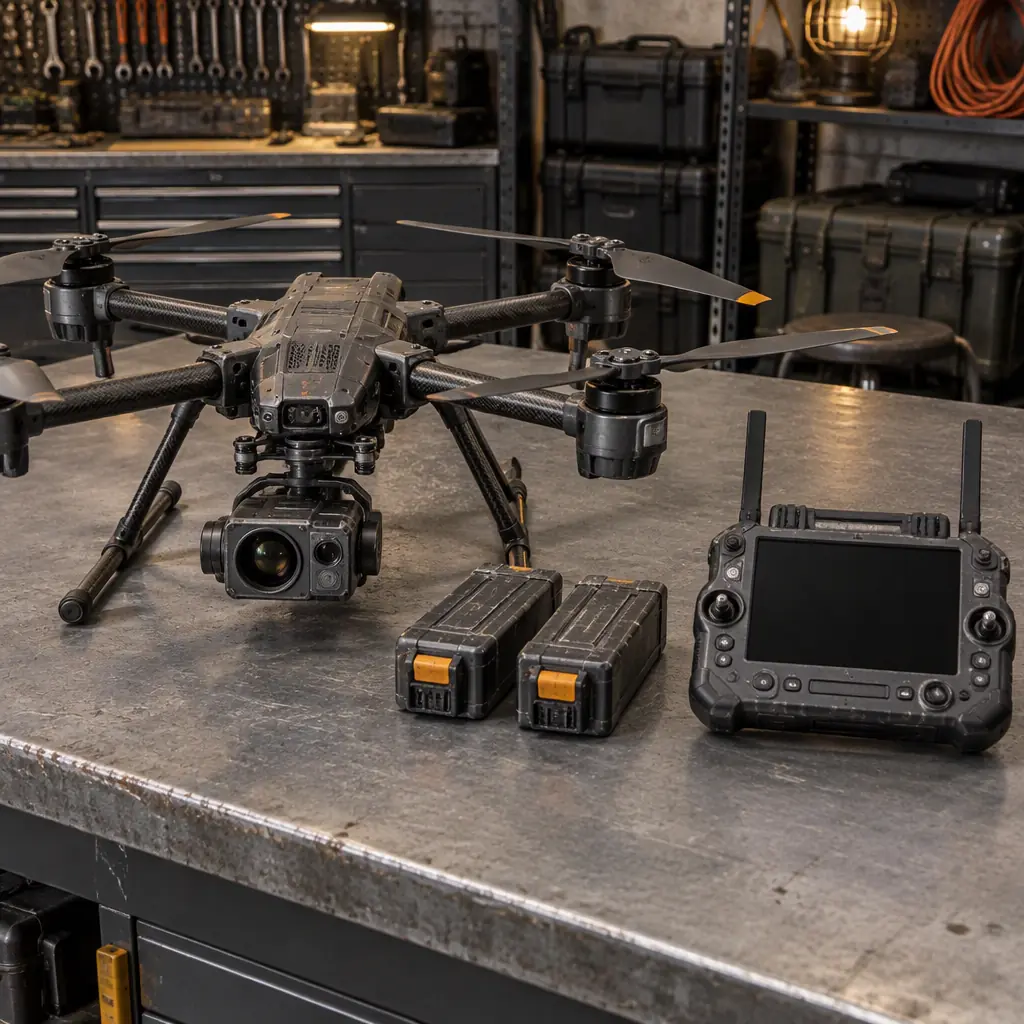
| Category | Component build cost band | Why it lands where it does |
|---|---|---|
| Search airframe and propulsion | USD 18,000 - 34,000 | Sets the search box that can be covered per sortie; a 25 kg-class airframe with the endurance to hold a thermal gimbal and a delivery mechanism sits at the top of the band |
| Thermal and daylight sensor payload | USD 12,000 - 26,000 | Driven by whether radiometric temperature data is required for the incident report rather than a recognisable image |
| Delivery, lighting and public-address systems | USD 4,500 - 9,000 | Low bill-of-materials, high integration; the safety case and interlock architecture dominate the line |
| Datalink, video return and ground station | USD 6,000 - 14,000 | Set by the requirement to stream to an incident command post and the number of simultaneous viewers, not by the operator's handset link |
| Batteries and field charging | USD 2,800 - 6,500 | Recurring, scales with the number of teams; cold-weather derating forces larger nameplate capacity than the datasheet suggests |
| Documentation and acceptance evidence | USD 2,000 - 5,000 | Endurance test data, detection-range demonstration against a controlled target and the delivery-cycle log |
Three implications follow from these bands. First, the airframe and the thermal payload together account for roughly two thirds of the hardware value, so a tender that negotiates hard on the airframe and accepts the sensor line as quoted has optimised the smaller lever. Second, the delivery and lighting systems look like the cheapest line on the sheet but carry the highest integration and certification cost per dollar of hardware; budgeted as a bracket they will overrun. Third, the battery line is the one that compounds, because it repeats per team and per year rather than per airframe.
For teams weighing a domestically assembled platform against an imported turnkey aircraft on multi-year cost, the build-versus-buy arithmetic is set out in build versus buy for UAV components, and the per-flight energy cost that drives the recurring battery line is covered in battery and power management.
What a SAR-sized platform looks like in practice
Two reference builds we use show how the numbers above translate into hardware, and why the endurance and power discussions are not academic.
- A heavy-lift multirotor built as an X8 coaxial octocopter with a 1,600 mm wheelbase, a 30 litre payload and a maximum take-off weight around 25 kg, delivering 12 to 15 minutes of active work per tank fill. For SAR the relevant lesson is the dispersal and coverage consequence of that short working window: a platform this size carries a delivery mechanism or a large sensor comfortably, but the search pattern has to be flown inside a working time measured in minutes, which puts the emphasis on thermal detection range and on getting the aircraft to the box quickly. The configuration is documented in the heavy-lift reference architecture.
- A VTOL fixed-wing survey platform with a 120 minute usable endurance carrying a 5 kg payload, a Hesai PandarXT LiDAR and a 42 MP camera, powered by an 888 Wh 6S8P Li-ion pack. Its energy budget is the useful comparison for SAR planning: roughly 68 percent of mission energy goes to cruise propulsion and only 22 percent to payload systems, with the lift motors briefly drawing about 1,200 W combined during transition. The practical reading for a SAR requirement is that a fixed-wing platform buys search area rather than hover capability, and that the payload power budget is small compared to the propulsion budget. See the LiDAR mapping platform reference architecture.
The choice between those two shapes is the single most consequential decision in a SAR specification, and it follows directly from whether the mission is a search box that has to be covered quickly or a point that has to be observed closely for a long time. The airframe comparison is worked through in multirotor versus fixed-wing.
What a search and rescue aircraft actually costs, in bands not adjectives.
Order-of-magnitude labels tell a procurement board which line is largest, but they do not tell it whether the programme is affordable. The table below puts indicative USD bands on a single SAR aircraft with its ground segment and sustainment, and adds the scaling effect so a buyer can see which lines move with fleet size and which do not. These are planning bands for a tender envelope, not quotations; the specification, sensor class and certification route move them materially.
| Cost element | Indicative band (USD) | Scaling effect |
|---|---|---|
| Airframe, propulsion and integration | USD 40,000 – 120,000 | Grows roughly linearly with airframe size; a second identical aircraft costs less than the first because the design is already paid for |
| Thermal / EO-IR gimbal and stabilisation | USD 25,000 – 150,000 | Barely scales with airframe; driven by sensor class and gimbal precision, and it is the single line most likely to be re-scoped mid-programme |
| Communications, datalink and antennas | USD 8,000 – 35,000 | Per-aircraft; a second ground station for a second crew is the only step change |
| Ground control segment | USD 15,000 – 60,000 | One-time per fleet up to roughly three aircraft, then per-crew |
| Batteries and charging infrastructure | USD 6,000 – 25,000 | Linear with aircraft count; cold-weather operation pushes the higher end |
| Certification and airworthiness documentation | USD 20,000 – 90,000 | One-time per platform type; not repeatable per unit, so it dominates the first aircraft only |
| Training, spares and first-year sustainment | USD 12,000 – 50,000 | Per crew, per year; the line most often omitted from the capital request |
Two readings matter to a tender. First, the certification and documentation band is a one-time cost spread across the fleet, so a programme that buys one aircraft carries it alone; a programme that buys three amortises it. Second, sustainment and training belong in the same envelope as the aircraft, because a SAR platform that cannot be flown for want of a trained crew or a spare gimbal has not delivered the capability, whatever the airframe cost. Ask tenderers to separate the one-time lines from the per-unit lines so the crossover between a single-aircraft and a fleet buy is visible.
Which of these bands a supplier owns, and which the operator owns.
A SAR award is a shared responsibility between the integrator and the operating organisation, and disputes in service almost always trace to a boundary that was left implicit. The table is the split we write into a SAR requirement document.
| Item | Integrator owns | Operating organisation owns |
|---|---|---|
| Aircraft and payload airworthiness | Design, build and the documentation that proves the configuration | Operating the aircraft within the published envelope |
| Datalink and spectrum | Supplying a compliant link and its antenna installation | Holding the licence, coordinating frequencies with the authority |
| Mission endurance | Delivering the endurance the specification asked for against a defined search box | Defining the search box and the endurance it implies, before award |
| Sensor performance | Factory acceptance of the gimbal to its own specification | Confirming the sensor meets the operational task, on a trial flight |
| Sustainment and spares | Publishing the maintenance schedule and the spares list | Funding and performing the schedule; holding the critical spares |
| Airworthiness change control | Re-qualifying the platform after any design change | Not modifying the aircraft outside the approved configuration |
The endurance row is the one to settle in writing before award. Endurance against a datasheet hover time is a different number from endurance over a search box, and if the operating organisation only discovers that after delivery the integrator will point to the catalogue and the operator to the mission. Put the search box, the transit distance and the on-station time into the requirement, and the endurance figure becomes a verifiable target rather than an assumption on both sides.
Two search and rescue aircraft we built, and what their numbers say.
SAR requirements are easiest to reason about against real builds. These two came from our project work and both turn on the same problem: the endurance that a search box demands, not the endurance a datasheet quotes.
- Heavy-lift search and logistics platform. A 25 kg MTOW coaxial octocopter built to carry either a 30 L payload or a rescue-delivery pack to a coordinates fix. The relevant numbers for a SAR buyer: the payload bay and the endurance budget were sized together, so the aircraft stays on station long enough to complete a search leg rather than a hover. The full build is written up at our heavy-lift platform, and the payload-bay logic transfers directly to a delivery or sensors-drop mission.
- VTOL LiDAR survey platform. A 120-minute fixed-wing VTOL carrying a 5 kg sensor pod on a belly mount — the same architecture a SAR mapping or wide-area search mission needs when the search box is large and the target is terrain. The build is documented at our LiDAR mapping platform, including the mass and drag penalty of the belly pod and the endurance those cost.
Both point the same way for a tender: state the search box and the on-station time first, let the aircraft size to that, and treat the payload bay and the endurance budget as one decision rather than two.
SAR clauses worth writing into the tender document.
- State the search box, the transit distance and the on-station time; require endurance to be demonstrated against them, not against a hover time.
- Separate one-time lines (certification, documentation, tooling) from per-unit lines so the fleet crossover is visible.
- Require the sustainment, spares and training envelope in the same capital request, with the first-year figure broken out.
- Name who holds the spectrum licence and who coordinates frequencies, and make it a condition of acceptance.
- Require the published maintenance schedule and critical-spares list as a deliverable, not an appendix.
- Define the change-control process: any design change triggers re-qualification and a re-issued configuration record.
- Require a trial-flight sensor acceptance against the operational task, witnessed by the operating organisation.
Building the SAR requirement document
A requirement that produces comparable bids has to state conditions alongside figures. The clauses that do the most work in a SAR tender:
- Search box size and shape. The area to be covered, the required detection probability and the time in which the first pass must be complete.
- Detection conditions. Thermal figures stated against a defined temperature difference and altitude, not as a single range.
- Command post requirements. Whether imagery must reach an incident command post, at what latency and to how many simultaneous viewers.
- Delivery payload and the safety case. The interlocks required, the evidence of uncommanded-release prevention and who owns re-qualification after firmware change.
- Field power plan. Whether the vehicle carries generation, how many batteries per team, and the swap turnaround the operation can tolerate.
- Sustainment and RMA. Spares holding, turnaround commitment and the battery withdrawal threshold by cycle count.
- Acceptance evidence. Endurance test against the specified payload, detection range demonstration against a controlled target, and a documented number of successful delivery-mechanism cycles.
Buying a SAR platform is closer to buying an airworthiness case than buying a camera. Writing the conditions next to every figure is what makes the award decision defensible, and what makes the in-service support arguments resolvable.
Inspection UAV components Discuss your SAR platform Back to Blog
Continue Reading
Industrial Inspection Components
Component selection for asset inspection platforms and their standoff requirements.
Thermal Imaging Payload Selection
Microbolometer resolution, lens choice and detection range for UAV thermal payloads.
UAV RF Communication Systems
Band planning, separation rules and datalink redundancy architecture.
Battery & Power Management
Pack sizing, BMS architecture and usable energy at cold temperatures.
Environmental Qualification Testing
Cold soak, ingress protection and vibration qualification for UAV hardware.