
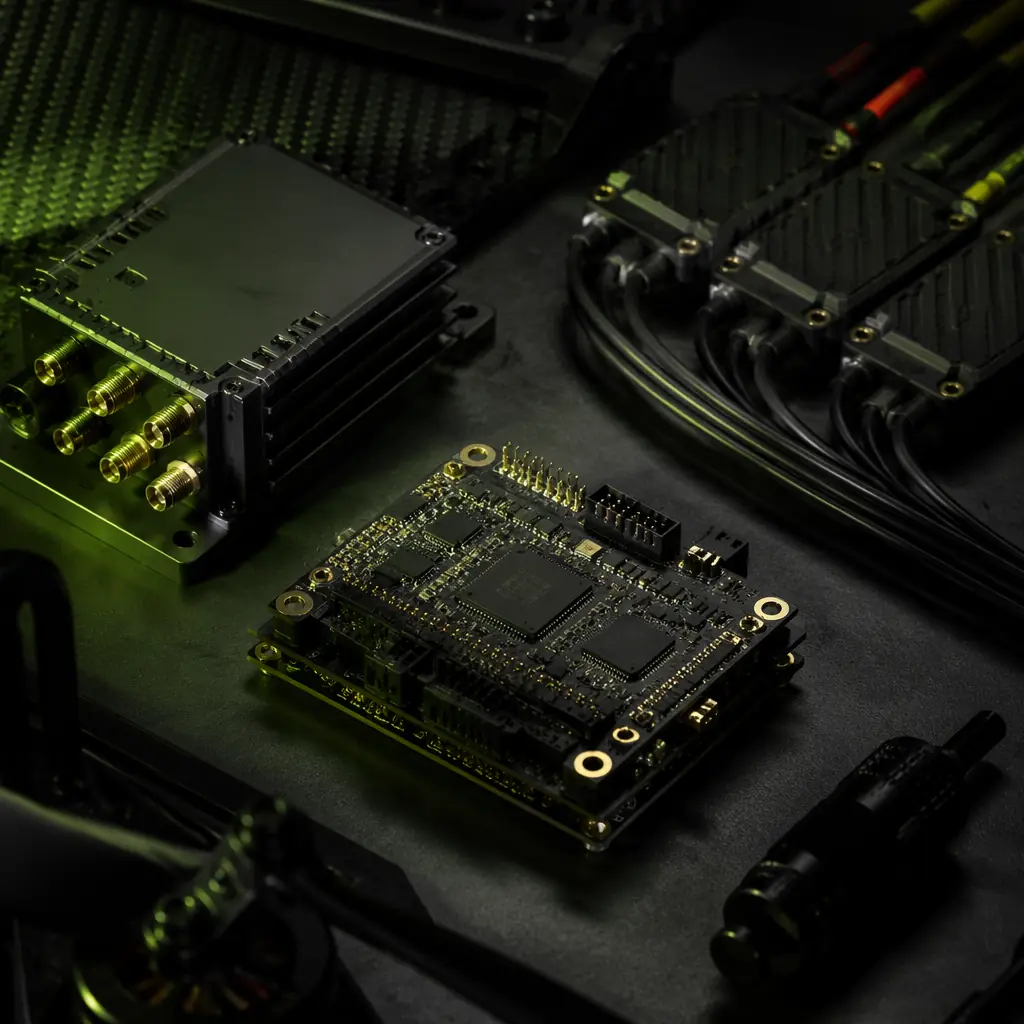
Defense and security UAV procurement differs from commercial procurement in one structural way: the operator cannot assume a benign environment. Commercial UAV design budgets for weather, RF congestion and human error. Defense design has to budget for an adversary who is deliberately trying to make the aircraft fail — and for a supply chain in which the authenticity of every component is itself a security property.
That produces two classes of requirement that commercial specifications usually omit. The first is resilience: the aircraft must keep flying when a link is degraded, a satellite constellation is unavailable, or an RF field is present. The second is provenance: every component must be traceable to an original manufacturer, with documentation that survives an audit. Both have to be written into the purchase order, because neither is verifiable after delivery in any practical sense.
The architectural foundation is the same layered model used across all UAV platforms, described in the UAV supply chain layers framework. What changes here is the depth of hardening applied to each layer.
Ingress protection is a system property, not an enclosure rating
A common and expensive mistake is to buy an IP67-rated airframe and then populate it with avionics that are unsealed, on the assumption that the enclosure protects everything inside. It does not, for three specific reasons: condensation forms inside sealed enclosures as they thermal-cycle, connector interfaces are the actual ingress path, and service access defeats the seal.
The component-level measures that actually deliver a weatherproof avionics stack:
- Conformal coating on every PCB, not just the flight controller. Acrylic coating at 25–50 μm gives adequate protection for most avionics; silicone or parylene is warranted where thermal cycling is aggressive or where the board carries high-impedance sensor inputs that cannot tolerate ionic leakage. Note the specific exclusion: connectors, barometric sensors, and any optical or MEMS element that must remain exposed. Board-to-board headers are a frequent coating gap — coat the assembled stack, not just the individual boards.
- Potting or gasketing at every cable egress. The cable is the wick. A potted gland or a proper compression gasket at each exit point is worth more than an extra millimetre of enclosure wall.
- Pressure equalisation vents with hydrophobic membranes. Fully sealed enclosures pump moisture in through every thermal cycle. A Gore-type vent equalises pressure while blocking liquid water, and it removes the condensation failure mode entirely.
- Desiccant and, where justified, an internal humidity sensor. A humidity reading in the telemetry stream lets the operator see a seal failure before it becomes an avionics failure.
The cold-weather and de-icing requirements overlap here, since hygroscopic failure modes appear below freezing as well as in rain: the cold-weather and de-icing components guide covers the heater, coating and lubricant choices.

Anti-jam GNSS: the antenna is where the margin is decided
GNSS jamming and spoofing are the most available, lowest-cost counter-UAV techniques, which makes GNSS resilience a component decision rather than a software feature. Three approaches exist, and they are not equivalent:
| Approach | What it actually buys | Cost and mass | Limitation |
|---|---|---|---|
| Filtered single-antenna receiver | Rejects out-of-band interference, some narrowband jamming | Low | No protection against in-band or wideband jamming |
| Controlled reception pattern antenna (CRPA) | Null-steering against directional jammers; typically 20–30 dB of rejection at the null | Moderate mass, 4–8 elements plus processor | Requires calibration; performance degrades with many simultaneous jammers |
| GNSS-denied navigation stack | Continued navigation with no GNSS at all — inertial plus visual or lidar odometry | Highest mass and power, significant integration work | Drift over long missions; needs a known start state |
For most defense-adjacent platforms the correct answer is layered: a CRPA-class antenna for jamming resilience, plus a non-GNSS navigation fallback so that a successful jam degrades accuracy rather than ending the mission. The fallback stack — inertial, visual odometry, terrain-relative navigation and how to budget their drift — is set out in the GNSS-denied navigation guide, and the jamming and spoofing detection problem specifically is covered in the GNSS anti-jamming and spoofing guide.
One specification detail that is routinely missed: antenna placement. A CRPA needs a defined ground plane and a clear, unobstructed field of view above the airframe. Mounting it adjacent to the airframe's carbon-fibre structure detunes the elements and silently destroys the null-steering performance you paid for. The antenna selection and placement guide covers the ground-plane and separation rules.
EMI hardening: assume the aircraft will be illuminated
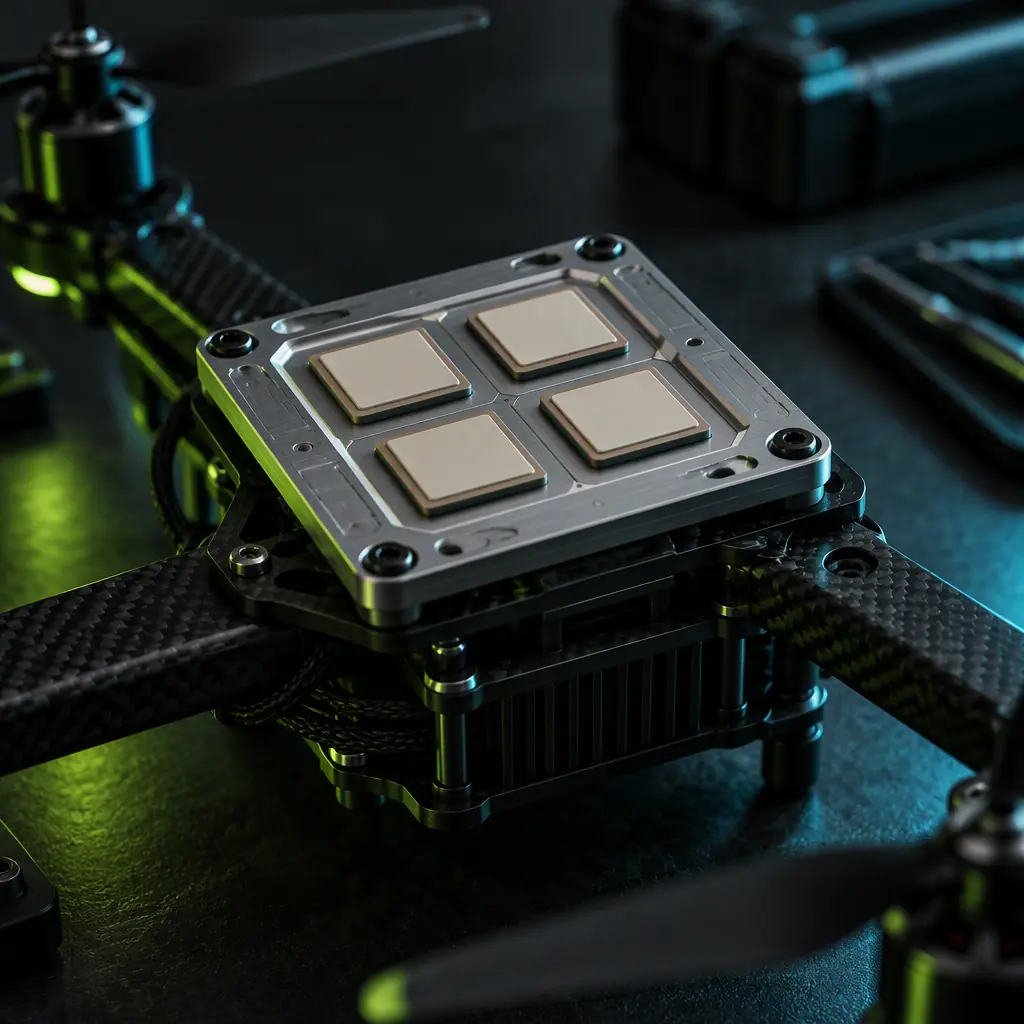
A defense UAV must operate in a dense electromagnetic environment — its own transmitters, adjacent platforms, and potentially a deliberate high-power field. The component-level measures, in order of return on effort:
- Enclosure shielding integrity. The enclosure is only as good as its worst seam and its cable penetrations. Conductive gaskets at all seams, and shielded, grounded feedthroughs for every cable crossing the boundary. An unshielded connector on a shielded box is a slot antenna.
- Filtered connectors and transient suppression at every interface. This covers both conducted EMI and the high-altitude electromagnetic pulse case, where the induced transient on a long cable run is the dominant threat to avionics.
- Twisted-pair and shielded runs for all signal and power feeds. Differential signalling with a defined return path, not single-ended wiring with a chassis ground assumed to be equipotential.
- Deliberate split of digital and RF grounds with a single controlled tie point. Avionics that share a noisy power return with a transmitter will exhibit sensor noise that is mistaken for a sensor fault.
The design rules, filtering topologies and test methods are set out in the EMC and EMI design guide. The adjacent concern is electrostatic discharge, which matters acutely for a platform that is handled in the field, often in dry cold air, by personnel in synthetic clothing. The ESD protection design guide covers the interface and handling requirements.
Secure datalinks: hardware, not just encryption
Link security is usually discussed as an encryption question, but the hardware layer determines whether the encryption can actually be relied on. The component requirements that matter:
- Key storage in dedicated secure elements, not general-purpose flash. A key held in application flash is extractable from a recovered airframe. A secure element with hardware key derivation and no export path changes the recovery threat model entirely.
- Anti-tamper and zeroisation provisions for the communications module and the flight controller, where the platform's operating parameters are themselves sensitive.
- Frequency agility across a defined band plan. Frequency hopping requires synthesizers that settle fast enough to hop without dropping packets; specifying "frequency hopping capable" without a hop rate and settling time is not a specification. Spectrum coordination is covered in the RF spectrum management guide.
- Independent physical and power domains for the secure link, so that a fault or a compromise in the commercial datalink does not extend to the secure one. The multi-link architecture rationale is set out in the RF communication systems guide.
Provenance and counterfeiting: the requirement nobody writes down
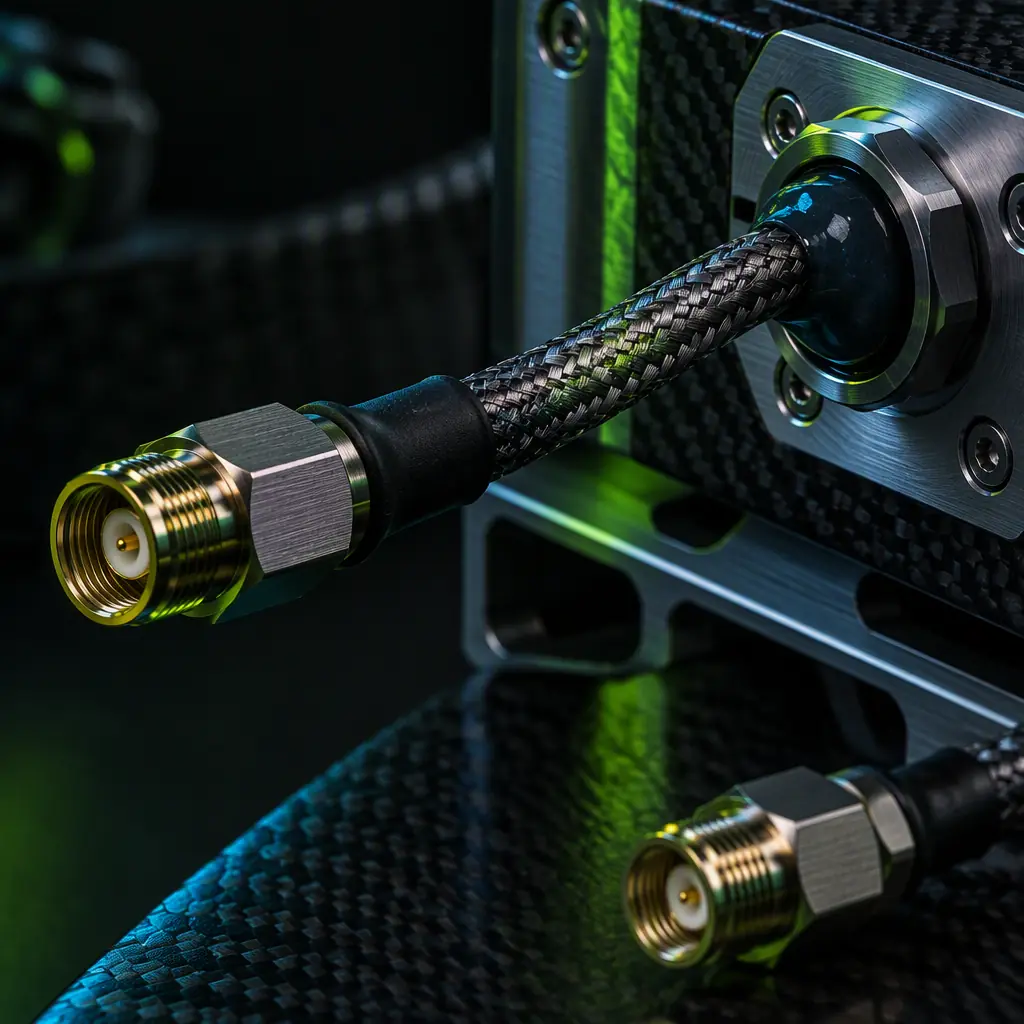
In defense electronics, a counterfeit component is not merely a reliability risk — it is a potential deliberate compromise, and it is a documented problem across the aerospace and defense supply chain. The procurement clauses that address it are the same ones covered in the supplier evaluation checklist and the component obsolescence management guide, applied with more rigour:
- Traceability to the original manufacturer for every active component, with lot and date code records retained for the production life of the platform, not just the delivery.
- Authorised-distributor-only sourcing for programmable and security-relevant parts — microcontrollers, FPGAs, secure elements, RF front ends and memory. This is the single highest-value clause in the document.
- Incoming inspection beyond a visual check. X-ray or XRF for die and plating verification on a sampling basis, and functional test on 100% of security-relevant parts.
- Firmware and configuration integrity verification at goods-in, with hash records. A genuine component carrying modified firmware is a supply-chain attack, and it is invisible to physical inspection.
For the programmatic side — how to structure the bill of materials, handle obsolescence and plan for long-life spares — the spares and lifecycle planning guide is the companion document.
The test evidence to demand before you accept delivery
Hardening claims are cheap; test reports are not. A defense-oriented component order should be accompanied by, at minimum:
- EMC test report to a named standard — radiated and conducted emissions and immunity, with the test setup documented. A certificate of conformity without data is not evidence.
- Ingress test evidence for the declared IP rating, performed on the assembled configuration that will actually ship, not on an empty enclosure.
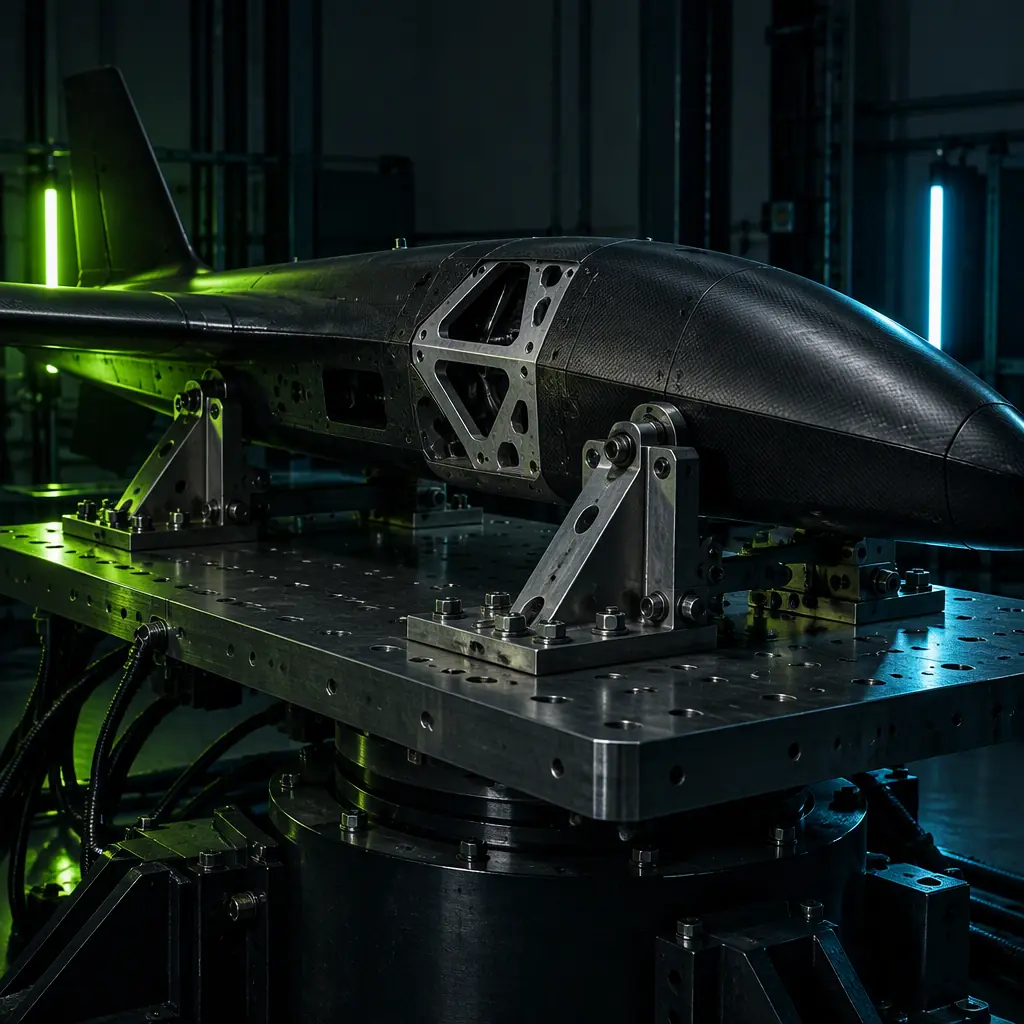
- Random vibration and mechanical shock reports to a stated profile, with the profile disclosed. The rationale and the standard profiles are covered in the environmental qualification testing guide.
- GNSS resilience test results — jammer-to-signal ratio at which the receiver loses lock, with and without the anti-jam function enabled.
- Pre-shipment functional test records for every unit, on the specific tests applied. The framework is described in the pre-shipment inspection guide, and the in-house quality regime that produces them in the UAV electronics manufacturing quality guide.
Export control is the final commercial gate and it is not optional: the classification of the platform, the destination, the end user and the end use all determine whether a shipment can lawfully proceed, and the documentation must be correct before goods move rather than after. The export logistics and shipping guide covers the documentation chain.
How to sequence a hardening programme
Hardening a whole platform at once is expensive and slow. The sequence that delivers the most resilience per unit of schedule:
- Ingress and conformal coating across the avionics stack. This is cheap, it addresses the most frequent real-world failure, and it does not require redesign.
- Power-domain independence for each datalink and payload. This eliminates the correlated-failure modes that turn a single fault into a lost aircraft.
- EMI hardening of enclosures, connectors and cable runs. Requires layout changes, so do it before the design freezes.
- GNSS resilience, starting with antenna placement and receiver filtering, then CRPA if the threat model justifies the mass.
- Secure link hardware and key storage.
- Supply-chain provenance controls, which should be in place from the first order rather than retrofitted.
Steps one and two can usually be applied to an existing design as a component substitution exercise. Steps three through six are design changes and should be planned as such.
Hardened hardware decisions transfer directly into two commercial mission classes: inspection aircraft that operate in congested or contested RF environments, and survey platforms that must keep working when satellite positioning degrades. The component families are the same; only the threat model changes.
Inspection UAV components Discuss a hardened platform Back to Blog
Continue Reading
GNSS Anti-Jamming & Spoofing
Detecting and resisting interference, and what the receiver can and cannot do.
EMC & EMI Design Compliance
Shielding, filtering and grounding rules that keep avionics quiet.
GNSS-Denied Navigation
The component stack for navigating when satellite positioning is unavailable.
Supplier Evaluation Checklist
Traceability, authorised distribution and the audit trail to require.
Environmental Qualification Testing
Vibration, shock and thermal test evidence worth accepting as proof.